Charles Babbage
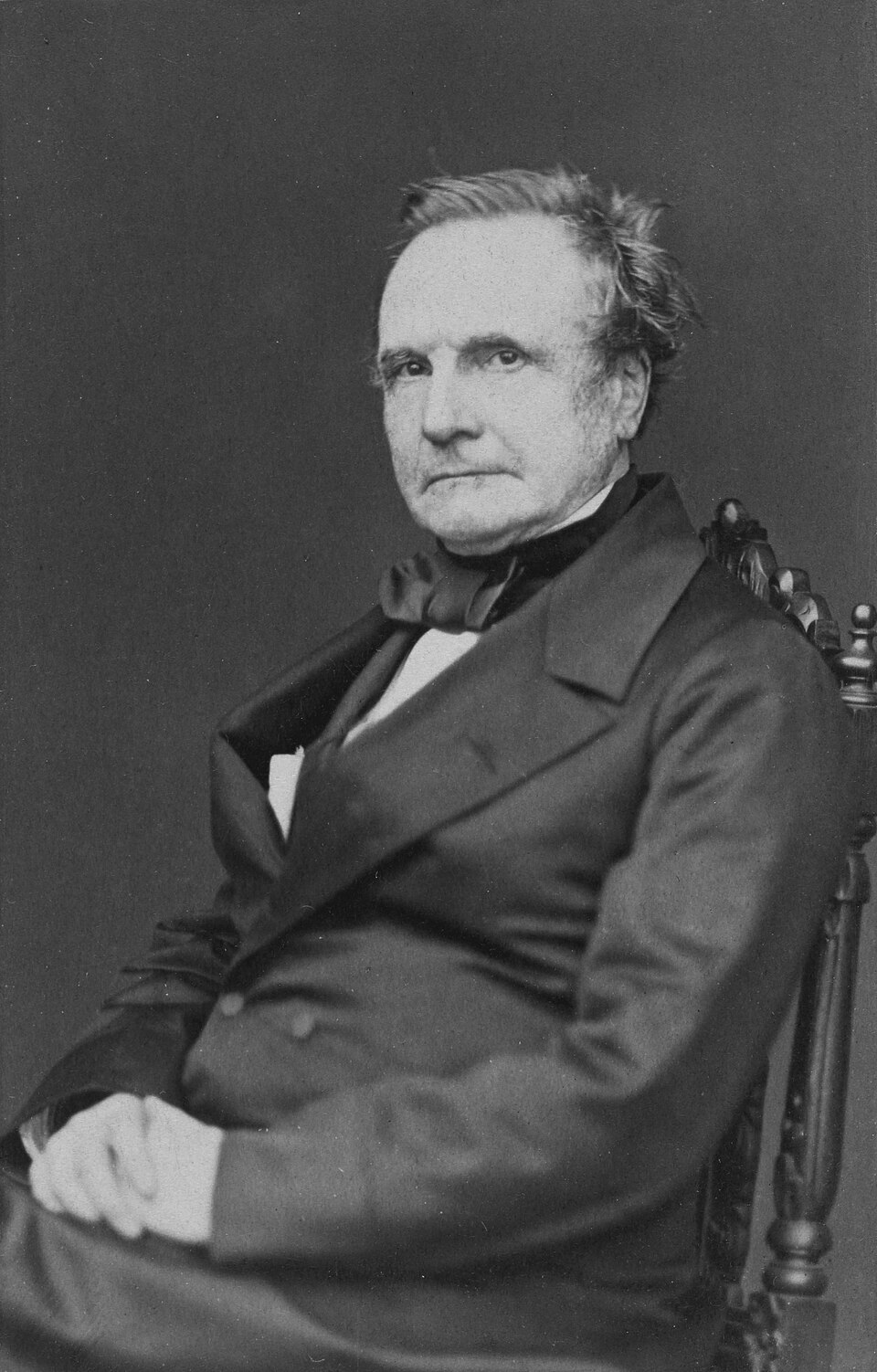
The Victorian polymath who conceived the programmable computer a century before anyone could build one.
Charles Babbage spent decades designing machines that could not yet exist — mechanical engines driven by punched cards and capable of any calculation a mathematician could specify. The Analytical Engine, never completed in his lifetime, embodied the logical architecture of the modern digital computer: a store, a mill, a control sequence, and input and output.
Origins and formation
Babbage was born in Walworth, Surrey, on 26 December 1791, into a prosperous banking family. He was largely self-taught in mathematics before entering Cambridge, where he found the teaching inferior to continental analysis. Together with John Herschel and George Peacock he founded the Analytical Society in 1812, which successfully campaigned to replace Newton's fluxional notation with Leibniz's differential calculus in British mathematics — a reform with lasting consequences for British science.
After graduating from Peterhouse, Cambridge in 1814, he pursued a career at the intersection of mathematics, economics, and mechanical philosophy. He was elected a Fellow of the Royal Society in 1816 and held the Lucasian Professorship of Mathematics at Cambridge from 1828 to 1839, a chair previously occupied by Newton.
The Difference Engine
Babbage's first major project was the Difference Engine, a mechanical calculator designed to tabulate polynomial functions by the method of finite differences — and thereby eliminate the human transcription errors then endemic in printed mathematical tables. He secured substantial government funding in 1823 and spent nearly two decades on the project before the collaboration with his engineer, Joseph Clement, collapsed. A complete Difference Engine was never built from Babbage's original drawings in his lifetime; the Science Museum in London constructed one from his plans in 1991, and it worked exactly as designed.
The Analytical Engine
More ambitious still was the Analytical Engine, conceived from around 1833. Where the Difference Engine could only evaluate polynomials, the Analytical Engine was general-purpose: it had a store (memory) of one thousand fifty-digit numbers, a mill (arithmetic unit), a reader for punched-card programs drawn from Jacquard loom technology, and a printer for output. The design included conditional branching and loops. Ada Lovelace, working from Italian notes on Babbage's lectures, wrote what is now considered the first algorithm intended for machine execution — a method to compute Bernoulli numbers on the engine — and recognised that it could manipulate any symbols, not just numbers.
The Analytical Engine weaves algebraical patterns just as the Jacquard loom weaves flowers and leaves.
The Analytical Engine was never built. Funding, political will, and the engineering tolerances of the era all worked against it.
Legacy
Babbage also wrote On the Economy of Machinery and Manufactures (1832), a pioneering text in what would later be called operations research, and proposed a number of other innovations including the cowcatcher for locomotives and a standardised postal rate scheme. His broader campaign for precision and systematisation in British manufacturing and science was a form of applied philosophy as much as engineering.
The twentieth-century computing pioneers who built the first electronic computers did not work directly from Babbage's drawings, but the logical architecture he described — store, mill, sequential control, conditional branching — maps cleanly onto the von Neumann architecture that underlies every modern processor. He described the problem of general computation, in mechanical terms, nearly a century before Turing gave it a theoretical foundation.