Niels Bohr
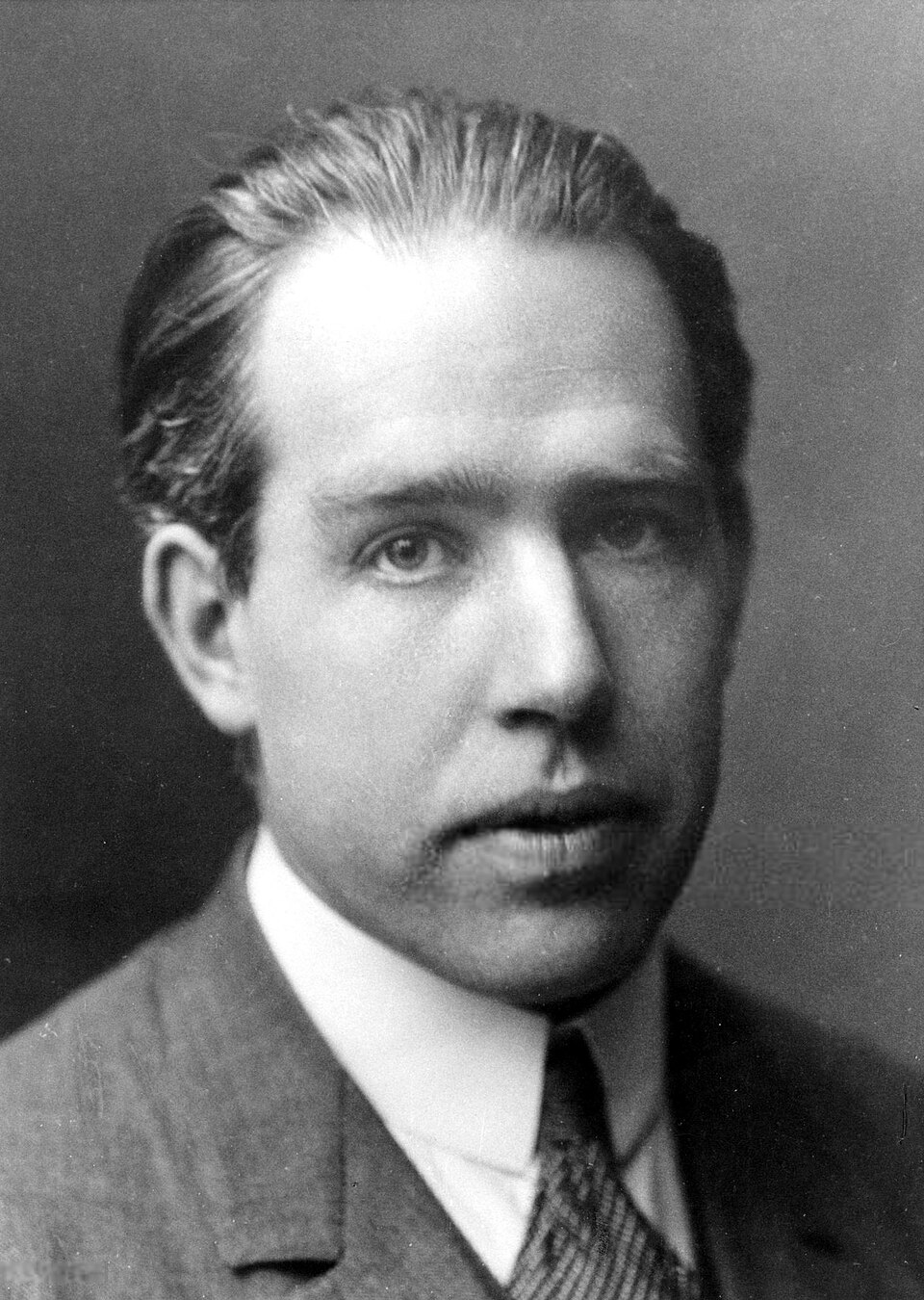
The Danish physicist who gave the atom its modern structure and forced science to accept that at the quantum scale, reality is irreducibly probabilistic.
Niels Bohr proposed the first quantum model of the atom in 1913, received the Nobel Prize in 1922, and spent the following four decades as the preeminent philosophical voice in the debate over what quantum mechanics means — a debate that remains unresolved.
Formation in Copenhagen
Bohr was born in Copenhagen in 1885. His father, Christian Bohr, was a professor of physiology; his mother, Ellen Adler, came from a prominent Jewish Danish family. He studied physics at the University of Copenhagen, completing his doctorate in 1911. A fellowship took him first to Cambridge to work with J. J. Thomson, and then to Manchester to work with Ernest Rutherford, who had recently established the nuclear model of the atom — a small dense nucleus surrounded by electrons. Bohr saw immediately that Rutherford's model was mechanically unstable: classical electromagnetism predicted that orbiting electrons would continuously radiate energy and spiral into the nucleus in a fraction of a second.
The 1913 atomic model
Bohr resolved the instability by introducing a radical constraint: electrons occupy only certain allowed orbits, defined by quantised angular momentum, and they do not radiate while in those orbits. Radiation occurs only when an electron jumps from a higher orbit to a lower one, emitting a photon whose energy equals the difference between the orbit energies. The model precisely reproduced the observed spectral lines of hydrogen. It was the first successful application of quantum ideas to atomic structure and established the basic picture — nucleus surrounded by electrons in quantised orbits — that still anchors introductory physics. Bohr received the Nobel Prize in Physics for this work in 1922.
The Copenhagen interpretation
When Werner Heisenberg, Erwin Schrödinger, Max Born, and others developed the full mathematical apparatus of quantum mechanics in the mid-1920s, Bohr was central to the philosophical discussion of what the new theory meant. The Copenhagen interpretation, largely shaped by Bohr, held that quantum systems do not have definite properties until measured; the wave function represents probabilities rather than actualities, and the act of measurement is irreducibly implicated in the result. Bohr's concept of complementarity — that wave and particle descriptions are mutually exclusive but both necessary — became its guiding principle. Einstein rejected this view, and the debate between Bohr and Einstein at a series of Solvay conferences in the late 1920s and 1930s is among the most productive disputes in the history of science.
If quantum mechanics hasn't profoundly shocked you, you haven't understood it yet.
Institute and wartime
In 1920 Bohr founded the Institute for Theoretical Physics in Copenhagen — later renamed the Niels Bohr Institute — which became a gathering point for European physicists throughout the interwar period. When Germany occupied Denmark in 1940, Bohr remained until 1943, when he was warned of imminent arrest; he escaped by boat to Sweden and was then flown to Britain in an unarmed aircraft. He participated in the British effort that merged with the Manhattan Project, working under the pseudonym Nicholas Baker. He was a persistent advocate for international scientific cooperation and for informing neutral governments of the bomb's development — arguments that were not acted upon.