Georg Cantor
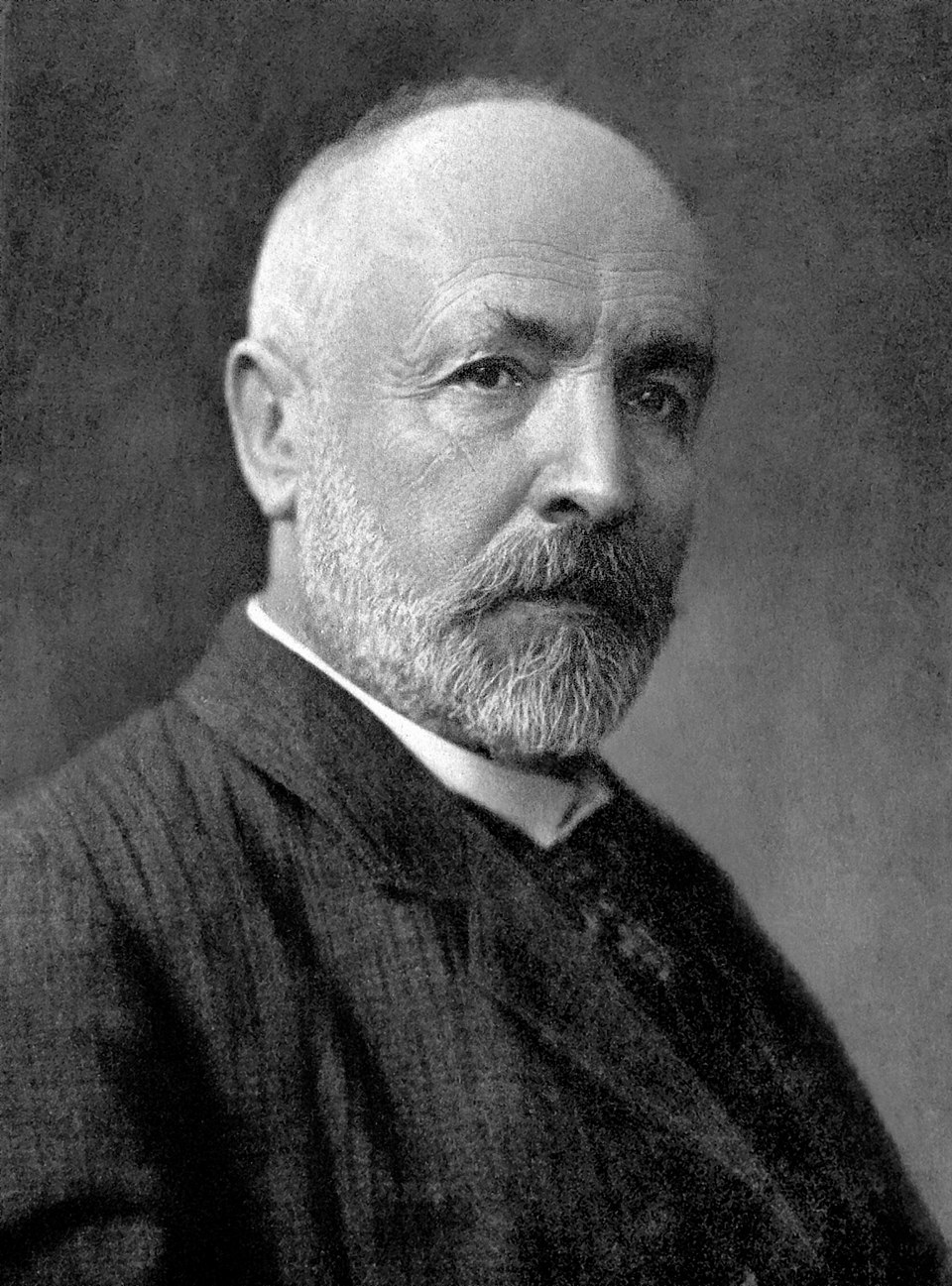
The mathematician who proved that some infinities are larger than others and gave mathematics its theory of the infinite.
Georg Cantor created set theory — the foundation on which modern mathematics is built — and proved that infinite sets can have different sizes. That the real numbers are strictly more numerous than the natural numbers, and that there exists a hierarchy of infinities with no largest member, were results so disturbing to his contemporaries that his leading critic, Leopold Kronecker, called him a corrupter of youth. Cantor spent the last decades of his life in and out of psychiatric institutions; his work was fully vindicated after his death.
Origins and formation
Cantor was born on 19 February 1845 in Saint Petersburg, where his father was a successful merchant. The family moved to Germany in 1856 when his father's health declined, and Cantor spent the rest of his life there. He studied at the University of Zurich and then the University of Berlin, where he was taught by Weierstrass and Kronecker. He submitted his doctoral thesis in 1867 and took a position at the University of Halle in 1869, remaining there until his retirement.
His early work was on number theory and trigonometric series — the same territory Riemann and Dirichlet had worked on. In attempting to characterise when two different trigonometric series could represent the same function, he was led to a careful analysis of the structure of infinite subsets of the real line, which became the seed of set theory.
The theory of infinite sets
Between 1874 and 1884 Cantor published a series of papers that transformed mathematics. In 1874 he proved that the algebraic numbers (roots of polynomials with integer coefficients) are countable — they can be put in one-to-one correspondence with the natural numbers — while the real numbers are not: no such correspondence exists. This was the first rigorous proof that different infinite sets can have different sizes.
In 1891 he published the diagonal argument — the clearest and most general proof of uncountability. Given any list of real numbers, Cantor constructs a number not on the list by making its nth decimal digit differ from the nth digit of the nth listed number. No list can be complete; the real numbers cannot be enumerated.
He defined cardinal numbers (sizes of sets) and ordinal numbers (order types of well-ordered sets) for infinite sets, and proved the Cantor theorem: for any set, its power set (the set of all subsets) is strictly larger. This implies a never-ending hierarchy of infinities: ℵ₀, ℵ₁, ℵ₂, …
He also formulated the Continuum Hypothesis: that there is no set whose size is strictly between that of the natural numbers and the real numbers. He spent years attempting a proof without success. In 1963, Paul Cohen proved that the Continuum Hypothesis is independent of the standard axioms of set theory — neither provable nor disprovable — in part vindicating the difficulty of Cantor's attempts.
The essence of mathematics is its freedom.
Opposition and illness
Kronecker, Cantor's former teacher and the most powerful mathematician in Berlin, actively opposed his work, calling it "a disease." Poincaré called transfinite numbers a "grave disease infecting mathematics." The criticism may have contributed to the severe depression Cantor suffered from 1884 onward; he was hospitalised multiple times at the Halle Nervenklinik. Between episodes he continued working, and in the 1890s received recognition from Hilbert and Dedekind, who understood the importance of his framework.
Legacy
Set theory became the universal language of 20th-century mathematics. Every definition in analysis, algebra, topology, and logic is now stated in set-theoretic terms. Cantor's diagonal argument is the direct ancestor of Gödel's incompleteness theorems and Turing's proof of the undecidability of the halting problem.