Arthur Conan Doyle
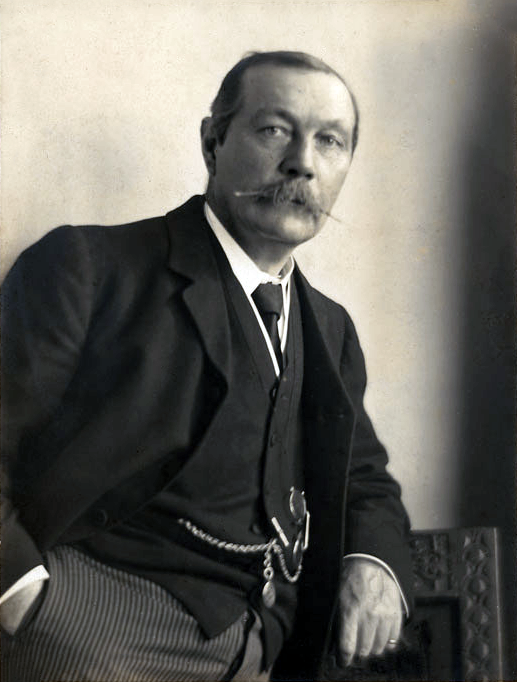
The physician who invented the world's most famous detective and, in doing so, established the template for analytical crime fiction.
Arthur Conan Doyle was a Scottish writer and physician who created Sherlock Holmes — a character whose method of observation and deduction became so vivid that readers wrote to him as a real person, and whose name has entered ordinary language as shorthand for analytical reasoning. The sixty Holmes stories are the foundation of the modern detective genre; yet they represent only a fraction of a vast and restless literary output.
Edinburgh and the medical mind
Doyle was born in Edinburgh on 22 May 1859 into an Irish Catholic family with strong artistic connections — his uncle Richard Doyle was a celebrated illustrator. He studied medicine at the University of Edinburgh, where he encountered Joseph Bell, a surgeon of remarkable diagnostic acuity who observed patients' occupations and histories from physical details alone. Bell became the direct model for Sherlock Holmes. Doyle qualified as a doctor in 1881, served as a ship's surgeon on voyages to the Arctic and West Africa, and ran practices in Plymouth and Southsea before his literary income made medicine unnecessary.
The Sherlock Holmes canon
A Study in Scarlet (1887), published in Beeton's Christmas Annual, introduced Holmes and his companion Dr. John H. Watson. The relationship — the brilliant, eccentric detective and his steady, wondering narrator — set a structural pattern that detective fiction has largely followed since. Holmes's methods are empirical and theatrical: he reads a visitor's past from the mud on their boots, the callus on their finger, the particular wear of their watch.
The stories appeared in The Strand Magazine from 1891, building a readership so intense that when Doyle killed Holmes at the Reichenbach Falls in "The Final Problem" (1893), public protests forced his eventual resurrection in The Adventure of the Empty House (1903). The full canon comprises four novels and fifty-six short stories.
Beyond Holmes
Doyle was a prolific writer whose other work is less remembered but substantial. The Lost World (1912) introduced Professor Challenger and established the template for the "lost prehistoric world" subgenre of speculative fiction. He wrote historical novels — The White Company (1891), Micah Clarke (1889) — which he considered his more serious work. He also produced volumes of poetry, plays, and journalism. Late in life he became a committed advocate for Spiritualism, a cause he promoted with the same evangelical energy he brought to his fiction.
He was knighted in 1902 for his pamphlet defending British conduct in the Boer War.
When you have eliminated the impossible, whatever remains, however improbable, must be the truth.
Legacy
Holmes is among the most adapted fictional characters in the history of narrative. The figure has appeared in countless film and television productions, stage productions, pastiches, and parody. The Baker Street Irregulars, a literary society devoted to Holmes scholarship, was founded in 1934. The Doyle estate retained copyright control into the twenty-first century. Holmes's name has entered common usage in multiple languages as a synonym for deductive skill.