Dante Alighieri
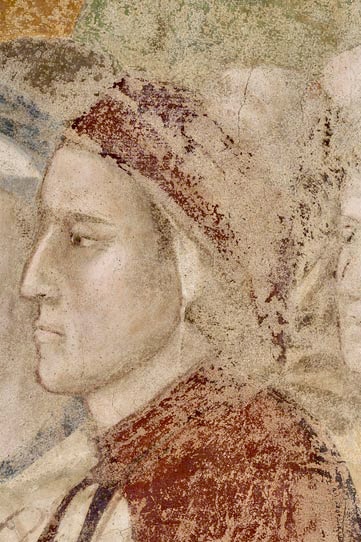
The Florentine poet who structured the entire moral universe of medieval Christianity into a three-part journey through the afterlife — and in doing so invented modern literary Italian.
Dante Alighieri wrote the Divine Comedy — an account of a journey through Hell, Purgatory, and Heaven — and in the process did something more: he showed that the vernacular tongue, the Italian spoken in the streets, was capable of bearing the weight of philosophy, theology, and the full range of human experience. It is the founding text of Italian literature and one of the indispensable works of world literature.
Florence and early life
Dante was born in Florence in 1265, the son of a minor noble family of no great means. He received an education in rhetoric and philosophy and was early drawn to poetry, particularly the Dolce Stil Novo tradition, whose practitioners sought to refine the vernacular lyric. He served in the Florentine cavalry, participated in the civic life of the commune, and held public office — Florence's politics were violent and factional, and he was a committed if complicated participant.
His early literary work included the Vita Nuova, a sequence of poems and prose commentary addressed to Beatrice Portinari, a Florentine woman he had known since childhood and who died in 1290. Beatrice was idealized as a spiritual guide; her role in the Comedy would deepen that conception.
The Divine Comedy
The Comedy — Dante called it simply Comedìa; Divina was added later — is a poem in three books (canticle): Inferno, Purgatorio, and Paradiso, each of thirty-three cantos (plus one introductory canto in the Inferno, for a total of one hundred). Written in terza rima — a chain of interlocking three-line stanzas — it narrates a journey undertaken by Dante himself, guided first by Virgil (reason), then by Beatrice (faith), through the entire structure of the afterlife as medieval Catholic theology conceived it.
The Inferno is the most read section: a descent through nine circles of Hell in which sinners are punished in ways that mirror their sins. The Purgatorio depicts the mountain of purgation and the souls working toward purification. The Paradiso ascends through the celestial spheres to the direct vision of God. The poem is a compendium of medieval knowledge — theology, philosophy, classical history, Florentine politics, astronomy — organised within a moral structure of extraordinary rigour.
In the middle of the journey of our life I came to myself within a dark wood where the straight way was lost.
Exile
In 1302 Dante was exiled from Florence by the victorious Black Guelph faction and sentenced to death if he returned. He never returned. The Comedy was composed during this exile, partly at Verona under the patronage of Cangrande della Scala, and elsewhere. He died in Ravenna in 1321. Florence repeatedly petitioned for the return of his remains; Ravenna has always declined.
The exile shaped the poem's political and personal intensity: the Inferno is populated by Dante's Florentine enemies; the Paradiso reaches toward the divine justice that earthly politics continually betrays.
Legacy
The Divine Comedy defined the Italian literary language — the Florentine vernacular Dante used became the standard form of written Italian, giving the nation's literature its foundation before it had political unity. Its influence on subsequent literature is total: Chaucer, Milton, T.S. Eliot, Beckett, and virtually every major European writer engaged with it. Boccaccio lectured on it publicly in Florence. Borges cited it as one of the two or three works most central to his thinking. The figure of Dante the traveller — alive in the land of the dead, taking notes — remains the prototype of the literary witness.