Jane Austen
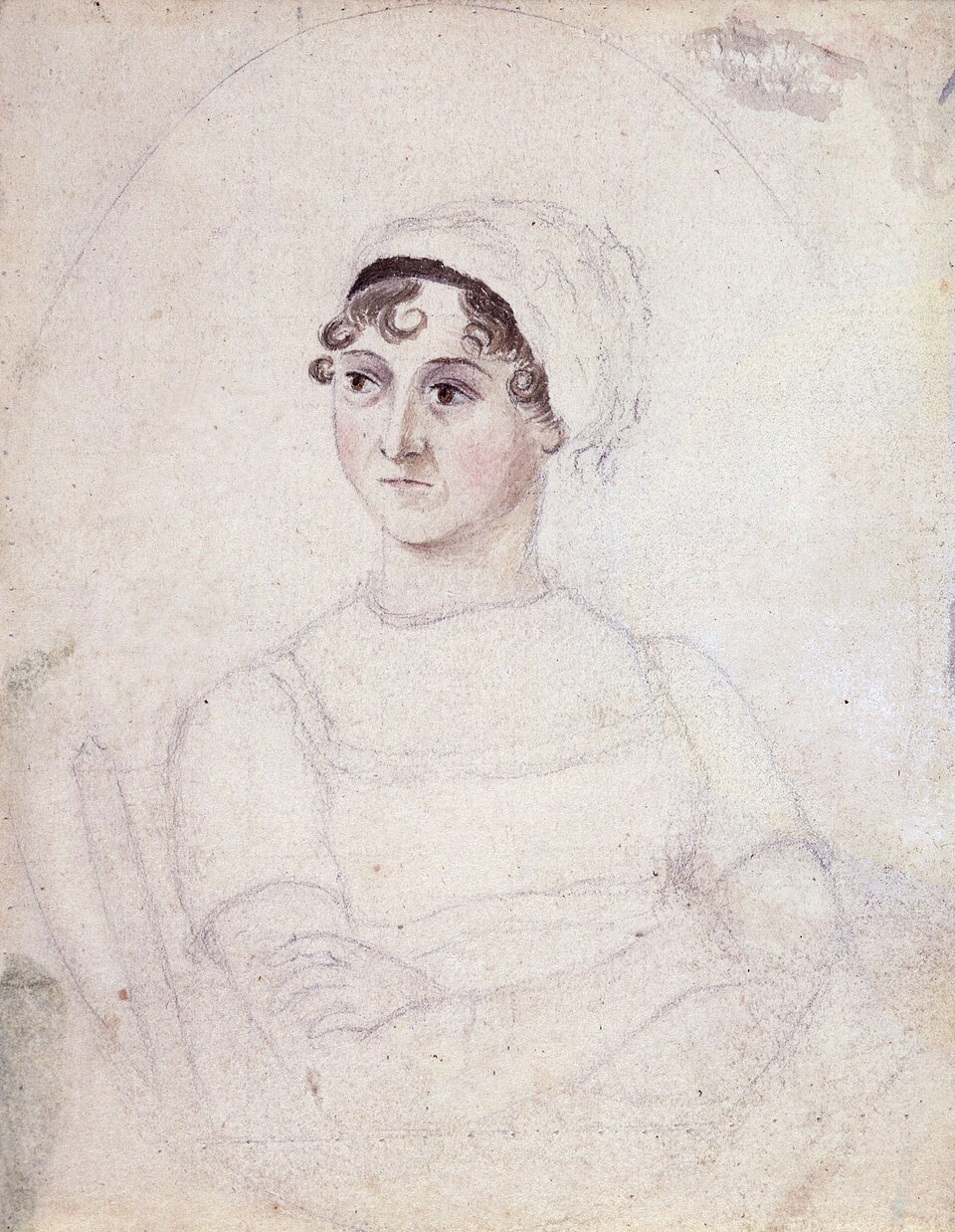
The English novelist who turned the provincial drawing room into a stage for moral intelligence, social comedy, and the economics of marriage.
Jane Austen wrote six novels that have never gone out of print, in a style so precisely calibrated to the social world it describes that every character misreads and every reader sees through them — a combination of comedy and moral authority that has no equal in English prose.
Hampshire and the range of a village
Austen was born in Steventon, Hampshire, the seventh of eight children of a Church of England rector. Her education was informal — a few years at boarding schools, the rest at home — but her father's extensive library gave her access to the fiction, poetry, and drama of the period. She began writing satirical sketches and burlesque novels in her teenage years; the juvenilia already display the comic precision and ear for self-delusion that would define her mature work.
She never married, lived almost always within a small domestic radius, and worked quietly on manuscripts that she revised over long periods. When she published, she did so anonymously — her novels appeared as By a Lady, then by the author of her previous titles. Her identity as a novelist was not widely known during her lifetime.
Six novels, one argument
Austen's six completed novels — Sense and Sensibility (1811), Pride and Prejudice (1813), Mansfield Park (1814), Emma (1815), Northanger Abbey and Persuasion (both published posthumously in 1818) — occupy a narrow social terrain: the English landed gentry and the professional middle class. Their subject is marriage, but marriage as an economic and ethical institution rather than a romantic one. Women without capital had limited choices; Austen maps those choices without sentimentality and without evasion.
The formal instrument she uses is free indirect discourse — a narration that slips between the author's perspective and the character's, letting irony do the work of explicit judgment. Elizabeth Bennet, Emma Woodhouse, and Anne Elliot are each wrong, in different ways, about what they know — and the novels' pleasures derive from watching them correct themselves.
It is a truth universally acknowledged, that a single man in possession of a good fortune, must be in want of a wife.
Method and irony
Austen's prose is famously economical. She uses dialogue and social performance as the primary evidence of character, trusting readers to register what a character's manner of speaking reveals about their inner life. Her settings are deliberately confined — a country house, a seaside resort, a city neighbourhood — because the confined setting concentrates the pressure. Wealth, entail, accomplishments, and connexions are not background texture; they are the material of the drama.
Emma is often cited as the most formally perfect of the novels. Its unreliable heroine is the source of every misreading the plot depends on, yet the reader misreads alongside her — a feat of narrative engineering that took two centuries of criticism to fully describe.
Reception and legacy
Austen was not prominent in her own time; her novels were well reviewed but not widely known. The transformation began with her nephew J.E. Austen-Leigh's Memoir (1869) and accelerated through the twentieth century until she became arguably the most-read serious novelist in English. Adaptations — theatrical, cinematic, and televisual — have run without pause since the 1930s. Her influence on the novel of manners is structural: the form she developed — precise social observation, ironic distance, moral clarity without moralising — defines a tradition that runs through George Eliot, Henry James, and Edith Wharton.