Maya Angelou
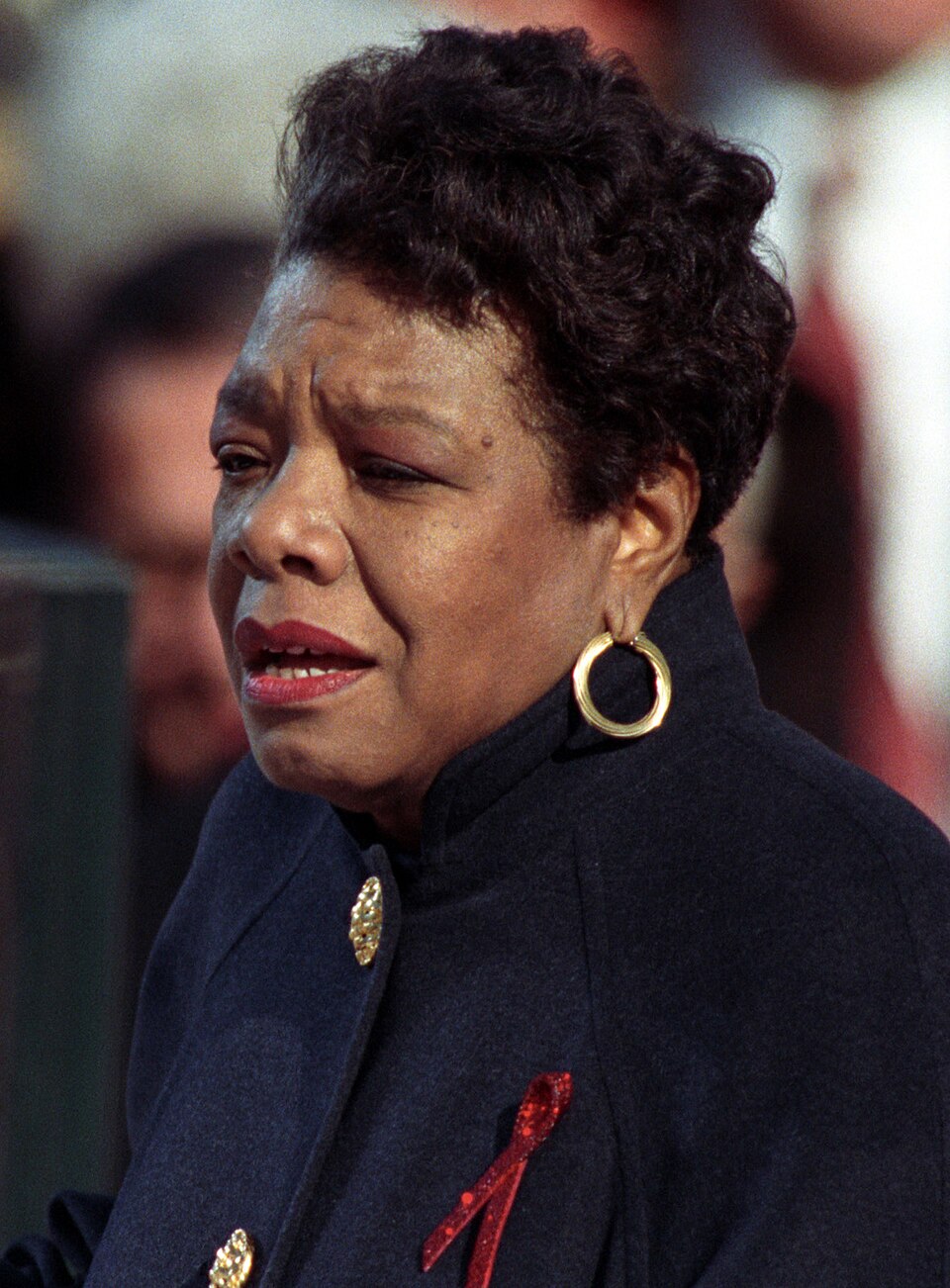
An American poet and memoirist who transmuted extreme personal adversity into literature of public grace, reaching audiences for whom no one had previously written.
Maya Angelou's first autobiography was rejected by twelve publishers before it found a home; it went on to spend two years on the New York Times bestseller list and remains one of the most widely taught memoirs in American education. That trajectory — from silence to canonical voice — is the story her books tell as well as the story of her life.
Stamps, St. Louis, and early silences
Born Marguerite Annie Johnson in St. Louis in 1928, Angelou was sent at age three, following her parents' divorce, to live with her paternal grandmother in Stamps, Arkansas. The town's harsh racial segregation gave her the first material she would eventually shape into art. At seven, visiting her mother in St. Louis, she was sexually assaulted by her mother's boyfriend; after she reported it and the man was killed (apparently by her uncles), Angelou stopped speaking, believing her voice had caused his death. She was mute for approximately five years. It was a teacher and poet, Bertha Flowers, who drew her back to language by insisting she read aloud — an act Angelou later described as her rebirth into words.1
A life in performance
Before she became a writer, Angelou was a performer. She studied dance with Martha Graham and Pearl Primus, worked as San Francisco's first Black female cable-car conductor, sang calypso in nightclubs, and toured Europe in a production of Porgy and Bess in the mid-1950s. She was active in civil rights circles — working with Martin Luther King Jr. as Northern Coordinator for the Southern Christian Leadership Conference and later living in Ghana with her son and a community of African American expatriates including W.E.B. Du Bois. This breadth of lived experience fed directly into her writing, which resists the label of any single genre.
The autobiographies
I Know Why the Caged Bird Sings (1969) — the title drawn from the Paul Laurence Dunbar poem "Sympathy" — was groundbreaking in its frankness: a Black woman's account of childhood trauma, racism, and survival that refused to resolve into uplift prematurely. It was the first volume of what became a seven-part autobiography, a form Angelou used across decades to track her continuing development: Gather Together in My Name (1974), Singin' and Swingin' and Gettin' Merry Like Christmas (1976), and four subsequent volumes each extending the self-portrait into new periods and geographies. The serial autobiography as a form — revisiting the same life repeatedly from different vantage points — is one of her distinctive contributions to American letters.
Poetry and public life
As a poet Angelou favoured accessible forms and strong oral rhythms, suited to public reading. Her poem "On the Pulse of Morning", written for and delivered at Bill Clinton's first presidential inauguration in January 1993, gave her the largest single audience of her career and brought her poetry to listeners who had never encountered it in print. She held a lifetime appointment as Reynolds Professor of American Studies at Wake Forest University. President Obama awarded her the Presidential Medal of Freedom in 2011.
Courage is the most important of all the virtues because without courage, you can't practice any other virtue consistently.
Footnotes
- Angelou credited her silence with teaching her to listen carefully to language — an attention she believed made her a better writer once she spoke again. ↩