Augustine of Hippo
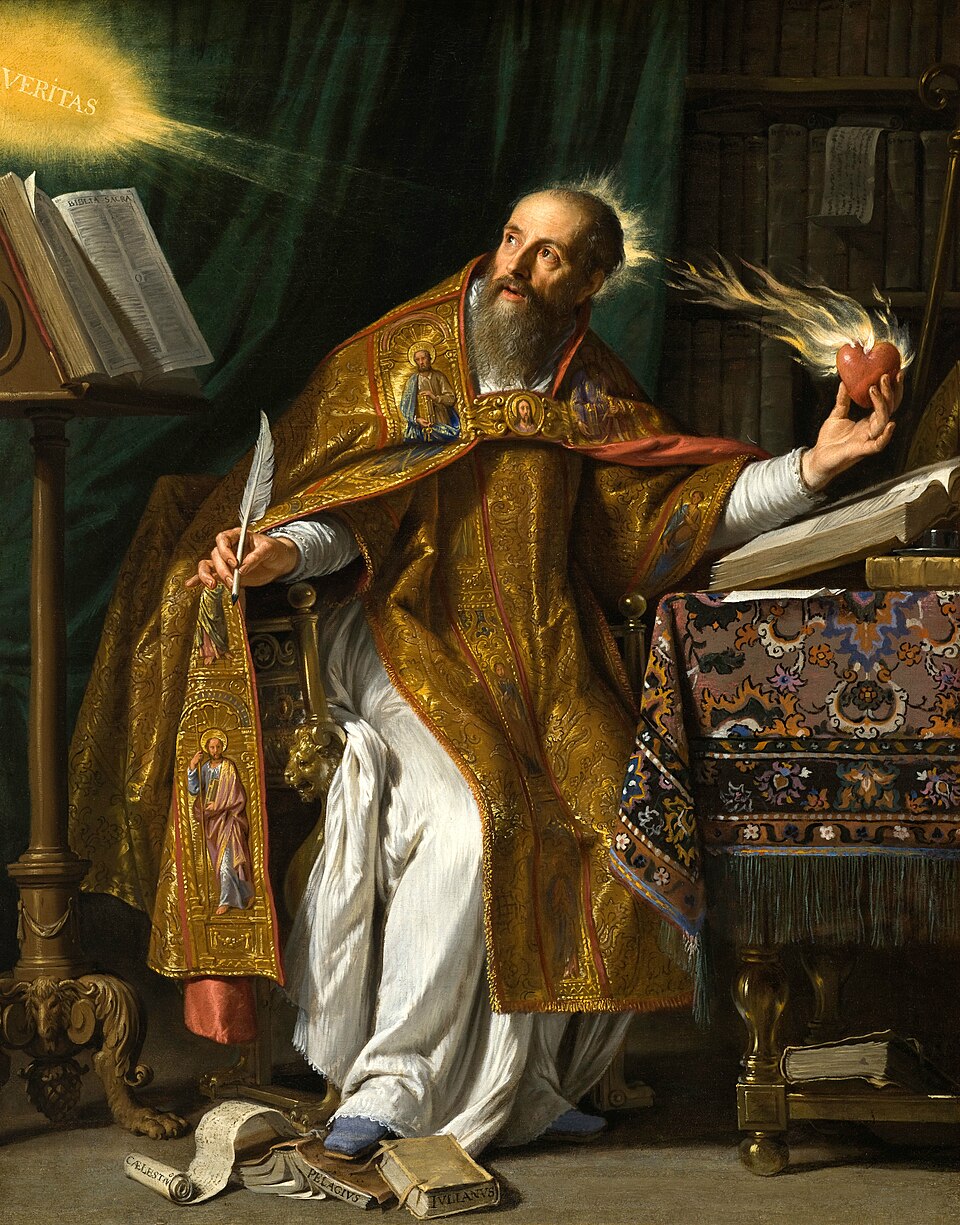
A restless North African intellect who moved from Manichaeism through Neoplatonism to Christian theology and left the Western Church with a philosophical vocabulary it still uses.
Augustine of Hippo converted to Christianity at thirty-one after a decade of philosophical restlessness, and then spent the remaining forty-four years of his life thinking, writing, preaching, and fighting doctrinal battles with an energy that made him the most productive theologian of late antiquity. His synthesis of classical philosophy and Christian doctrine became so foundational to Western thought that historians of philosophy often mark a distinct break at his work — before Augustine, and after.
Early life and intellectual wandering
Augustine was born on 13 November 354 in Thagaste, a modest town in the Roman province of Numidia Cirtensis in North Africa (modern-day Souk Ahras, Algeria). His mother Monica was a devout Christian; his father Patricius was a pagan who converted late in life. Through Monica's influence and his own evident brilliance, Augustine received an excellent education in rhetoric, eventually reaching Carthage as a student and then making his way to Rome and Milan as a teacher of rhetoric.
For nearly a decade he adhered to Manichaeism, a dualist religious movement that promised a rational account of the problem of evil. He later abandoned it, finding its cosmology intellectually unsatisfying. His reading of Neoplatonic philosophy — particularly works associated with Plotinus and Porphyry — gave him a non-material conception of the divine that Manichaeism had not provided, and brought him closer to Christianity. The decisive influence came through the sermons of Ambrose, Bishop of Milan, who demonstrated that the Christian scriptures could be read allegorically rather than literally.
Conversion and ordination
Augustine's conversion in 386 is one of the most documented personal transformations in ancient history, recorded in his own account in the Confessions. He describes a moment in a Milan garden, hearing a child's voice repeating tolle lege — take up and read — and opening Paul's letter to the Romans at a passage that resolved his years of moral struggle. He was baptised by Ambrose at Easter 387.
Returning to North Africa, he was ordained a priest at Hippo Regius in 391, somewhat against his wishes, and became its bishop four years later. He would hold that post for the remaining thirty-five years of his life, dying as the Vandals besieged the city on 28 August 430.
The Confessions and City of God
The Confessions, completed around 400, is an extended address to God reviewing Augustine's life up to and shortly after his conversion. It is simultaneously a spiritual autobiography, a philosophical analysis of memory and time, and a sustained meditation on the nature of the will. Its opening lines establish the governing idea that everything in the text unfolds from: "Thou madest us for Thyself, and our heart is restless, until it repose in Thee."
The City of God, begun after the Visigothic sack of Rome in 410 and completed around 426, was written in response to the charge that Christianity had weakened Rome. Augustine's argument is broader than its polemical occasion: he distinguishes two cities — the City of God and the city of the world — whose members are mixed together in historical time and will only be separated at the Last Judgement. The work became the most ambitious political theology produced in the patristic period.
Our heart is restless, until it repose in Thee.