Thomas Aquinas
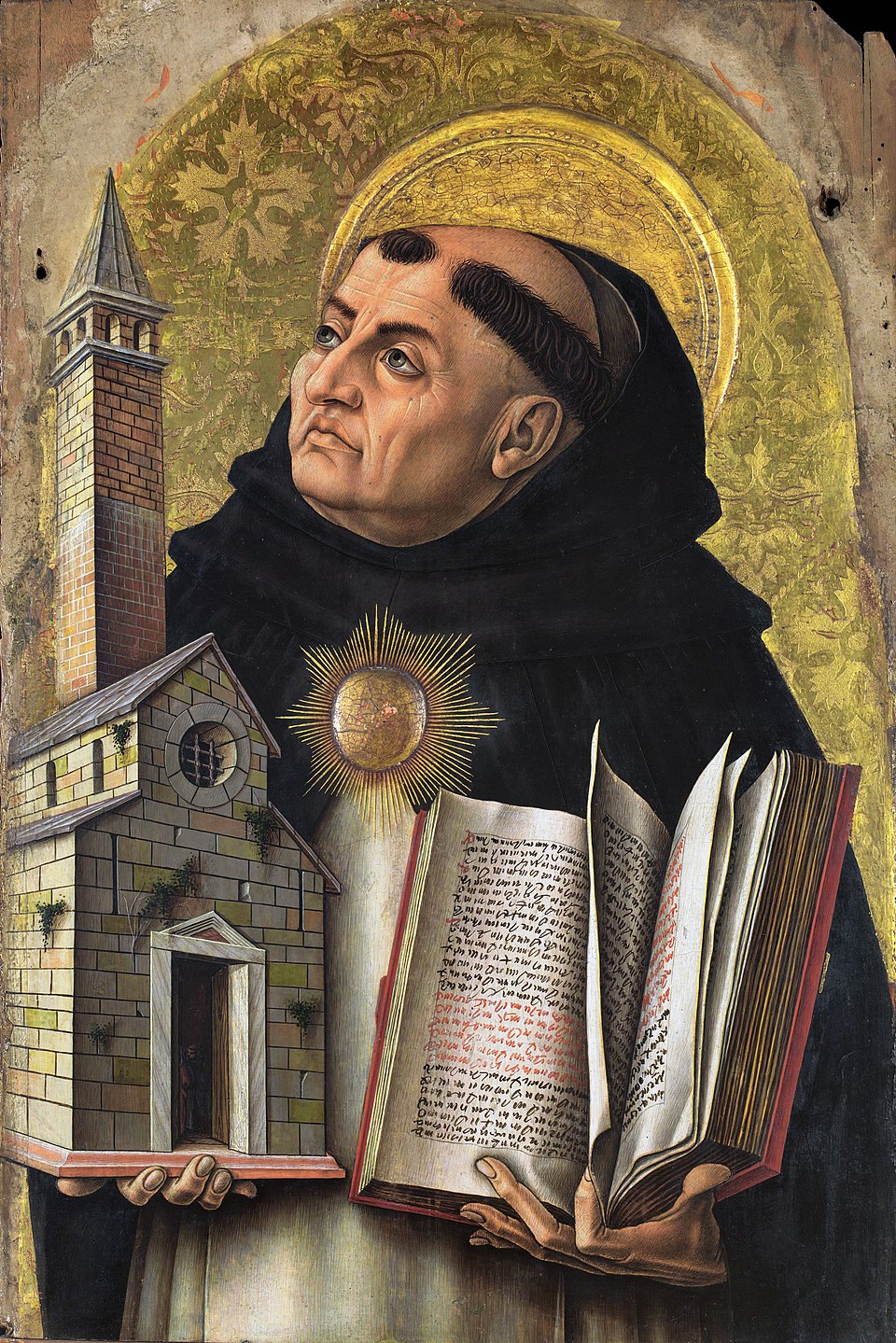
The Dominican friar who spent his career reconciling Aristotelian reason with Christian faith produced a philosophical system so comprehensive that the Catholic Church eventually adopted it as its own.
Thomas Aquinas arrived at the University of Paris in the mid-thirteenth century just as Aristotle's works, newly recovered through Arabic translations, were disrupting European intellectual life. His response — a painstaking synthesis of Aristotelian philosophy and Christian theology — became Thomism, the school of thought that the Catholic Church would ultimately designate its official philosophical framework. The Summa Theologica, his largest work, remains one of the most ambitious intellectual structures ever attempted.
Origins and formation
Thomas was born around 25 January 1225 at the family castle near Roccasecca, in the Kingdom of Sicily. His family was of minor nobility with connections to the imperial court of Frederick II, and they intended him for a respectable ecclesiastical career — possibly as Abbot of the nearby Benedictine monastery of Monte Cassino. When Thomas instead chose to join the newly founded Dominican Order, a mendicant order with no institutional property and a focus on preaching and study, his family was sufficiently opposed that they held him captive for over a year in an attempt to change his mind.
The attempt failed. He eventually studied under Albert the Great (Albertus Magnus) in Cologne, where his exceptional capacity became apparent, and then moved to Paris, where he would study and teach in two separate periods. His fellow students reportedly called him the "dumb ox" for his quiet demeanour — a characterisation Albert reportedly dismissed, predicting that the ox's bellowing would one day fill the world.
Aristotle and the problem of reason
The recovery of Aristotle's complete works through Arabic and Greek manuscripts presented a challenge to medieval European universities: here was a comprehensive account of nature, ethics, and metaphysics produced by a pagan philosopher without reference to Christian revelation, and it was far more systematic than anything previously available in Latin. Some theologians wanted Aristotle's works banned. Others attempted an uncritical adoption.
Aquinas chose a third path. Reason and revelation, he argued, cannot genuinely contradict each other because both derive ultimately from God. Philosophy, properly conducted, will arrive at truths consistent with faith, even though it cannot by itself reach the full content of revealed doctrine. Natural theology — the attempt to know something of God through reason alone — is legitimate and yields real knowledge; revealed theology supplements and corrects it where natural reason reaches its limits.
This position required careful work to sustain. Aquinas moved through Aristotle's texts methodically, writing extensive commentaries that distinguished between what he took to be genuinely Aristotelian positions and later Neoplatonic additions, and he built his own systematic theology on the Aristotelian framework of form, matter, act, and potency.
The Summa Theologica
The Summa Theologica (or Summa Theologiae) was begun around 1265 and left unfinished at Aquinas's death. It is organised as a series of questions, each divided into articles that state objections to the position Aquinas will defend, give his reply, and then answer each objection individually — a form derived from the disputational methods of the medieval university. The work covers the existence and nature of God, the structure of creation, human nature and the virtues, the Incarnation, and the sacraments across three main parts and nearly three thousand articles.
In December 1273 Aquinas abruptly stopped writing. He told his companion Reginald that he could write no more: "Everything I have written seems to me like straw compared to what I have seen." He died three months later, on 7 March 1274, at the Cistercian monastery of Fossanova, on his way to the Second Council of Lyon.
The things that we hold by faith and the things that reason demonstrates cannot be contrary to one another.