Hannah Arendt
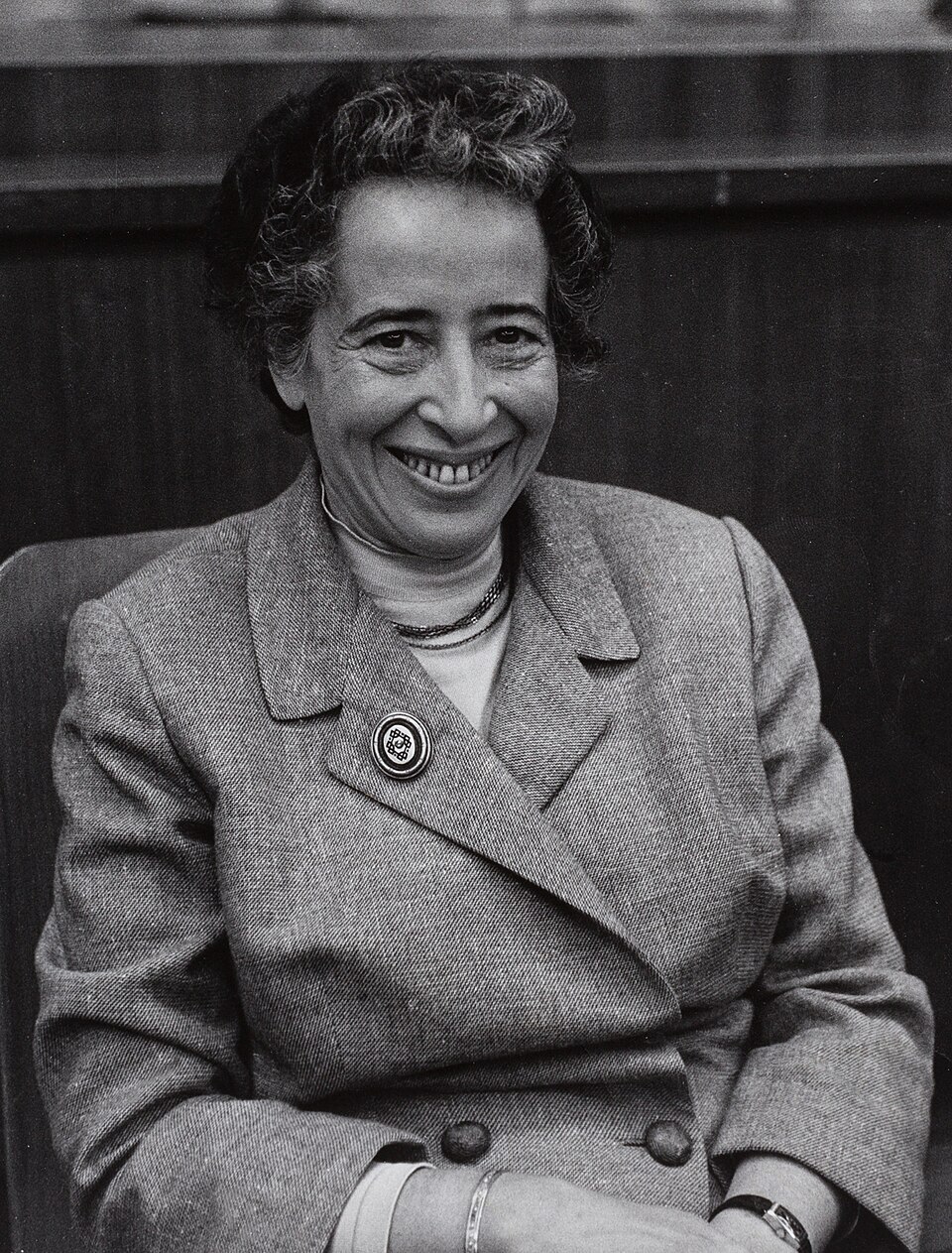
A refugee from Nazi Germany who became the century's most penetrating analyst of totalitarianism, freedom, and the human capacity for both thought and atrocity.
Hannah Arendt studied under Martin Heidegger and Karl Jaspers before fleeing Germany in 1933, eventually arriving in New York as a stateless refugee. The experience of political catastrophe was not incidental to her thought — it was its foundation, generating questions about power, plurality, and the conditions under which human beings act freely in public life that remain urgent today.
Formation and flight
Born in 1906 in Linden, near Hanover, Arendt grew up in Königsberg and Berlin in a secular Jewish family. She studied philosophy at Marburg under Martin Heidegger, at Freiburg under Edmund Husserl, and completed her doctoral dissertation on the concept of love in Saint Augustine under Karl Jaspers at Heidelberg in 1929. The relationship with Heidegger — intellectual, personal, and deeply complicated by his subsequent embrace of National Socialism — would shadow her thought and biography throughout her life. She was arrested by the Gestapo in 1933, escaped to Paris, worked for Zionist organisations aiding Jewish youth emigration, and after France fell fled via Lisbon to New York in 1941. She was stateless for eighteen years.
The defining work
The Origins of Totalitarianism (1951) established Arendt's international reputation. The book analysed the common elements of Nazism and Stalinism — antisemitism, imperialism, and the destruction of the public-political realm — at a time when most Western thinkers were reluctant to draw such comparisons. The Human Condition (1958) developed her tripartite distinction between labour, work, and action, arguing that genuine political life depended on the recovery of action — the human capacity to begin something new among equals.1 Eichmann in Jerusalem (1963), her report on the trial of the Nazi official Adolf Eichmann for The New Yorker, introduced the phrase "the banality of evil" to describe not a monster but a thoughtless bureaucrat — and provoked fierce and lasting controversy.
| Work | Year | Central concept |
|---|---|---|
| The Origins of Totalitarianism | 1951 | Antisemitism, imperialism, totalitarianism |
| The Human Condition | 1958 | Labour / work / action |
| On Revolution | 1963 | Freedom, founding, revolution |
| Eichmann in Jerusalem | 1963 | "The banality of evil" |
| The Life of the Mind | 1978 | Thinking, willing, judging |
Method and style
Arendt resisted disciplinary boundaries. She was not a systematic philosopher in the German idealist tradition but a phenomenologist of political experience, drawing on classical Greek texts — above all Aristotle's Politics — alongside Kant's Critique of Judgement, which she reread late in life as a philosophy of political judgement rather than aesthetics. Her prose in German and English combines analytical precision with rhetorical power; she was widely read outside the academy and taught at institutions including the New School for Social Research, the University of Chicago, and Princeton.
Legacy
Arendt died in New York in 1975, leaving The Life of the Mind unfinished. Her concepts — plurality, natality, the public realm, the banality of evil — have been absorbed into political philosophy, legal theory, and democratic theory. Seyla Benhabib, Judith Butler, and Elisabeth Young-Bruehl are among the scholars who have worked in sustained dialogue with her thought. A 2012 film by Margarethe von Trotta dramatised the controversy surrounding Eichmann in Jerusalem and reintroduced her to a wide non-specialist audience.
The sad truth is that most evil is done by people who never make up their minds to be good or evil.
Footnotes
- The terms are derived from the Greek distinction between poiesis (making) and praxis (action), which Arendt considered the essential categories of the vita activa. ↩