Marcus Aurelius
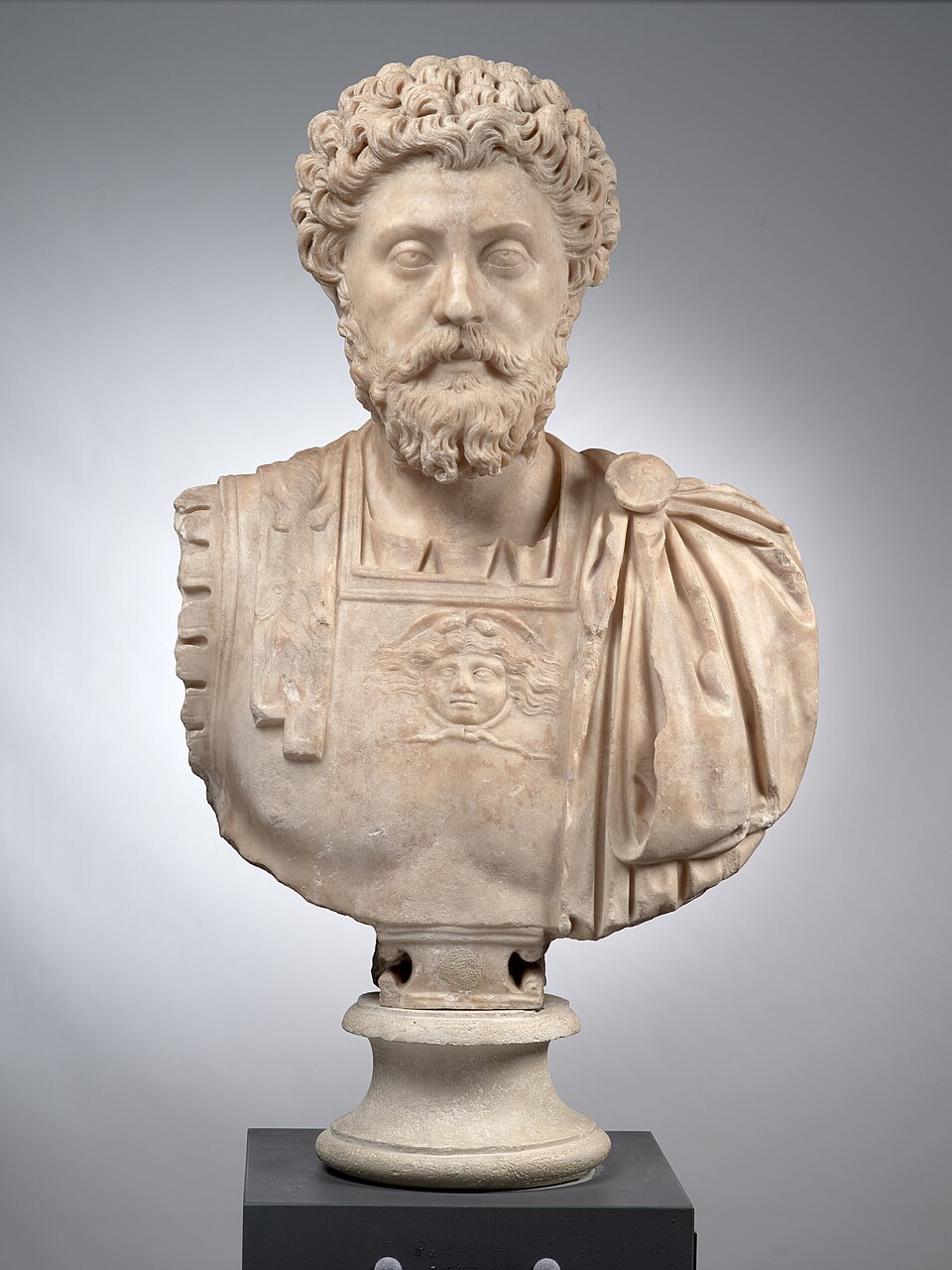
The last of Rome's Five Good Emperors ruled an empire under near-constant pressure and spent his private hours writing Stoic meditations he never intended anyone else to read.
Marcus Aurelius governed the Roman Empire for nearly two decades of plague, frontier war, and internal conspiracy, and did so by most accounts with unusual restraint and deliberation. The private notebooks he kept in Greek — later titled Meditations — were not written for an audience; they are a record of one man's repeated, effortful attempt to live according to Stoic principle while holding the most powerful office in the Western world.
Rise and formation
Born in Rome on 26 April 121, Marcus Annius Verus came from a distinguished Spanish-Roman family with close ties to the imperial court. The emperor Hadrian took notice of the boy early and arranged his eventual adoption into the succession. He was educated by a succession of notable teachers — the rhetorician Fronto among them — but the intellectual influence that shaped him most was Stoic philosophy, particularly the writings of Epictetus, whose Discourses he encountered as a young man.
In 140 he was appointed consul for the first time under the emperor Antoninus Pius, who had adopted him as heir. He served as consul again in 145 and 161. When Antoninus Pius died in 161, Marcus acceded to the throne at the age of thirty-nine and immediately shared power with his adoptive brother Lucius Verus — an unprecedented act of co-rule that held until Verus's death in 169.
The Antonine Plague and the frontier wars
Marcus's reign was far from the stable Pax Romana his immediate predecessors had maintained. Within his first years, legions returning from a campaign in Parthia brought back a devastating epidemic — now known as the Antonine Plague — that killed an estimated five million people across the empire and disrupted military recruitment and economic life for over a decade.
Simultaneously, pressure on the northern frontier intensified. Germanic tribes, among them the Marcomanni and Quadi, crossed the Danube in 166 and raided deep into Roman territory. Marcus spent much of his reign on campaign along the Danube, personally commanding forces from the legionary base at Carnuntum. He achieved significant military successes and had extended Roman territory northward when he died at his field headquarters on 17 March 180, most likely from the plague or another illness.
The Meditations
The private notebooks Marcus kept during his campaigns were written in Greek and addressed to himself — a set of exercises in Stoic self-examination rather than a treatise intended for publication. They circulated in manuscript for centuries before eventually reaching print in 1558. The twelve books that survive cover recurring preoccupations: the brevity of life, the obligation to act justly without regard for reward, the management of anger and ambition, and the discipline of directing attention only to what lies within one's own power.
The Meditations do not present a systematic philosophy. They return to the same themes repeatedly, as though repetition itself is the practice. Their peculiar value lies precisely in this quality: they show Stoicism not as an abstract doctrine but as a daily effort, imperfectly sustained.
You have power over your mind, not outside events. Realise this, and you will find strength.