James Baldwin
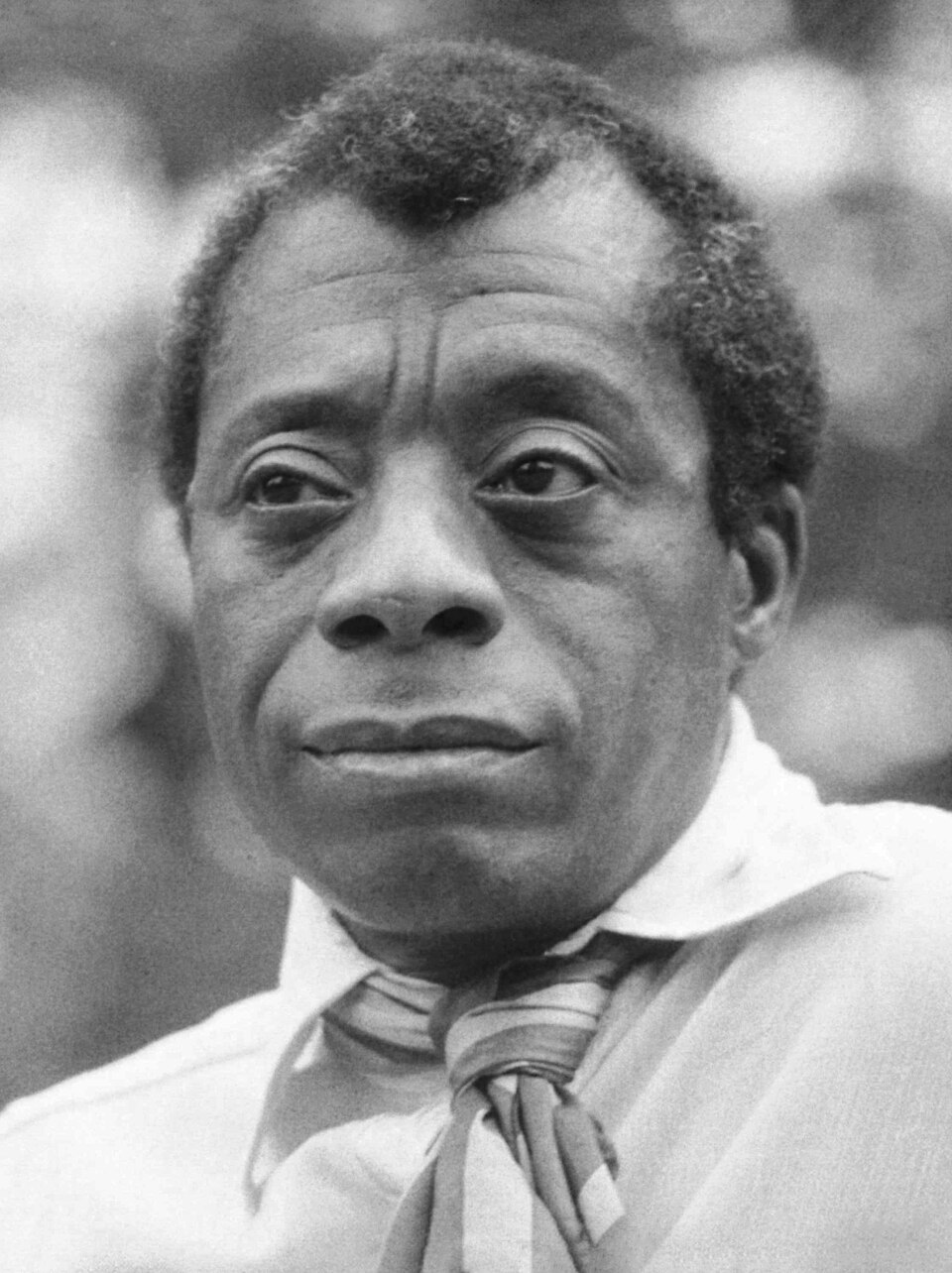
An American novelist and essayist who brought the moral weight of the civil rights struggle into the literary form itself, writing with fury and precision about race, sexuality, and the cost of American self-deception.
James Baldwin wrote as if his life depended on it — which, in the America he inhabited, was not far from the truth. From Harlem to Paris to the steps of the March on Washington, he produced an essay and fiction body that is inseparable from the political emergency it addressed, yet formal enough to outlast its moment entirely.
Harlem and the pulpit
Baldwin was born in Harlem in 1924 and raised in a household presided over by his stepfather, a storefront preacher whose sermonising would leave permanent marks on the cadences of Baldwin's prose. By fourteen he was himself preaching; by seventeen he had stopped, moving instead toward literature. He read voraciously and came under the mentorship of painter Beauford Delaney, who introduced him to the cultural world downtown. His friendship with Richard Wright in New York led, eventually, to a fellowship that allowed him to leave for Paris in 1948 — a departure that would define the geography of his life. He spent much of the next four decades in France, able to write about America most clearly from the distance of Europe.
The fiction
Baldwin's first novel, Go Tell It on the Mountain (1953), drew directly on his Harlem childhood and his stepfather's church, rendering a single day — a Tarry Service at a Pentecostal temple — as an excavation of three generations of Black American suffering and survival. Time magazine later ranked it among the 100 best English-language novels. Giovanni's Room (1956) broke further ground: a novel with no Black characters, set in Paris, exploring a white American's inability to accept his love for another man — a work of such candour that his publisher initially refused it. Another Country (1962) returned to New York, mapping the intersections of race, desire, and grief across an interconnected group of friends.
The essays
Baldwin's nonfiction is where his thinking is most fully exposed. Notes of a Native Son (1955) collected dispatches from Harlem and from his first years in Paris, establishing his essential argument: that America could not know itself as long as it refused to know its Black citizens. The Fire Next Time (1963) — two essays, one addressed to his nephew — appeared as the civil rights movement reached its peak and became an immediate classic: prophetic in tone, devastating in argument, written in sentences of extraordinary syntactical control.1 His 1965 Cambridge Union debate with William F. Buckley Jr. on the proposition "The American Dream is at the expense of the American Negro" remains one of the most watched intellectual confrontations of the twentieth century.
Exile and legacy
Baldwin died at his home in Saint-Paul-de-Vence, southern France, in December 1987. He was sixty-three. His influence on subsequent American writing — on Toni Morrison, who edited some of his later work at Random House, on Ta-Nehisi Coates, on countless others — is incalculable. The directness of his address, the moral seriousness that never tipped into sanctimony, the willingness to hold race and sexuality and class simultaneously in view: these remain available to any writer willing to look.
Not everything that is faced can be changed, but nothing can be changed until it is faced.
Footnotes
- The Fire Next Time takes its title from a spiritual: "God gave Noah the rainbow sign / No more water, the fire next time." ↩