Aristotle
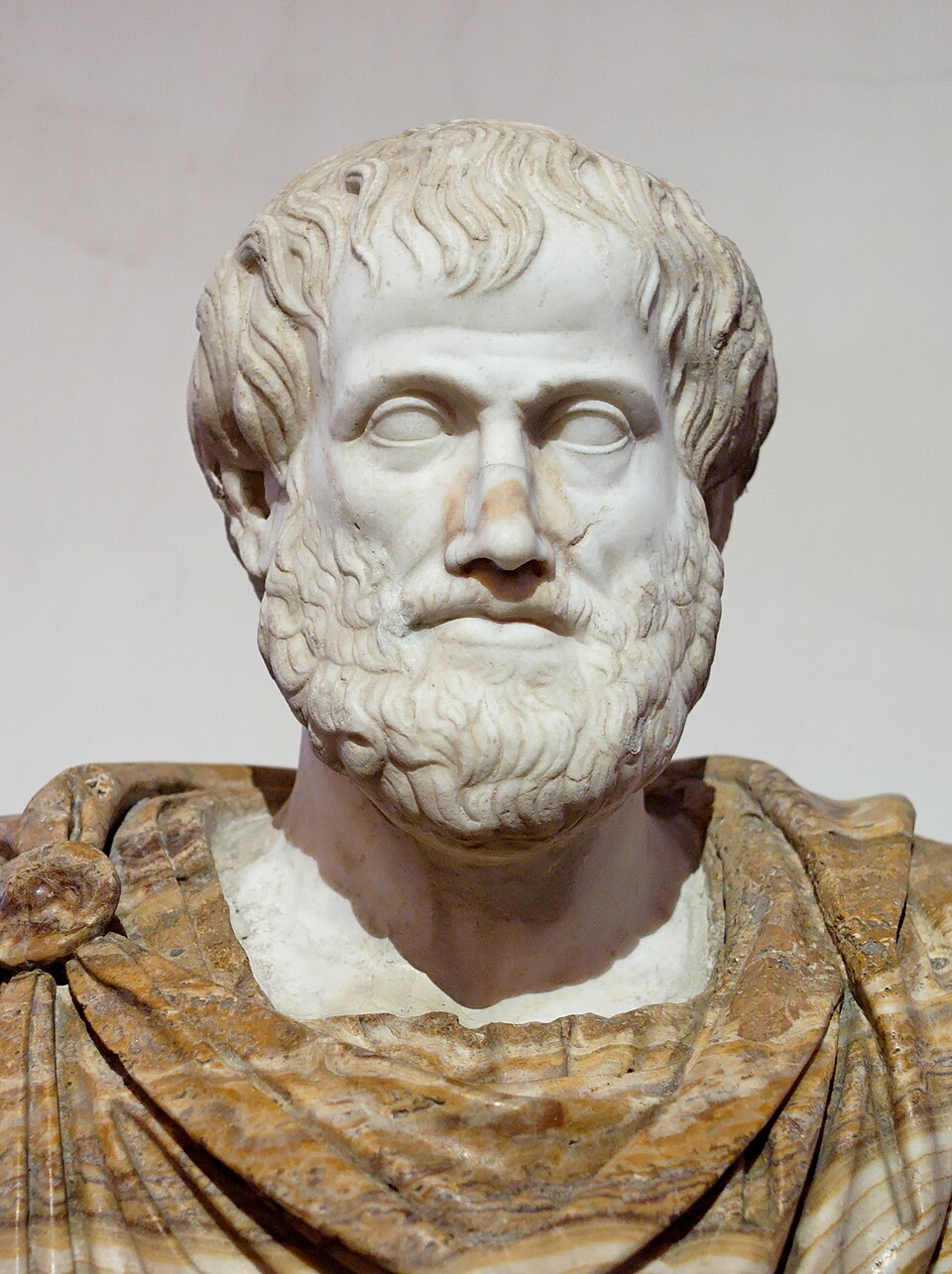
The Macedonian-born philosopher who founded formal logic, classified the natural world, and set the terms of Western intellectual inquiry for two millennia.
Aristotle studied under Plato for twenty years, tutored the heir to the Macedonian throne, and spent the last decade of his life running a school in Athens whose intellectual range — logic, biology, ethics, politics, rhetoric, poetics — has never been equalled by a single thinker. His writings shaped the curriculum of medieval Europe and the Islamic world, and set questions that philosophy and science have not finished answering.
Early life and the Academy
Aristotle was born in Stageira, in Chalcidice, around 384 BC. His father, Nicomachus, was court physician to Amyntas II of Macedon — a connection that placed the family close to power and gave Aristotle early exposure to empirical observation of the natural world. At seventeen he travelled to Athens and enrolled in Plato's Academy, where he remained for twenty years, first as student and eventually as an associate of exceptional standing.
Despite his closeness to Plato, Aristotle diverged from him on foundational questions. Where Plato located reality in abstract Forms existing independently of material things, Aristotle argued that form is always instantiated in matter — that universals exist only in and through particulars. This shift in metaphysical commitment set the direction of his subsequent work across every discipline he touched.
Tutor to Alexander
After Plato's death in 347 BC, Aristotle left Athens. He spent time in Asia Minor and the island of Lesbos, conducting biological observations — particularly of marine life — that survive in his zoological writings and remain remarkable for their accuracy and scope. Around 343 BC, King Philip II of Macedon invited him to tutor his son Alexander, then thirteen. Aristotle held this position for approximately eight years. The intellectual relationship between tutor and future conqueror has been debated ever since; what is clear is that Aristotle gave Alexander a systematic education and that Alexander retained enough regard for him to fund biological specimens gathered on campaign.
The Lyceum and the Peripatetic school
In 335 BC, Aristotle returned to Athens and founded his own school, the Lyceum, on the eastern edge of the city. The school's members — and the tradition they established — became known as Peripatetics, probably from the Greek for "walking about," reflecting a teaching style conducted in the school's covered walkways.
The Lyceum was not solely a philosophical school. Aristotle and his associates assembled a library, collected constitutions of Greek city-states, and pursued research in biology, botany, and natural history alongside the philosophical and logical work. The body of treatises that survives represents either his lecture notes or notes taken by students — not finished prose for public circulation.
His logical writings, collected later as the Organon, developed syllogistic logic: the formal analysis of valid inference through structured argument. This was the first systematic account of deductive reasoning, and it dominated logic in the West until the 19th century.1
All men by nature desire to know.
Footnotes
- Syllogistic logic held its position until Gottlob Frege's Begriffsschrift (1879) introduced predicate logic, which could handle quantified statements and relational reasoning that Aristotle's system could not. Aristotle's syllogistic remains a valid fragment of modern logic. ↩