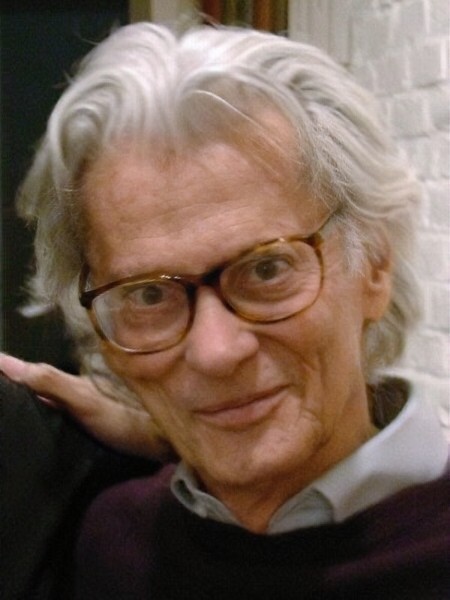
Pierre Cardin
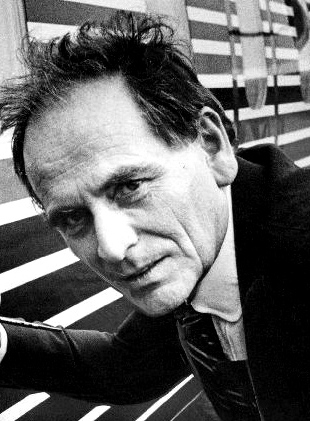
The couturier who pointed fashion toward the future — geometric, unisex, mass-distributed — and then licensed that future to nearly a thousand products worldwide.
Pierre Cardin arrived in Paris from Italy as a young man, worked at the house that created the New Look, and then built his own empire on a single contrary argument: that fashion should address the future, not the past. His Space Age silhouettes, modular geometry, and willingness to sell to anyone — not just the wealthy — made him one of the most influential and most contested figures in twentieth-century dress.
Formation
Pietro Costante Cardin was born on 2 July 1922 in Sant'Andrea di Barbarana, in the Veneto region of Italy. His family emigrated to France while he was still young, settling in Saint-Étienne. He trained as a tailor and moved to Paris, where he worked at the houses of Paquin and Schiaparelli before joining Christian Dior in 1946. At Dior he contributed to the landmark "New Look" collection of 1947 — the structured, full-skirted silhouette that reset post-war fashion.1 In 1950 he left to found his own house on the rue du Faubourg Saint-Honoré.
The bubble dress and early signature
Cardin's first major statement as an independent designer came in 1954 with the bubble dress: a hemline caught and gathered to form a rounded, sculptural shape at the knee. The garment was less about ornament than about volume as form — a structural idea that would recur throughout his career. The dress was widely copied and established his reputation as a designer willing to alter the silhouette itself rather than simply rearrange its surface.
Space Age and geometric abstraction
The work for which Cardin remains best known appeared in 1964: his Space Age collection, which presented geometric cutouts, vinyl visors, modular knit shifts, and body-stocking underlayers in a palette of black, white, and primary colour. The collection was designed to read as clothing for a future that the space race had made imaginable. Cardin preferred form to figure — he stated openly that he was often indifferent to the female body as a design constraint — and his garments reflect that: shapes hold their geometry regardless of what is inside them.2
The collection extended to unisex garments and men's wear, with collarless jackets and slim trousers that anticipated what the decade would make mainstream. Cardin was among the first couturiers to treat men's fashion as a serious design space.
Ready-to-wear and mass distribution
In 1959 Cardin became the first major Parisian couturier to design a ready-to-wear line for sale in a department store — Printemps. The Chambre Syndicale de la Haute Couture expelled him for the breach of protocol; he was readmitted the following year.3 The episode marks a turning point in couture's relationship with mass retail: Cardin demonstrated that the name and the standard could survive outside the atelier.
He extended this logic further through licensing, eventually attaching his name to more than 900 products across dozens of countries — alarm clocks, chocolates, cigarettes, furniture. Critics argued the volume diluted the brand; Cardin argued it extended access. Both assessments were correct.
My name is more important than myself.
Later career
In 1981 Cardin purchased Maxim's, the historic Paris restaurant on the rue Royale, and subsequently opened Maxim's outposts in cities including Beijing and New York. In 1992 he was elected to the Académie des beaux-arts — one of the few fashion designers to enter that institution. He continued working into his nineties. He died in Neuilly-sur-Seine on 29 December 2020, aged 98.
Footnotes
- Cardin's precise contribution to the New Look is documented in Rawsthorn (1984); his own accounts vary somewhat across interviews. ↩
- Cardin made this argument in several interviews; he described his aim as designing for "a human body I invent myself." The formulation is characteristic of his futurist position. ↩
- The expulsion and readmission are documented in trade press from 1959–1960 and summarised in multiple fashion histories. ↩