Coco Chanel
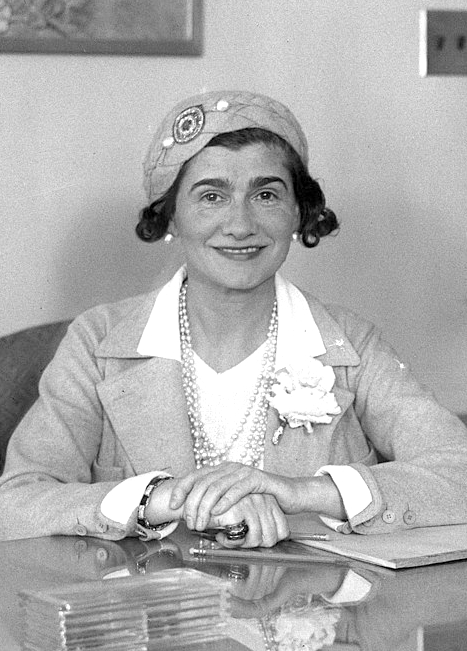
The couturière who dismantled Edwardian excess and rebuilt women's dress from jersey and common sense — and whose monogram remains the most recognised in fashion.
Gabrielle Chanel opened her first hat shop in Paris in 1910. By 1920 she had redefined feminine dress so completely that what had come before looked like costume. Her method was subtraction: she removed the corset, the excessive ornament, and the social anxiety about borrowing from menswear, and in their place put simplicity, comfort, and an idea of elegance that proved more durable than any seasonal trend.
Origins and early career
Chanel was born in Saumur in 1883 and raised partly in the orphanage at Aubazine after her mother's death, where she learned to sew. She worked briefly as a café singer in Moulins and Vichy — the source of the nickname Coco — before her relationship with the textile heir Étienne Balsan gave her access to Paris society and, crucially, to Balsan's stables at Royallieu, where she absorbed the vocabulary of equestrian sportswear: jersey, tweed, practical cut. Her first millinery boutique opened at 21 rue Cambon, Paris, in 1910, followed by a second in Deauville and a third in Biarritz.
The fabric of modernism
Chanel's decisive material innovation was jersey — then used almost exclusively for men's undergarments — which she began using for women's dresses and blouses around 1913. Jersey draped, moved, and breathed in ways that the stiff, structured fabrics of Edwardian couture did not. Combined with a simplified silhouette that allowed the body to move naturally, this produced garments that looked radical but felt obvious.1 The little black dress — which Vogue compared in 1926 to Ford's Model T, predicting it would become a universal uniform — distilled this logic perfectly: one colour, no fuss, permanent utility.
Chanel No. 5 and the interlocked-CC
In 1921, working with the perfumer Ernest Beaux, Chanel released Chanel No. 5 — one of the first perfumes to use synthetic aldehydes to create an abstract rather than naturalistic scent. The name came from the fifth sample Beaux submitted. It became, over the following century, arguably the best-known commercial fragrance in the world.
Her interlocked-CC monogram, which she designed herself, has been in use since the 1920s and remains the brand's primary visual identity. The design of the Chanel 2.55 bag (February 1955) added a second landmark object to the house's permanent vocabulary.
| Innovation | Approximate date | Significance |
|---|---|---|
| Jersey dresses | c. 1913 | Liberates women's silhouette |
| Little black dress | 1926 | Universal wardrobe staple |
| Chanel No. 5 | 1921 | Synthetic aldehydic fragrance |
| 2.55 quilted bag | 1955 | Shoulder strap — first of its kind |
The hiatus and return
Chanel closed the house in 1939 at the outbreak of war and did not reopen it until 1954, when she was seventy years old. The comeback was initially received coldly in Paris — the press judged her new collection old-fashioned — but enthusiastically in America. The Chanel suit (braid-trimmed, collarless jacket, straight skirt), which became her signature form in this second period, was worn by Jackie Kennedy on 22 November 1963. Chanel died in January 1971 at eighty-seven, still working.
Elegance is refusal.
Footnotes
- Chanel borrowed freely from masculine dress — the pea coat, the cardigan, the blazer — stripping their class associations and reassigning them to women. ↩