Barbara McClintock
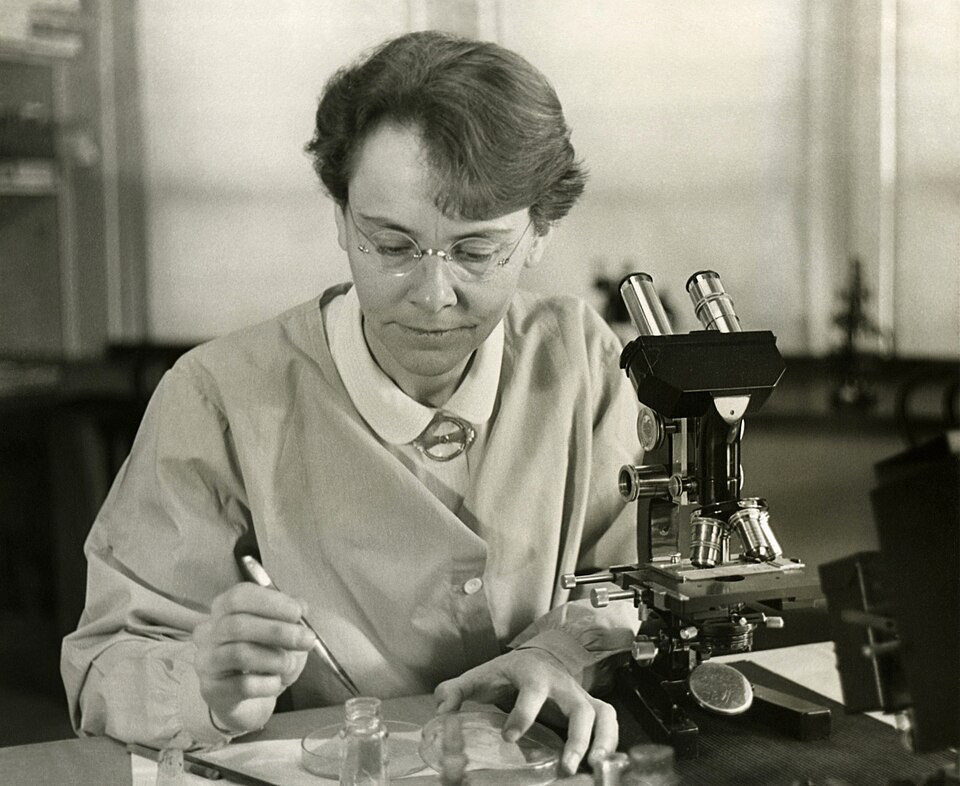
A geneticist who discovered that genes move — and then waited thirty years for science to believe her.
Barbara McClintock spent her career reading chromosomes the way a careful editor reads manuscripts — noting anomalies, tracing cause, following the argument wherever it led. What she found in her maize fields upended the assumption that the genome was a fixed, stable text.
Training and early work
McClintock was born in Hartford, Connecticut in 1902 and grew up determined to study science at a time when institutional science rarely made room for women. She enrolled at Cornell University, where she completed a PhD in botany in 1927. At Cornell she became the driving figure in the development of maize cytogenetics — the discipline of studying chromosomes in the corn plant — producing work of such technical precision and interpretive depth that her peers recognized her immediately as exceptional.
Her contributions in the 1930s and 1940s covered the foundational architecture of inheritance: she developed improved techniques for visualizing maize chromosomes under the microscope, demonstrated crossing-over as the physical mechanism of genetic recombination during meiosis, and characterized the function of telomeres and centromeres — the structural anchors that protect chromosomal information during cell division. She was elected to the National Academy of Sciences in 1944, one of the first women admitted.
Transposons: the discovery
From the late 1940s, McClintock worked at the Cold Spring Harbor Laboratory on Long Island, where she would remain for the rest of her career. Studying the inheritance of kernel color in maize, she noticed patterns that standard genetics could not explain: traits appeared, disappeared, and reappeared in ways that implied genes were not fixed in place but capable of moving within and between chromosomes.
She presented her findings in 1951. The response from the genetics community ranged from polite scepticism to dismissal. The idea of mobile genetic elements — what she called "transposable elements," later termed transposons — was too radical for the reigning model of the stable, linear genome. McClintock continued her work largely without recognition for the following decade, eventually scaling back public presentations rather than repeat the experience.
If you know you are on the right track, if you have this inner knowledge, then nobody can turn you off.
Vindication by molecular biology
The molecular biology revolution of the 1960s and 1970s provided the tools to look where McClintock had already been looking. Researchers confirmed transposable elements in bacteria, then in yeast, then in animals, then in the human genome — where transposons account for roughly 45 percent of all DNA. The theoretical consequence was significant: the genome was not a static blueprint but a dynamic system capable of reorganizing itself, with transposons driving evolution, adaptation, and genetic diversity.
Recognition arrived in a concentrated burst. The MacArthur Foundation awarded her a fellowship in 1981. The Nobel Prize in Physiology or Medicine followed in 1983. She received it as sole winner — the first woman to win that prize unshared. She was 81 years old.
Cold Spring Harbor and later life
McClintock lived and worked at Cold Spring Harbor until her death in 1992 at the age of 90. She remained active in the laboratory into her eighties, attending seminars and following the literature as the field she had founded continued to expand. A notably private figure, she gave few interviews and attracted little public attention until the Nobel announcement made avoidance impossible.
Her archive is held at the American Philosophical Society. The work in her laboratory notebooks — careful, incremental, rigorously self-questioning — documents one of the longest acts of patient scientific conviction in the twentieth century.