Baruch Spinoza
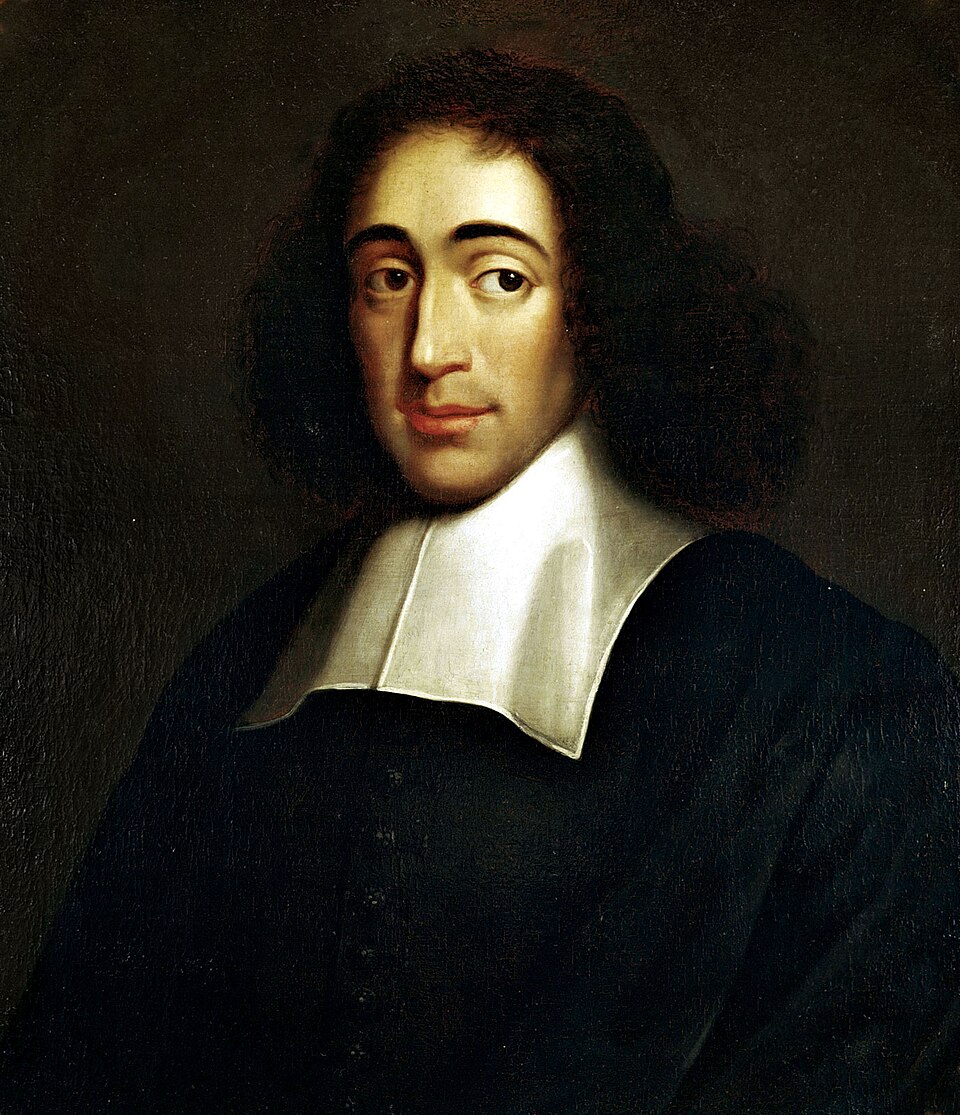
A lens-grinder from Amsterdam who built the most rigorous philosophical system of the seventeenth century and was excommunicated for it at twenty-three.
Baruch Spinoza was expelled from his Amsterdam Jewish community at twenty-three with one of the harshest excommunication decrees on record. He spent the rest of his short life in rented rooms, earning his keep by grinding optical lenses, and produced a body of work that dismantled the philosophical and theological assumptions of his age with a geometric severity that neither his contemporaries nor successors could ignore.
Origins and excommunication
Spinoza was born on 24 November 1632 in Amsterdam, into the community of Portuguese-Jewish exiles — the conversos and their descendants who had fled the Iberian Inquisition and reconstituted Jewish life in the tolerant Dutch Republic. His family were merchants in the dried-fruit trade; his father was a respected member of the community. Spinoza received a thorough Hebrew and Talmudic education and also studied Latin and the works of Descartes, Hobbes, and the neo-Scholastics.
In July 1656, the governing council of the Amsterdam Jewish community issued a cherem — a ban and excommunication — against Spinoza. The document uses unusually severe language, condemning his "abominable heresies" and "monstrous deeds," without specifying what these were. Scholars infer that he had already begun articulating ideas that would surface in his later work: that God and Nature are one, that the soul is not immortal, and that the Mosaic law was a political rather than divine ordinance. He was twenty-three years old.
Geometric method and the Ethics
Spinoza modelled his philosophy on Euclidean geometry. The Ethics — his masterwork, circulated in manuscript and published posthumously in 1677 — opens with definitions and axioms and proceeds through propositions, demonstrations, corollaries, and scholia, each step claimed to follow with logical necessity from the last. The ambition was to show that the whole of reality could be derived from first principles with the rigour of a mathematical proof.
The governing claim of the Ethics is that there is only one substance, which Spinoza calls God or Nature (Deus sive Natura). Everything that exists — minds, bodies, emotions, ideas — is a modification of this single infinite substance. This is the position later called pantheism or panentheism, and it made Spinoza scandalous: if God is identical to Nature, there is no transcendent deity who issues commands, rewards virtue, or answers prayer. Providence, miracle, and personal immortality dissolve.
From this metaphysical foundation Spinoza developed a determinist psychology. Human beings, like everything else, are governed by their nature; freedom is not the absence of causation but the achievement of self-understanding. The bondage analysed in Part IV of the Ethics is the condition of being driven by confused ideas and passive emotions; liberation consists in understanding the causes of one's affects and thereby transforming them into active rational states.
Biblical criticism
The Tractatus Theologico-Politicus, published anonymously in 1670, is Spinoza's other major work. It applied the same rational method to scripture, arguing that the Bible should be read like any other ancient text — examined for its historical context, its internal contradictions, and the human interests of its authors. Moses did not write the Pentateuch in its final form; prophecy was a function of imagination rather than divine transmission; the authority of religious law was political and civil, not metaphysical. The Tractatus is one of the founding documents of modern biblical criticism and of the argument for the separation of church and state.
Spinoza died of lung disease in The Hague on 21 February 1677, aged forty-four. His housemates found his Ethics manuscript among his papers; it was published by his friends later that year.
The free person is one who lives according to the dictate of reason alone.