Béla Bartók
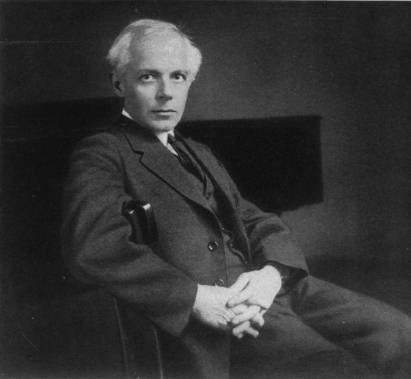
The Hungarian composer and ethnomusicologist who fused the folk music of Eastern Europe with the techniques of the Western concert tradition to produce some of the most demanding and original work of the twentieth century.
Béla Bartók spent his career doing two things at once: collecting and cataloguing the folk music of Hungary, Romania, Slovakia, Bulgaria, and North Africa, and composing concert works that absorbed those findings into a distinctly modern language. Neither effort was decorative. The field recordings shaped his rhythm and melody at a structural level; the compositions gave the ethnomusicology a reason to exist in the concert hall. He is regarded as one of the most significant composers of the twentieth century and, alongside Franz Liszt, one of Hungary's greatest.
Origins and formation
Bartók was born on 25 March 1881 in Sânnicolau Mare, then part of Austria-Hungary and now in Romania. His mother was a piano teacher, and he showed exceptional musical aptitude from early childhood. He studied at the Royal Academy of Music in Budapest, where he encountered the music of Richard Strauss and, crucially, the nationalist works of Liszt — influences he would absorb and then move decisively beyond.
The turn came in 1905, when Bartók began systematic field trips through rural Hungary with the composer Zoltán Kodály. What he found contradicted the Hungarian folk music he had previously known from urban arrangements. The older rural tradition — modal, asymmetrical in rhythm, rooted in oral transmission — could not be accommodated within the conventions of Western harmony. Bartók spent the rest of his life working out what to do with that discovery.
The ethnomusicological project
Between 1905 and the outbreak of the Second World War, Bartók made field recording expeditions across Hungary, Transylvania, Slovakia, Bulgaria, Turkey, and North Africa, collecting tens of thousands of folk melodies. He transcribed, classified, and analysed them with rigorous scholarly method, producing studies that laid the foundations for what later became ethnomusicology as a formal academic discipline.
The implications for his compositional practice were direct. Folk melody gave him alternatives to tonal harmonic progression — scales, modes, and rhythmic patterns that were not derived from the European art-music canon but were equally coherent. The result was a musical language that was simultaneously modern, rooted, and entirely his own.
Major works
Bartók's catalogue spans opera, ballet, orchestral music, chamber music, and piano pedagogy. His opera Bluebeard's Castle, composed in 1911, sets a compressed and psychologically intense version of the Bluebeard myth for two voices and orchestra. The ballet The Miraculous Mandarin (1919) is violent and expressionist, its choreographic scenario offset by music of ferocious rhythmic energy.
The middle period produced some of his most concentrated work. The six string quartets — composed between 1908 and 1939 — are widely considered among the most significant in the repertoire since Beethoven. Music for Strings, Percussion and Celesta (1936) demonstrated the full range of his orchestral thinking: intricate counterpoint, precise timbral organisation, and formal architecture of unusual clarity.
The Concerto for Orchestra, composed in 1943 after Bartók had emigrated to the United States, is his most performed work. It was commissioned by Serge Koussevitzky for the Boston Symphony Orchestra and represents something of a late reconciliation with accessible form without conceding any of the harmonic or rhythmic individuality that defined his mature language.
Exile and final years
In 1940, as fascism consolidated its grip on Hungary and its neighbours, Bartók and his wife emigrated to the United States. He took up a research fellowship at Columbia University, continuing his ethnomusicological work. His years in New York were difficult: he was largely unknown to American audiences, in poor health, and financially precarious. His situation improved somewhat after the Concerto for Orchestra brought him renewed recognition, but he died of leukaemia on 26 September 1945 before hearing his Piano Concerto No. 3 — his final completed work, left seventeen bars short of completion, which his pupil Tibor Serly finished from his sketches.
My true guiding idea, of which I have been fully conscious since I found myself as a composer, is the brotherhood of peoples — a brotherhood despite all war and conflict.