Leonard Bernstein
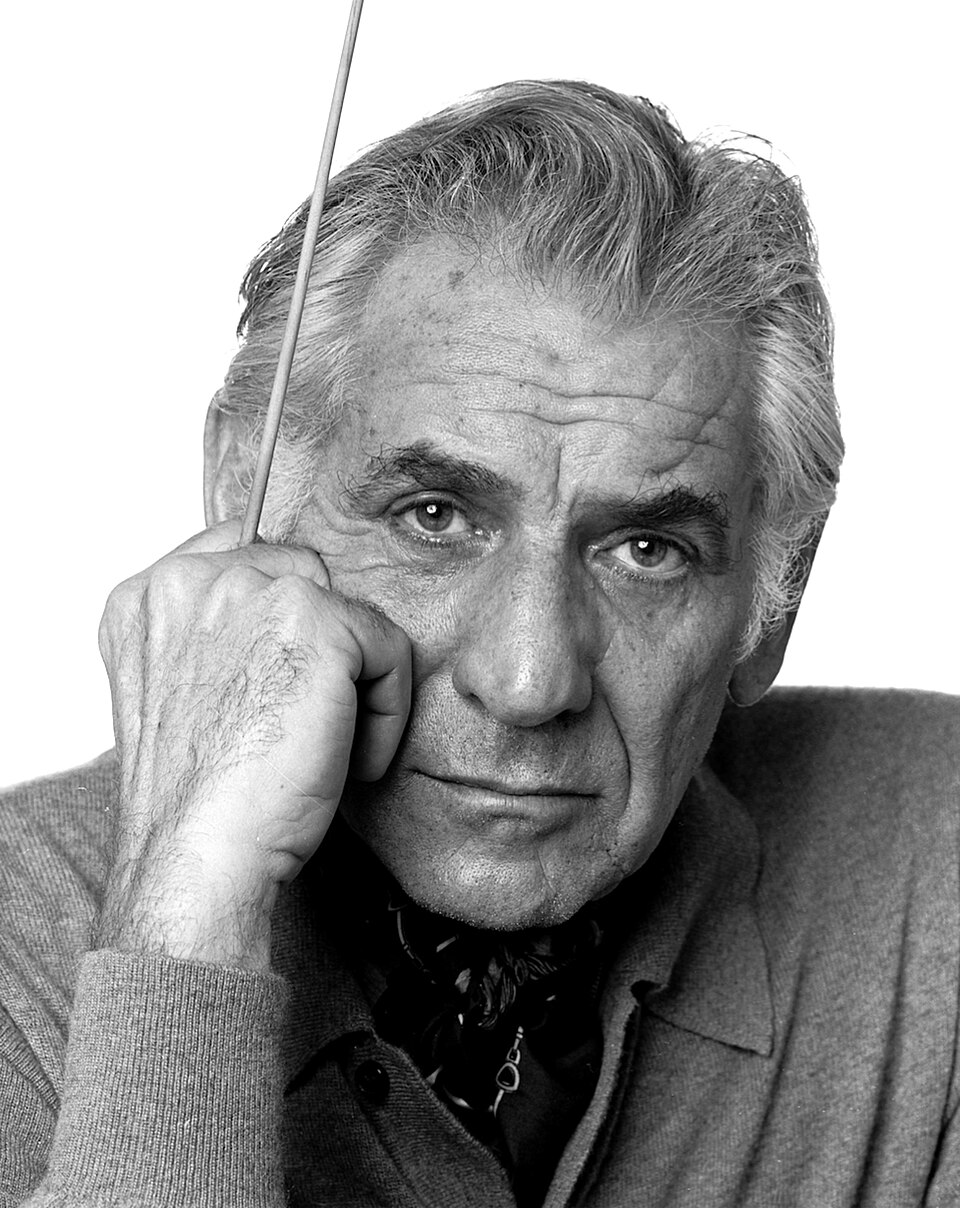
The American conductor and composer who made the concert hall, the Broadway stage, and the television studio equally his own — and became the most internationally celebrated American musician of his generation.
Leonard Bernstein refused the category boundaries that American musical life tried to impose. He conducted Mahler and Beethoven with the New York Philharmonic, wrote Broadway musicals, presented music to television audiences in a series that ran for fifteen years, composed a Mass for the opening of the Kennedy Center, and debated the nature of musical meaning in the Norton Lectures at Harvard — without accepting that any of these pursuits diminished the others.
Formation
Bernstein was born in 1918 in Lawrence, Massachusetts, to a family of Ukrainian Jewish immigrants. His father discouraged music as a profession; Bernstein studied at Harvard nonetheless, graduating in 1939, and then entered the Curtis Institute in Philadelphia to study conducting under Fritz Reiner. A critical figure in his formation was Serge Koussevitzky, conductor of the Boston Symphony Orchestra, who mentored him at the Tanglewood summer institute and whose influence shaped Bernstein's understanding of the conductor as interpretive personality rather than mere timekeeper.
The conducting breakthrough
In November 1943 Bernstein, then twenty-five and assistant conductor of the New York Philharmonic, stepped in at a day's notice for an ill Bruno Walter in a nationally broadcast concert. The performance — and the circumstances — made front-page news and established his reputation overnight. He was appointed music director of the New York Philharmonic in 1958, the first American-born musician to hold the post, and remained until 1969. Under his direction the orchestra toured internationally and the position became a platform for a new kind of public musicianship.
The Young People's Concerts for CBS, which he presented from 1958 to 1972, brought orchestral music to television audiences with an explanatory directness that assumed intelligence without condescension. They remain among the most effective examples of classical music communication on film.
Music can name the unnameable and communicate the unknowable.
Composition
Bernstein's compositional output moved between genres without hierarchy. Fancy Free (1944), a ballet choreographed by Jerome Robbins, led directly to the Broadway musical On the Town the same year. Wonderful Town (1953) and Candide (1956) followed. West Side Story (1957), with a book by Arthur Laurents and lyrics by Stephen Sondheim, is the work that has lasted most durably in the repertoire: its setting of the Romeo and Juliet story in New York gang rivalry produced a score whose fusion of jazz, Latin rhythms, and classical structure remained genuinely original. The Symphony No. 2 (The Age of Anxiety, 1949) and Symphony No. 3 (Kaddish, 1963) are among his major concert works.
He was also a writer — The Joy of Music (1959) and The Infinite Variety of Music (1966) collected his programme notes and essays — and a teacher who was genuinely concerned with how music meant what it meant.