Johann Sebastian Bach
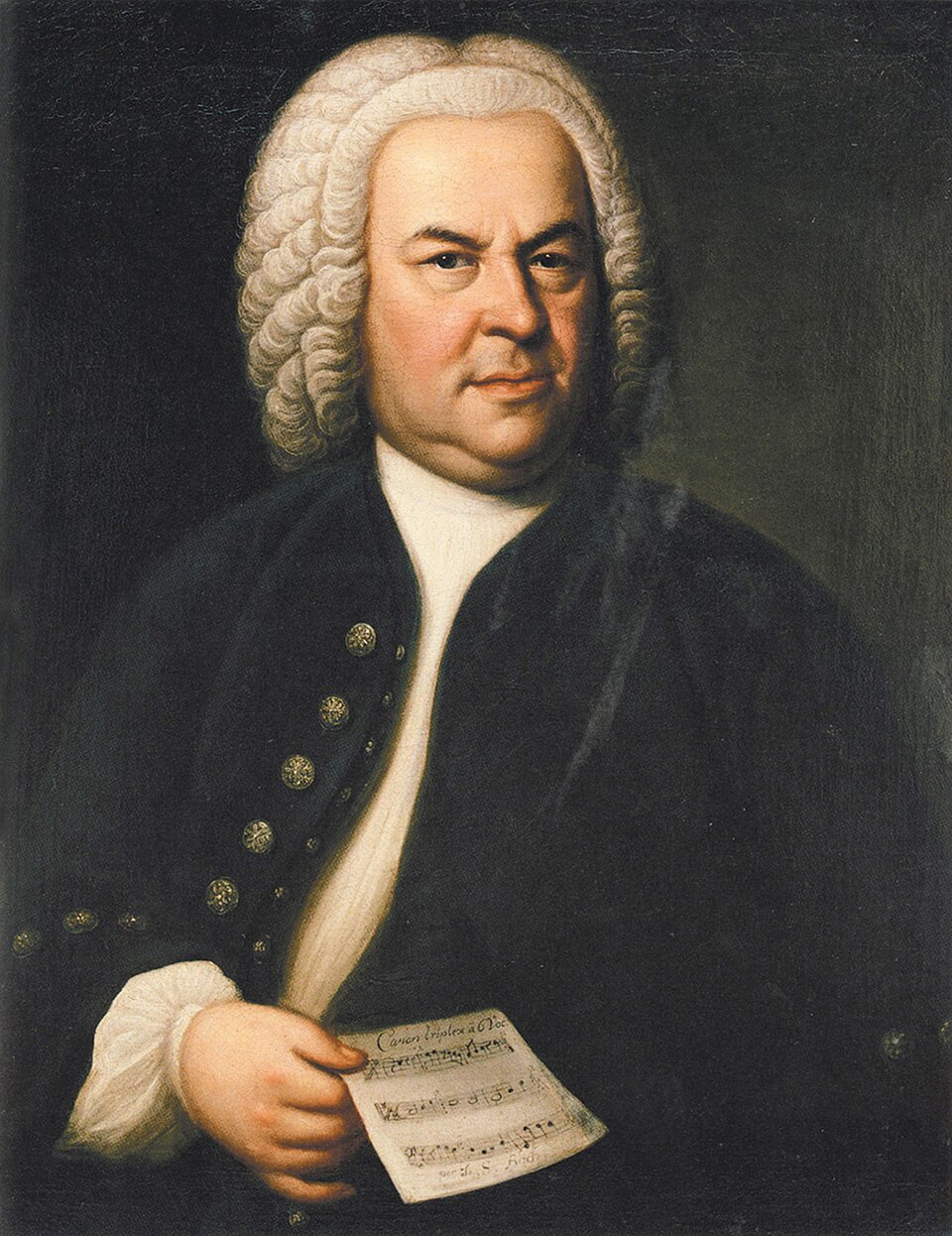
The late Baroque composer who brought counterpoint to its highest expression, producing a body of work so structurally complete that music has been measuring itself against it ever since.
Johann Sebastian Bach composed for the glory of God and the instruction of his neighbour — his own phrase — and produced music of such structural depth and expressive range that Felix Mendelssohn's revival of the St Matthew Passion in 1829, nearly eighty years after Bach's death, inaugurated a cult of genius that has never subsided. Every subsequent composer in the Western tradition has had to account for him.
Formation in Thuringia
Bach was born in Eisenach, Thuringia, in 1685, into a family so dense with professional musicians that "a Bach" was local shorthand for "a musician." He was orphaned at nine and raised by his eldest brother Johann Christoph, an organist in Ohrdruf, who gave him his initial keyboard training. He subsequently held court and church posts at Arnstadt, Mühlhausen, and Weimar — advancing rapidly and generating friction with employers who found his elaborations on the Lutheran chorale excessive.
His years at Köthen (1717–1723) under Prince Leopold, a Calvinist who required instrumental rather than sacred music, produced the Brandenburg Concertos (dedicated to Margrave Christian Ludwig of Brandenburg in 1721), the Cello Suites, and the first book of The Well-Tempered Clavier — a systematic demonstration that a keyboard tuned to equal temperament could produce satisfying music in all twenty-four keys.
Leipzig and the cantata cycle
In 1723 Bach was appointed Thomaskantor at the Thomasschule in Leipzig, a post he held until his death. The position required him to produce a new cantata for Sunday service weekly; he composed approximately three complete annual cycles — over two hundred cantatas surviving — in addition to the major Passion settings and the Mass in B minor. The scope of the Leipzig output is extraordinary: each cantata integrates a chorale text into a structure of recitatives, arias, and choruses, with the full weight of late-Baroque counterpoint applied to the expression of Lutheran theology.
The St Matthew Passion (BWV 244), first performed on Good Friday 1727, sets the Passion narrative in two alternating choirs with orchestra, producing a drama of such architectural scale and emotional directness that it stands as the largest single work in the choral repertoire.
Soli Deo Gloria.
Counterpoint as method
Bach's technical command of counterpoint — the simultaneous development of independent melodic lines that harmonise with each other — has no equal in Western music. The Art of Fugue (BWV 1080), left incomplete at his death, is a systematic exploration of fugal technique applied to a single subject, demonstrating every known contrapuntal device. The Musical Offering (BWV 1079), written for Frederick the Great of Prussia in 1747 based on a theme the King provided, adds ricercars and canons to the same programme of systematic exposition.
The Goldberg Variations (BWV 988) — thirty variations on a bass line, written for harpsichord — demonstrate a different kind of control: the capacity to generate a large-scale structure of immense variety from a single generating idea.
Reception and legacy
Bach was not unknown in his own time — he was celebrated as an organist and teacher — but his own music was considered old-fashioned, too learned, insufficiently melodic by the galant standards of mid-eighteenth-century taste. Mendelssohn's revival of the St Matthew Passion in Berlin in 1829 initiated the Bach Revival that has not since faltered. Every major tradition in Western music — Romantic, Impressionist, neo-Classical, Serial, jazz — has positioned itself in relation to his polyphonic thought.