Louis Armstrong
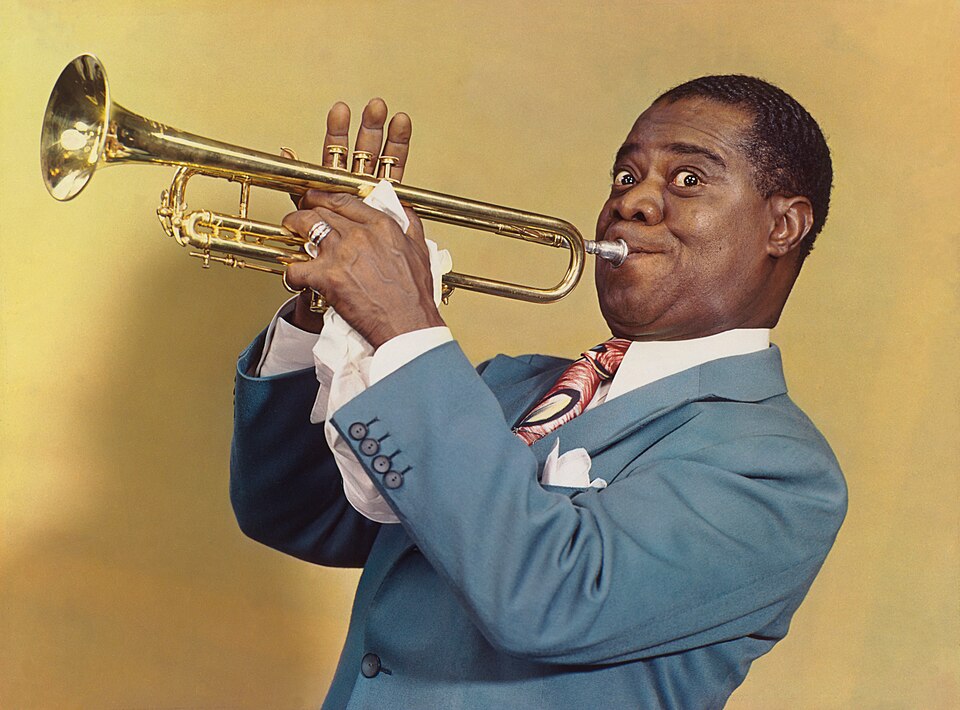
The New Orleans trumpeter who didn't merely play jazz — he invented the vocabulary every soloist after him would speak.
Louis Armstrong remade what a jazz musician could be: a singular voice, an improvisor of breathtaking authority, and a performer capable of reaching audiences that had never heard a jazz record. His five-decade career ran from the rough brothels and funeral parades of New Orleans through the hot small-group recordings of the 1920s, the big-band era, and the international television age — and at every turn he was recognisably himself, the most imitated brass player in the history of popular music.
Early life
Armstrong was born on 4 August 1901 in New Orleans into poverty; his father left the family when Louis was an infant, and he was raised largely by his grandmother and mother. He earned small change singing on street corners and grew up absorbing the city's extraordinary musical culture — brass bands, ragtime, blues, and the improvised forms that would consolidate into jazz.
At thirteen, after firing a pistol in the street during a New Year's Eve celebration, he was sent to the New Orleans Colored Waif's Home for Boys, a reformatory that turned out to be transformative. The home's music teacher, Peter Davis, taught him cornet, and Armstrong proved so gifted that he was made leader of the institution's band. Released after eighteen months, he sought out the reigning king of New Orleans cornet, Joe "King" Oliver, who took the teenager under his wing and became the closest thing to a musical father Armstrong would have.
By his late teens Armstrong was working the riverboats that travelled up and down the Mississippi, playing to passengers and absorbing influences from across the region. In 1922, Oliver — now based in Chicago — called him north to join his Creole Jazz Band.
The Hot Fives and Sevens
Chicago gave Armstrong the studio. Between 1925 and 1928, working for OKeh Records under his own name, he recorded two series of small-group sides — the Hot Five and Hot Seven sessions — that transformed the course of jazz. The personnel were largely New Orleans veterans, but what Armstrong did within these recordings was new: long, arching melodic improvisations built on harmonic logic rather than mere decoration of the tune, a rhythmic conception that replaced the stiff two-beat feel of early jazz with something closer to swing, and a tone of brilliant, almost orchestral power.
Tracks such as "Cornet Chop Suey" (1926), "Potato Head Blues" (1927), and "West End Blues" (1928) — the last opening with an unaccompanied cadenza of unforgettable authority — established that the jazz soloist could be the primary creative force in a performance. Every subsequent jazz improviser, on every instrument, worked in the space Armstrong opened.
His singing, developed across the same period, was equally influential. His use of scat — wordless vocalising that treated the voice as an instrument — and his rhythmically free, deeply personal approach to phrasing created a template that shaped popular vocal performance for decades.
Ambassador Satch
By the 1930s Armstrong had moved from small groups to leading his own big band, and his fame had become genuinely international. He toured Europe repeatedly, made films in Hollywood, and became one of the most recognisable entertainers in the world. The repertoire broadened: he recorded popular songs alongside jazz standards, and his genial stage manner made him a crossover figure at a time when that crossing was commercially and culturally significant.
In 1956 the State Department sponsored his international tours, and newspapers dubbed him "Ambassador Satch" — a title that acknowledged both his global reach and the complicated position of a Black American artist representing a country whose racial politics he had, at times, criticised sharply. His 1957 denunciation of President Eisenhower's handling of the Little Rock school desegregation crisis, delivered publicly and at personal professional risk, was among the most forthright statements made by any American entertainer during the civil rights era.
In 1964 his recording of "Hello, Dolly!" knocked the Beatles from the top of the Billboard chart and earned him the Grammy Award for Best Male Vocal Performance the following year. In 1967, recording with producer Bob Thiele, he cut "What a Wonderful World" — a song that became, in time, one of the most played recordings in the history of popular music.
His playing spoke without explanation — every phrase landed with the weight of something already decided, already true.
Legacy
Armstrong's technical innovations — in improvisation, swing feel, trumpet range, and scat singing — are so thoroughly absorbed into jazz that they are now simply the language of the form. He is the reason the jazz soloist is understood as a creative voice rather than a section player; the reason jazz phrasing swings rather than marches; the reason a brass player might attempt the extreme upper register as a matter of expressive choice rather than exhibitionism.
He was inducted into the Rock and Roll Hall of Fame (as an early influence, 1990), the DownBeat Jazz Hall of Fame, and the National Rhythm & Blues Hall of Fame. A posthumous Grammy Lifetime Achievement Award followed in 1972. The Louis Armstrong House Museum in Corona, Queens — the home he shared with his fourth wife Lucille for nearly thirty years — is now a National Historic Landmark.
His influence on performers is beyond catalogue. Miles Davis, Dizzy Gillespie, Clifford Brown, and virtually every subsequent jazz trumpeter acknowledged the foundational debt; but so did singers from Billie Holiday to Bing Crosby to Ella Fitzgerald, who each absorbed something of his rhythmic and emotional intelligence.