Hector Berlioz
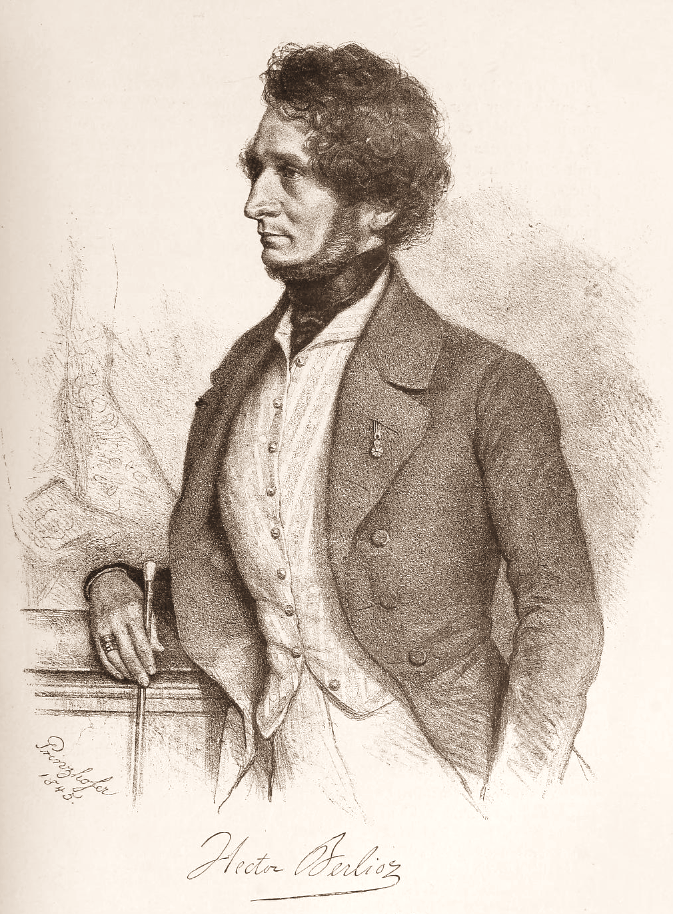
The French Romantic who pushed the orchestra to its outer limits, invented the programme symphony, and wrote memoirs as vivid as his music.
Hector Berlioz arrived at the Paris Conservatoire already a formed temperament: he had taught himself music from treatises, absorbed the shock of Gluck, Shakespeare, and Beethoven before his formal training began, and carried convictions about dramatic and orchestral expression that the Conservatoire's pedagogical methods could not dislodge. The Symphonie fantastique — his first symphony, composed at twenty-six — is the most radical orchestral piece of the first half of the nineteenth century, and the shock it administered has not entirely dissipated.
Origins and formation
Berlioz was born in 1803 in La Côte-Saint-André, a small town in the Isère department of France, the son of a physician who gave him a basic musical education but did not encourage a professional career. He was sent to Paris to study medicine and enrolled at the Paris Conservatoire to study composition in parallel. His encounters with Gluck's operas, Beethoven's symphonies, and Shakespeare's plays — read in translation — were the decisive formative experiences: he absorbed all three as models of expressive possibility at exactly the age when such encounters are most productive.
He won the Prix de Rome in 1830, the same year the Symphonie fantastique premiered.
The Symphonie fantastique and programme music
The Symphonie fantastique (1830) is a five-movement work with a detailed programme — an autobiographical fantasy about an artist's obsession — and a single recurring melody, the idée fixe, that appears in each movement in transformed guise. The device of the recurring theme was not new; its programmatic systematisation was. Berlioz circulated the programme with the score, making explicit that the music was narrating a specific sequence of events. The work's orchestration — its precision of colour, its extremity of dynamic range, its invention of effects no previous symphony had employed — was without precedent.
Harold in Italy (1834), written for Paganini at his commission though Paganini never performed it, adds a solo viola representing a Byronic wanderer, again with a programme from literature. Roméo et Juliette (1839), a "dramatic symphony" for soloists, chorus, and orchestra, elaborates the programmatic idea further into something that is simultaneously symphony, cantata, and operatic abstraction.
The art of music is the art of expressing the inexpressible.
Orchestration and the treatise
Berlioz's Grand traité d'instrumentation et d'orchestration modernes (1844) was the first serious technical treatise on orchestration — a systematic account of every orchestral instrument's range, character, and combinatorial possibilities. Richard Strauss later revised and expanded it. As a practical document it remained in use through the twentieth century. Its theoretical basis — that orchestration is inseparable from composition, not a garment applied to a pre-existing harmonic structure — influenced every subsequent composer who encountered it.
Legacy
Berlioz's influence on the orchestra is structural: the forces required for his major works — his Requiem calls for four brass bands placed at the corners of the performance space — expanded what orchestral music could ask for and be heard to do. His treatise shaped generations of composers in their approach to instrumental colour. Wagner, who conducted the Symphonie fantastique in Dresden, absorbed its lessons in orchestral texture. His Memoirs, published posthumously, are among the most vivid accounts of musical life in the Romantic era.