Béla Tarr
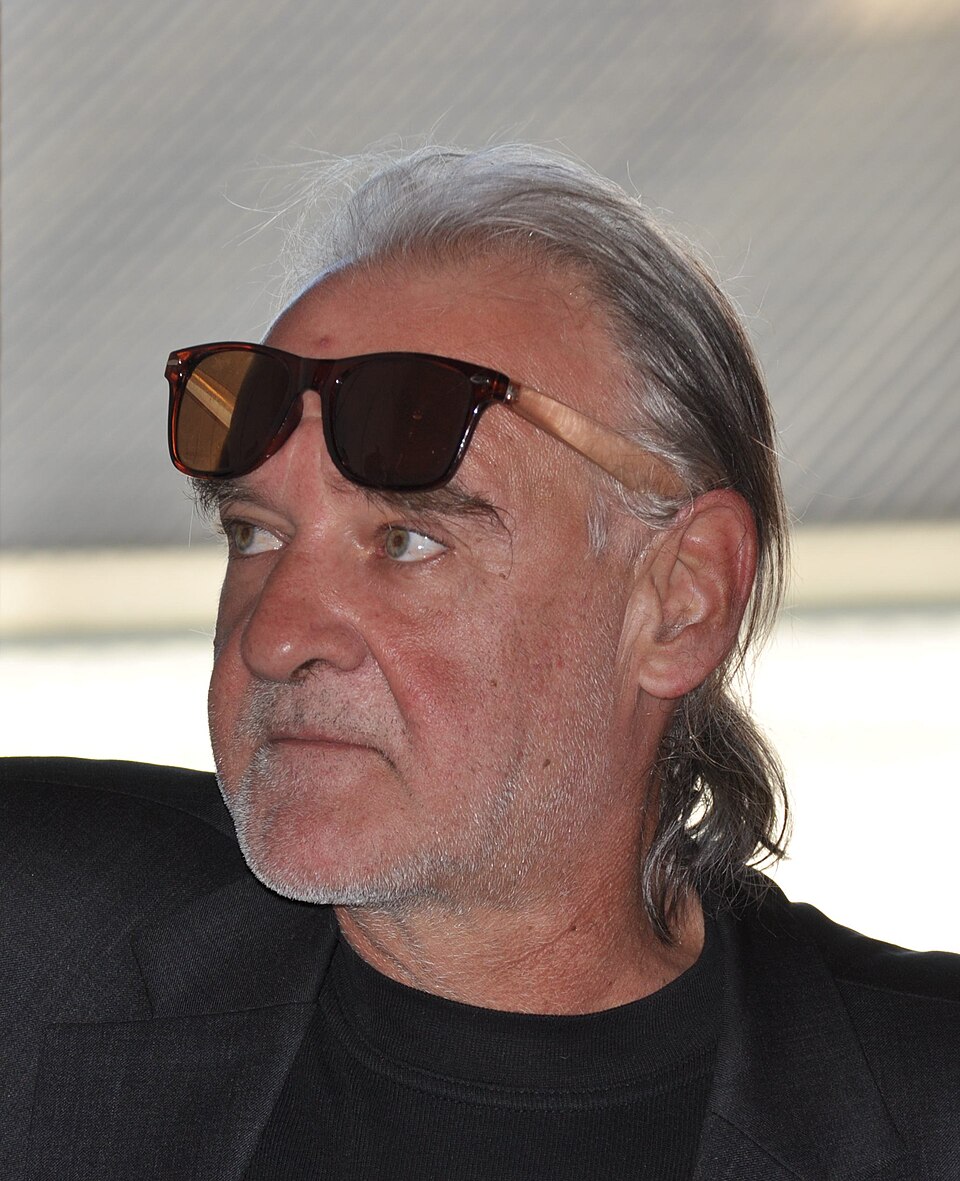
The Hungarian filmmaker who turned duration into subject matter — building slow, stark black-and-white worlds where waiting itself becomes meaning.
Béla Tarr made films in which nothing happens quickly and everything matters. His black-and-white images — rain-soaked Hungarian plains, dilapidated interiors, figures walking against wind — unfold in takes that stretch minutes at a time, refusing the consolations of plot and insisting instead on raw duration as the medium through which despair and solidarity are felt.
Origins and early social realism
Tarr was born in Pécs in 1955 and began making films in his early twenties, initially working in a direct, social-realist mode that drew on the lives of ordinary Hungarians. His first feature Family Nest (1977) was shot in documentary style with non-professional actors, depicting working-class life in Budapest with unflinching proximity. These early works were politically charged products of the late socialist period, concerned with poverty, alcoholism, and institutional indifference.
The shift from this early naturalism toward the hypnotic long-take style of his mature work was gradual but decisive. Influences from Andrei Tarkovsky and the Straub-Huillet tradition of durational cinema reshaped his approach through the 1980s.
Sátántangó and the long take
Sátántangó (1994), adapted from László Krasznahorkai's novel, is the work that secured Tarr's international reputation and his place in the canon of slow cinema. At approximately seven hours and fifteen minutes, the film depicts the collapse of a collective farm whose inhabitants are manipulated by the return of a charismatic con man. Shot over years on authentic Hungarian locations, its sequences of muddy roads, persistent rain, and exhausted faces unfold without cuts or theatrical lighting. The film appears regularly in scholarly polls of the greatest films ever made.
Krasznahorkai's novels were a continuous collaborating force in Tarr's later career. Werckmeister Harmonies (2000), also adapted from Krasznahorkai, distilled the approach further: a small town confronted by a mysterious whale and a wave of violence, narrated through fewer than forty shots.
I don't think in terms of story. I think in terms of time.
Method and visual grammar
Tarr's method was defined by extreme preparation and extreme patience on set. Long takes were choreographed with the precision of dance — the camera, actors, and lighting moving in coordinated sequences that could run ten minutes without interruption. Editing in the conventional sense was largely abolished; transitions were made through movement within the frame rather than cuts between frames.
The black-and-white palette was not nostalgic but functional: it stripped images to their structural essentials, removing colour's emotional shorthand and forcing the viewer into an alertness to texture, light, and shadow. His cameraman Gábor Medvigy and later Fred Kelemen were essential partners in this.
Legacy
The Turin Horse (2011), which Tarr declared his final film, won the Grand Jury Prize at the Berlin Film Festival. It depicts a horse-cart driver and his daughter over six days at the end of the world — a meditation on extinction rendered in thirty shots. By ending his filmmaking career at the point where image-making itself seemed inadequate, Tarr remained consistent with his own premise: that cinema is not a tool for storytelling but for confronting what cannot be said.
His influence on slow cinema — on directors such as Lav Diaz, Carlos Reygadas, and Gus Van Sant — is extensive and acknowledged. He spent his later years teaching at the Sarajevo Film Academy.