Benoit Mandelbrot
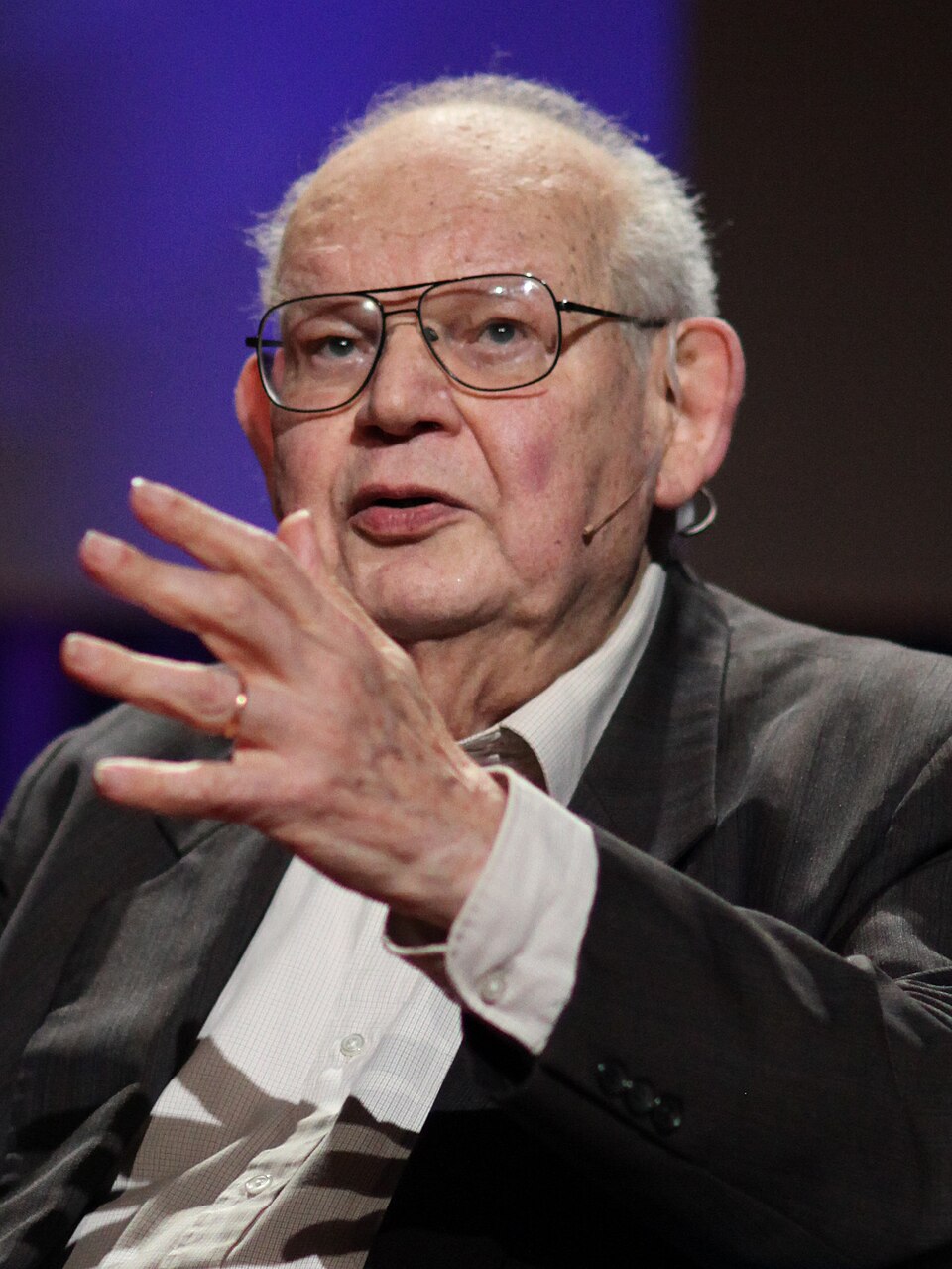
The Polish-born mathematician who showed that roughness has geometry — and gave the 20th century its most recognisable mathematical image.
Benoit Mandelbrot spent his career outside the mathematical mainstream, moving between IBM Research, academic posts, and problems other scientists considered too irregular or messy to study. What he found in those problems — coastlines, stock prices, turbulence, noise in telephone networks — was a hidden order of self-similarity: the same patterns repeating across scales. He called these structures fractals, coined the word in 1975, and spent the rest of his life arguing that roughness is the rule of nature, not the exception.
Origins and formation
Mandelbrot was born on 20 November 1924 in Warsaw, Poland, into a Lithuanian Jewish family with strong intellectual traditions. In 1936 the family moved to Paris; when the Nazis occupied France, they moved to Tulle in the Corrèze and survived the war in hiding. He studied at the École Polytechnique and received his doctorate from the University of Paris in 1952.
He joined IBM Research in Yorktown Heights, New York, in 1958 and remained there for thirty-five years, eventually as an IBM Fellow. The research environment suited him: IBM gave him computing resources and the freedom to pursue problems wherever they led, without the institutional pressure to work within a recognised discipline. He was simultaneously affiliated with Harvard, Yale, and the Albert Einstein College of Medicine at various points.
Fractal geometry
Mandelbrot's key insight was that many natural and economic phenomena exhibit self-similarity: they look the same at every scale of magnification. Coastlines are jagged whether measured in kilometres or metres. The branching of trees repeats at every level. Price movements in commodity markets look the same whether plotted by the minute or by the decade.
He published Les Objets fractals in 1975 — coining the word "fractal" from the Latin fractus (broken, irregular) — and expanded it into The Fractal Geometry of Nature (1982), the book that brought fractal geometry to both a scientific and a general audience. He showed that the dimension of a fractal object is not necessarily a whole number: a coastline might have a fractal dimension of 1.25, somewhere between a line and a plane.
The Mandelbrot set — the set of complex numbers for which the iteration z → z² + c remains bounded — was explored computationally by Mandelbrot in 1979–80 and became one of the most widely reproduced mathematical images in history. Its boundary exhibits fractal structure at every level of magnification.
Applications
Mandelbrot's methods found application across fields. His analysis of cotton price fluctuations in the early 1960s showed that price changes follow a distribution with much heavier tails than the normal distribution — a finding that financial economists largely ignored until the 1987 crash and the 2008 financial crisis revived the question. His work on noise in telephone networks (the Hurst exponent, long-range dependence) influenced information theory and signal processing. Fractal antenna designs are now used in mobile phones.
Clouds are not spheres, mountains are not cones, coastlines are not circles, and bark is not smooth, nor does lightning travel in a straight line.
Legacy
Mandelbrot received the Wolf Prize in Physics in 1993. He joined Yale as Sterling Professor of Mathematical Sciences in 1999. He continued publishing and lecturing until his death from pancreatic cancer on 14 October 2010, in Cambridge, Massachusetts. His 2004 memoir, The Fractalist, described a career spent deliberately outside conventional categories — which he considered its chief advantage.