Bernhard Riemann
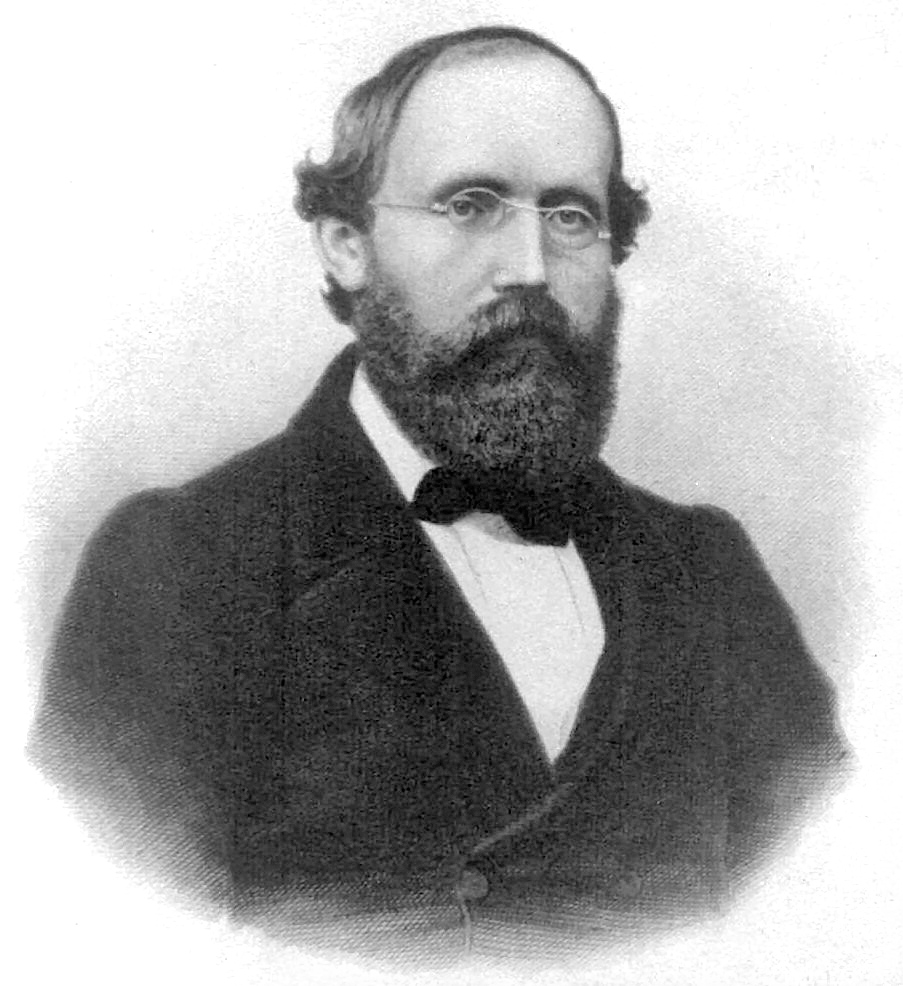
The German mathematician who in forty years of short life redrew the geometry of curved space and left behind the most important unsolved problem in mathematics.
Bernhard Riemann died of tuberculosis at thirty-nine, but in that short life he transformed analysis, number theory, and geometry in ways that took the mathematical community decades to absorb. His 1854 habilitation lecture invented the concept of a manifold and the geometry of curved space; his 1859 paper on prime numbers stated the hypothesis that bears his name and remains unproved; and his integral, his surfaces, and his zeta function are standard vocabulary in every university mathematics curriculum.
Origins and education
Riemann was born on 17 September 1826 in Jameln, a village in the Kingdom of Hanover. His father was a Lutheran minister; the family was poor and Riemann's health was always fragile. He studied theology briefly at Göttingen before his mathematical ability became evident and he transferred to mathematics, studying under Gauss and later under Dirichlet in Berlin. He returned to Göttingen for his doctoral thesis and habilitation.
Gauss — then in his seventies and rarely impressed — was moved by Riemann's 1851 doctoral thesis on the foundations of complex analysis, which introduced what are now called Riemann surfaces: two-dimensional manifolds on which complex functions can be studied geometrically. Gauss described it as bearing the mark of a "creative, active, truly mathematical mind."
The habilitation lecture and Riemannian geometry
The qualification lecture Riemann gave in 1854 — "Über die Hypothesen, welche der Geometrie zu Grunde liegen" ("On the Hypotheses which lie at the Bases of Geometry") — is one of the most consequential texts in the history of mathematics. Riemann generalised the notion of geometry from flat Euclidean space to arbitrary n-dimensional manifolds equipped with a metric — a rule for measuring distances that can vary from point to point. He showed that the intrinsic curvature of such spaces (building on Gauss's work on surfaces) can take any value and need not be zero.
This framework, now called Riemannian geometry, supplied the mathematical language Einstein needed sixty years later for general relativity. The curved spacetime of Einstein's field equations is a four-dimensional Riemannian (actually pseudo-Riemannian) manifold.
The Riemann hypothesis
In 1859 Riemann published a single paper on the distribution of prime numbers: "Über die Anzahl der Primzahlen unter einer gegebenen Grösse." In it he introduced the Riemann zeta function as a complex-variable function and stated that all non-trivial zeros of the function appear to lie on the line with real part 1/2. This conjecture — the Riemann hypothesis — has never been proved or disproved. It is one of the Millennium Prize Problems and remains the most celebrated open question in mathematics.
Legacy
Riemann also gave the first rigorous formulation of the Riemann integral, made contributions to Fourier analysis, and developed the theory of Riemann surfaces that underlies complex analysis and algebraic geometry. He died of tuberculosis in Selasca, Italy, on 20 July 1866, aged thirty-nine. His housekeeper reportedly burned most of his unpublished manuscripts after his death.
The question of the validity of the hypotheses of geometry in the infinitely small is bound up with the question of the ground of the metric relations of space.