Billy Wilder
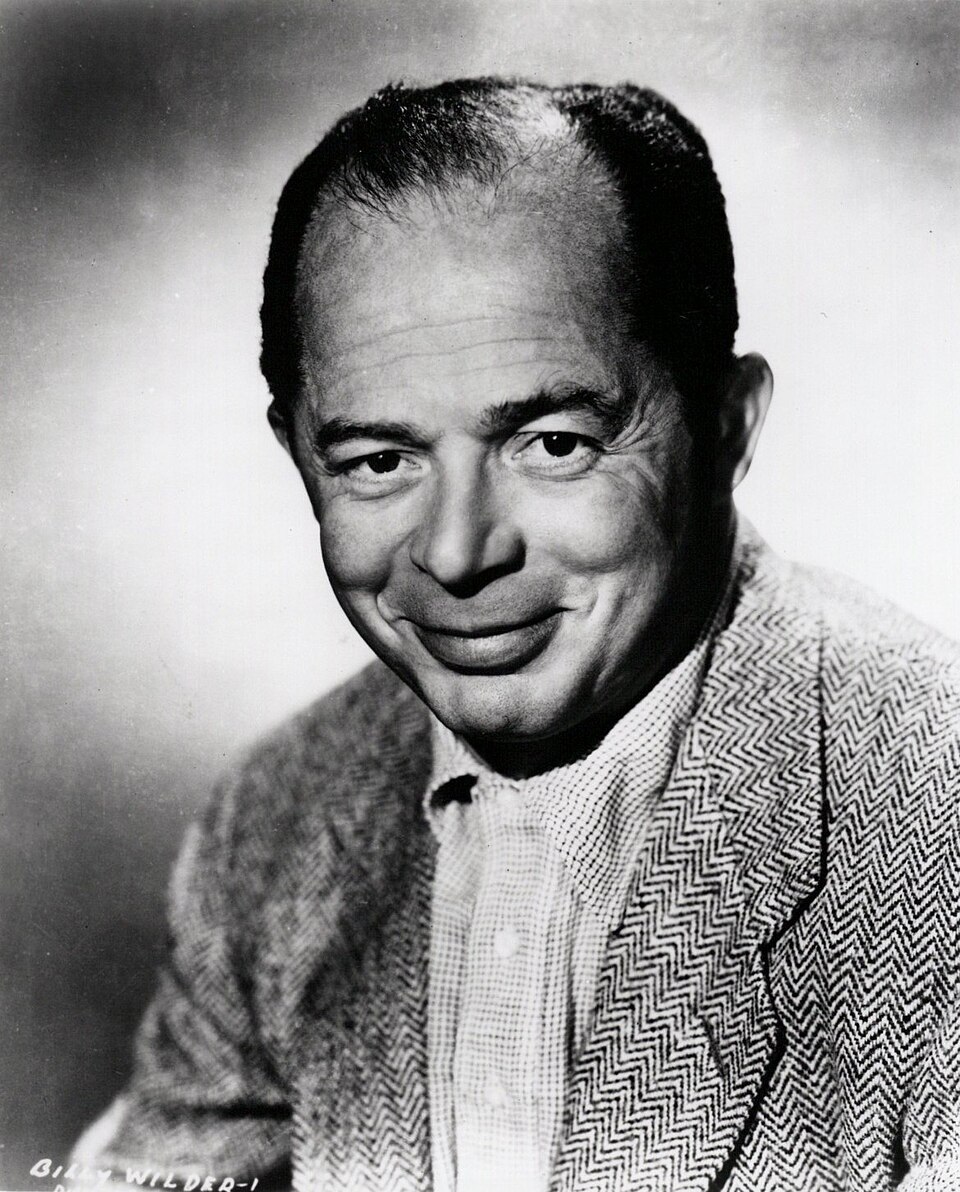
The Austrian émigré who rewrote Hollywood's moral grammar, turning cynicism and wit into a body of work that claimed two Best Picture Oscars and permanent residency in the American canon.
Billy Wilder arrived in Hollywood in 1934 with a suitcase, a limited command of English, and a story sense forged in Weimar Berlin. Over the next five decades he directed comedies that cut, thrillers that unnerved, and dramas that refused consolation — earning seven Academy Awards and the permanent reputation of a filmmaker who trusted his audience to keep up.
From Vienna to Weimar to Hollywood
Wilder was born Samuel Wilder on 22 June 1906 in Sucha, a small town in Galicia then part of Austria-Hungary, now Poland. His family moved to Vienna, where he acquired the nickname "Billie" after his mother's admiration for Buffalo Bill. He drifted into journalism in Vienna and then Berlin, working as a reporter and dance-hall companion before breaking into the German film industry as a screenwriter in the late 1920s.
When the National Socialists came to power in January 1933, Wilder left Germany immediately. He spent months in Paris — directing his first feature, Menschen am Sonntag having already been co-directed in 1930 — before securing passage to the United States. He arrived in Hollywood in 1934. His mother, stepfather, and grandmother, who remained in Europe, were murdered in the Holocaust.
The screenwriter who became a director
Wilder's earliest Hollywood years were spent writing, often in collaboration with Charles Brackett. The partnership produced scripts for Ernst Lubitsch, among others, and by 1942 Wilder had moved into directing his own material. Double Indemnity (1944), co-written with Raymond Chandler from James M. Cain's novel, established the film noir template and was nominated for seven Academy Awards.
The Lost Weekend (1945) — a portrait of alcoholism adapted from Charles R. Jackson's novel — won Best Picture and Best Director at the Academy Awards, and the Palme d'Or at Cannes. The same year it was initially suppressed: the liquor industry offered Paramount a reported four million dollars to shelve it. The studio declined.
Sunset Boulevard (1950), written again with Brackett, remains the sharpest autopsy of Hollywood mythology ever filmed. Norma Desmond became the archetype of faded grandeur, and the film's opening — a dead man narrating his own murder — announced that Wilder would not be tidying his endings.
Comedy as a serious instrument
Wilder's comedies are structurally intricate and tonally unstable in ways that make them difficult to replicate. Some Like It Hot (1959), with Jack Lemmon and Tony Curtis fleeing the mob in women's clothing, regularly appears on lists of the greatest American comedies; its final line — "Nobody's perfect" — is among the most quoted in cinema. The Apartment (1960) won Best Picture, Best Director, and Best Original Screenplay, making Wilder one of a small number of filmmakers to win Best Picture twice. The film, in which a corporate climber lends his apartment to executives conducting affairs, is a comedy of moral exhaustion that ends with something resembling grace.
His collaborations with I.A.L. Diamond, which began with Love in the Afternoon (1957) and continued through Buddy Buddy (1981), produced the late phase of his career — including The Apartment, Irma la Douce (1963), and The Fortune Cookie (1966). Diamond and Wilder wrote in adjacent offices, passing pages between rooms.
Method and temperament
Wilder prepared scripts with exceptional thoroughness before allowing cameras to roll. He was known for exacting standards on set and for a directorial persona that combined Old World precision with a sardonic American vernacular. He collected modern art obsessively — a collection that eventually included works by Picasso, Miró, and Egon Schiele — and considered the painter's discipline analogous to the screenwriter's.
His recurring collaborators included cinematographer Joseph LaShelle and actors Jack Lemmon, who appeared in seven Wilder films, and Walter Matthau. Lemmon called the collaboration the most important of his career.
If you have a problem with the third act, the real problem is in the first act.