Bob Dylan
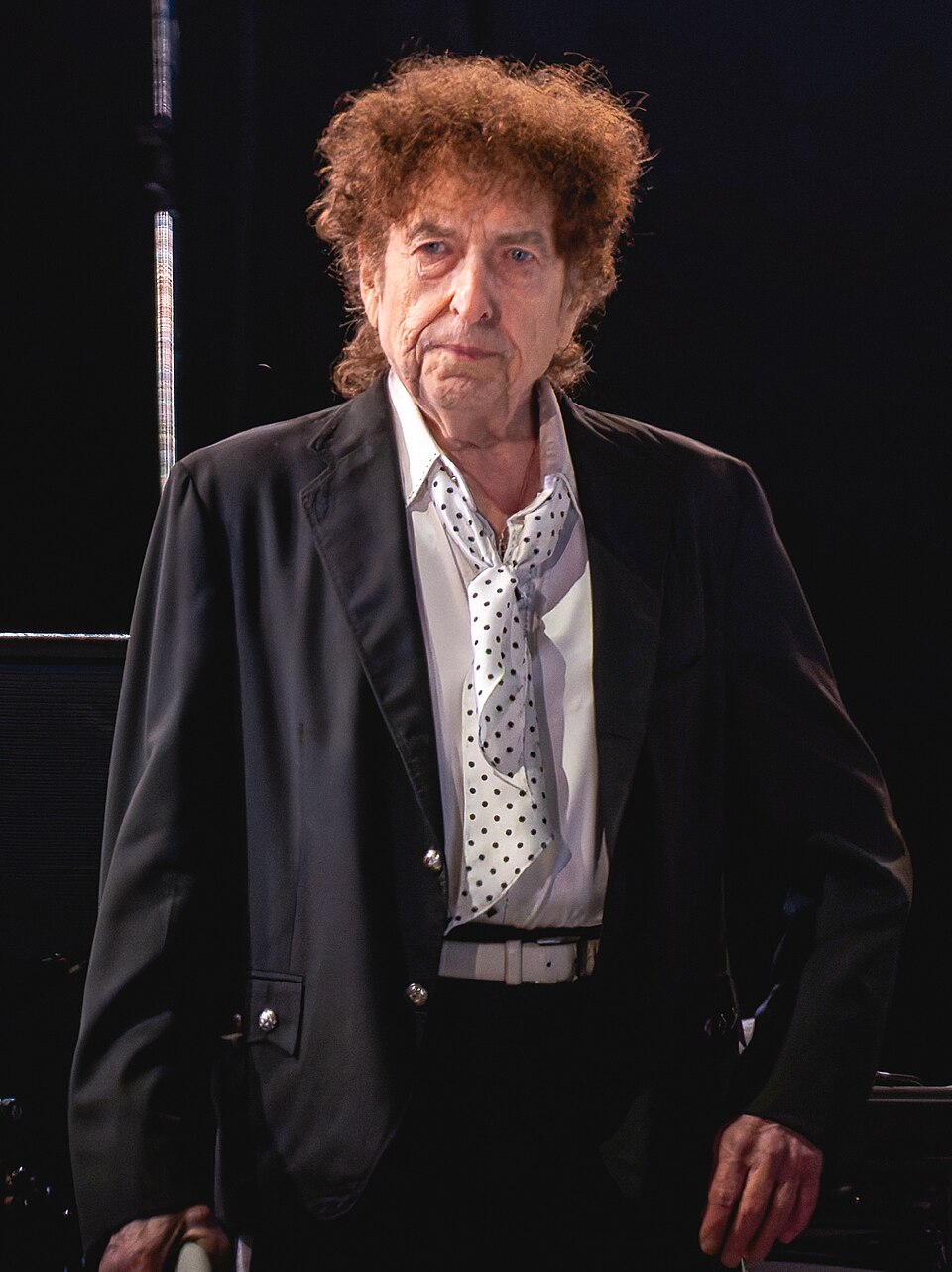
The songwriter who rewired folk music with the voltage of poetry and made the personal political without ever quite being reducible to either.
Bob Dylan is an American singer-songwriter whose six-decade career transformed folk music, rock, and the very idea of what a popular song could carry. Born Robert Allen Zimmerman in Duluth, Minnesota, he arrived in New York in 1961 and within two years had become both the voice of a protest generation and a writer working at a density of allusion and imagery that folk music had not previously attempted. He has remained, through repeated reinvention, one of the most consequential figures in popular culture — and, in 2016, the first songwriter to receive the Nobel Prize in Literature.
Duluth to Greenwich Village
Dylan grew up in Hibbing, Minnesota, a mining town on the Iron Range, where he taught himself guitar and harmonica and immersed himself in early rock and roll and the recordings of Hank Williams and Woody Guthrie. He enrolled briefly at the University of Minnesota before dropping out and making his way to New York City in January 1961, arriving in Greenwich Village and introducing himself to the ailing Guthrie in hospital — a gesture of homage and ambition in equal measure. He was signed to Columbia Records by producer John Hammond later that year. His debut album, released in 1962, drew on traditional folk and blues material; his second, The Freewheelin' Bob Dylan (1963), contained almost entirely original compositions and announced a writer of extraordinary range.
Protest, Poetry, and Electric Revelation
"Blowin' in the Wind" and "The Times They Are a-Changin'" made Dylan the de facto poet laureate of the civil rights and anti-war movements, yet he chafed at the role. By 1965 his writing had shifted register entirely, reaching into surrealist imagery, Beat-influenced wordplay, and sustained narrative aggression. Bringing It All Back Home introduced electric rock instrumentation; Highway 61 Revisited (1965) — with its opening track "Like a Rolling Stone", often cited as one of the greatest rock songs ever recorded — confirmed the transformation. At the Newport Folk Festival in July 1965, Dylan performed an electric set with a full band, provoking boos from part of the audience: an episode still debated as a rupture between folk orthodoxy and commercial rock, or simply as an artist refusing to be owned by any movement.1
Blonde on Blonde (1966), recorded partly in Nashville, was the first widely acknowledged double album in rock and remains a touchstone of the period. Shortly after its release Dylan was involved in a motorcycle accident in Woodstock, New York; he withdrew from public performance for eighteen months, a period during which he recorded the informal sessions later released as The Basement Tapes.
The Long Middle: Renewal and Range
Dylan's subsequent career has been characterised by refusal to consolidate. He moved through country (Nashville Skyline, 1969), evangelical Christianity (Slow Train Coming, 1979), and a return to secular complexity that produced Blood on the Tracks (1975) — a cycle of songs about fractured intimacy that many regard as his finest sustained work — and Oh Mercy (1989), produced by Daniel Lanois. His "Never Ending Tour," begun in 1988, has made him one of the most consistently performing artists in popular music, playing hundreds of shows a year well into his eighties. He has also maintained a parallel career as a visual artist, exhibiting paintings, drawings, and iron-welded sculptures internationally.
| Album | Year | Notes |
|---|---|---|
| The Freewheelin' Bob Dylan | 1963 | First major original compositions |
| Highway 61 Revisited | 1965 | "Like a Rolling Stone"; electric era |
| Blonde on Blonde | 1966 | First major double album in rock |
| Blood on the Tracks | 1975 | Widely regarded as a late masterwork |
| Oh Mercy | 1989 | Produced by Daniel Lanois |
Nobel Prize and Continuing Presence
In October 2016 the Swedish Academy awarded Dylan the Nobel Prize in Literature, citing "the creation of new poetic expressions within the great American song tradition." The decision was celebrated by many and contested by others who questioned whether song lyrics constituted literature; Dylan's own response — weeks of silence before acceptance — was characteristically oblique. He did not attend the Stockholm ceremony but delivered a Nobel lecture, read on his behalf, that ranged across Homer, Moby-Dick, and the folk tradition, and was itself received as a significant piece of prose.2
I define nothing. Not beauty, not patriotism. I take each thing as it is, without prior rules about what it should be.