Buckminster Fuller
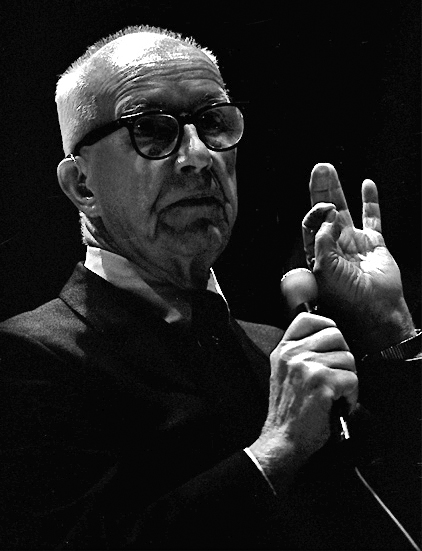
The architect who tried to do more with less until the whole planet could afford to live well.
Richard Buckminster Fuller Jr. was an American architect, systems theorist, writer, designer, inventor, philosopher, and futurist. He styled his name as R. Buckminster Fuller in his writings, publishing more than 30 books and coining or popularizing such terms as "Spaceship Earth," "Dymaxion," "ephemeralization," "synergetics," and "tensegrity."
Early Life and Crisis
Born on 12 July 1895 in Milton, Massachusetts, Fuller came from a family with a strong tradition of independent thought. He enrolled at Harvard College but was expelled twice — once for irresponsibility and once after reinstating, before leaving permanently without a degree. These failures did not discourage him so much as redirect him.
The defining rupture came in the mid-1920s. After a series of business failures and the death of his daughter, Fuller reached a personal crisis that he later described as a moment of suicidal contemplation near Lake Michigan. He resolved instead to dedicate his life to an experiment: could one individual, operating without capital or credentials, make a meaningful difference to humanity as a whole? The rest of his career was his answer.
Systems Thinking and the Dymaxion Concept
Fuller's working method was inseparable from his philosophy. He coined the word "ephemeralization" to describe the principle of doing more and more with less and less — a trajectory he believed technology was already following and that, if consciously directed, could eliminate material scarcity. The word "Dymaxion," assembled from "dynamic," "maximum," and "tension," became his brand for designs governed by this principle.
The Dymaxion house (1929) was a prefabricated, hexagonal dwelling suspended from a central mast, designed to be mass-produced and air-delivered anywhere on Earth. The Dymaxion car (1933) was a three-wheeled, rear-engine vehicle capable of sharp turns at low speeds; three prototypes were built. Neither reached production, but both demonstrated Fuller's conviction that design should serve all of humanity rather than existing markets.
The Geodesic Dome
The work for which Fuller is best remembered is the geodesic dome — a structure composed of a network of triangles that approximate a sphere. The geometry distributes stress so evenly that the structure requires no internal supports, and its strength-to-weight ratio increases as the dome scales up. Fuller received a US patent for the geodesic dome in 1954.
The dome was adopted rapidly by the US military for lightweight radar installations and by industry for large clear-span enclosures. Fuller's dome for the 1967 Montreal Expo remains one of the most visited examples. By his death in 1983 an estimated 300,000 geodesic structures had been built worldwide. The geodesic form also inspired the 1985 discovery of the carbon molecule buckminsterfullerene (C₆₀), named in his honour.
World Game and Legacy
Fuller developed the concept of the World Game in the late 1960s as a counter to military war games: a large-scale simulation in which players would allocate global resources to eliminate poverty, hunger, and conflict without disadvantaging any nation. He proposed it be played on a Dymaxion map — his own equal-area projection that represents the continents with minimal distortion. "Operating Manual for Spaceship Earth" (1969) remains the most accessible statement of his belief that Earth is a finite vessel whose passengers must learn to manage it cooperatively or perish.
His two-volume "Synergetics" (1975 and 1979) attempted to ground these ideas in a comprehensive geometry of nature, arguing that the behaviour of whole systems is unpredicted by the behaviour of their parts in isolation. Shortly before his death he was awarded the Presidential Medal of Freedom. He died on 1 July 1983 in Los Angeles, California, aged 87.
You never change things by fighting the existing reality. To change something, build a new model that makes the existing model obsolete.
Related
Architecture · Design · Ideas