Buster Keaton
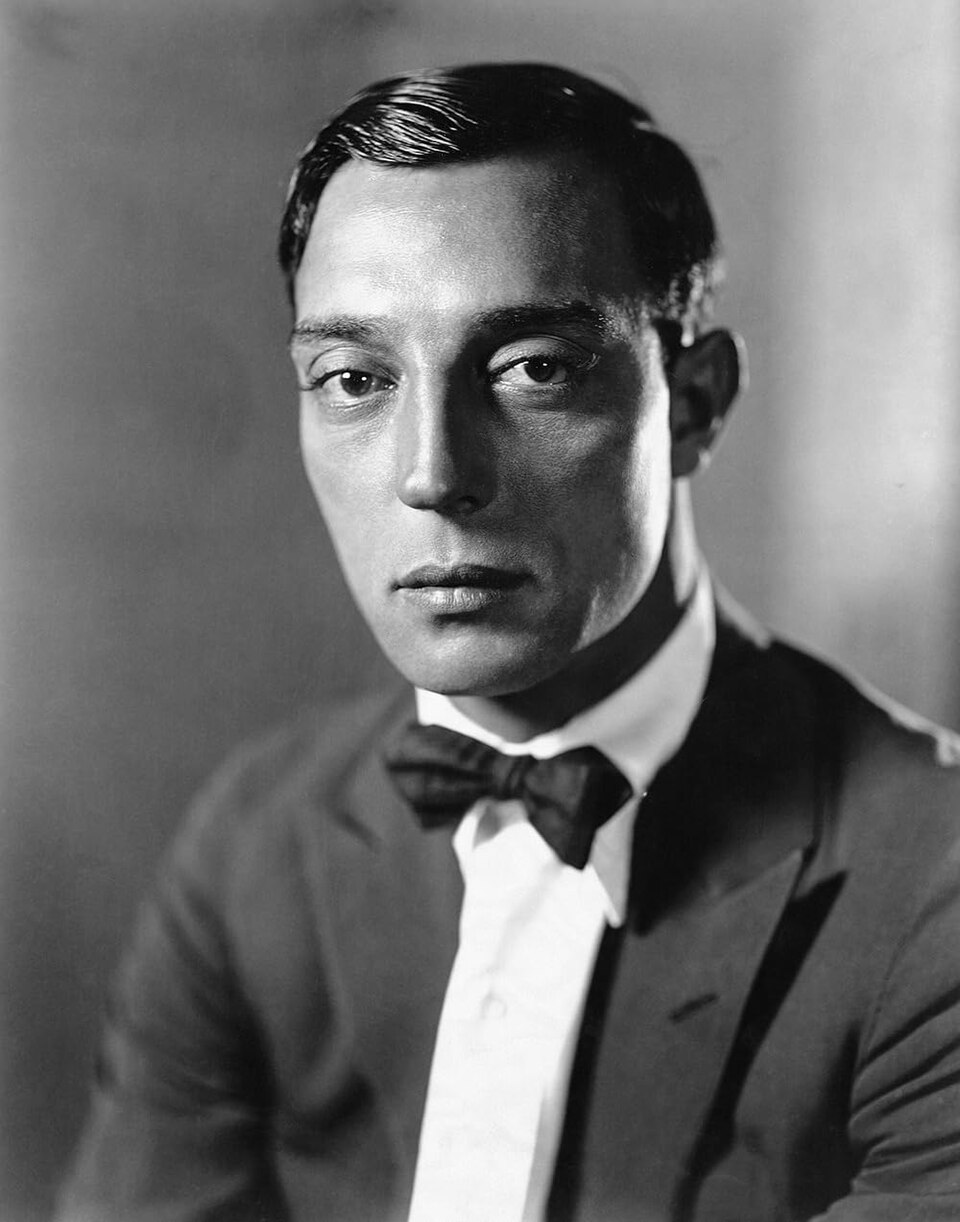
The silent-film comedian who never smiled on screen and built some of the most formally inventive films in cinema history.
Buster Keaton made films in which a solitary, expressionless man was pitted against forces — machines, crowds, armies, nature — vastly larger than himself. He almost always prevailed, not through luck or sentiment, but through ingenuity and an unshakeable physical composure. That composure was both his screen persona and his artistic method.
Vaudeville origins
Joseph Frank Keaton was born on 4 October 1895 in Piqua, Kansas, to Joe and Myra Keaton, travelling vaudeville performers. He was on stage as a toddler, incorporated into the family act — The Three Keatons — where his father would spin and throw him about the stage as a comic prop. The act was rough by any standard; it was also an education in timing, physical control, and how to fall without injury, skills that would define Keaton's film career.
The nickname "Buster" was fixed in childhood, variously attributed to a tumble down a flight of stairs witnessed by Harry Houdini, among others. By adolescence Keaton was the driving force of the act. When vaudeville began its decline, the move to film was natural.
The Arbuckle apprenticeship and short films
In 1917 Keaton met Roscoe "Fatty" Arbuckle and joined his Comique Film Corporation, appearing in a series of two-reel comedies. Working with Arbuckle taught Keaton the grammar of screen comedy — how space, editing, and camera angle could make a gag land or die — and gave him room to experiment. When Arbuckle moved to features, Keaton formed his own production unit and between 1920 and 1923 made nineteen two-reel shorts, several of which — One Week (1920), The Playhouse (1921), Cops (1922) — are among the most formally ambitious short films of the silent era.
The shorts established Keaton's signature approach: the gag as a precisely engineered system, built from location, setting, props, and the human body in motion. Where Charlie Chaplin's comedy arose from character, Keaton's arose from problem-solving under pressure.
Feature films and peak achievement
Keaton moved to features in 1923 with Our Hospitality, and over the following five years produced a sequence of films that constitutes one of the most sustained creative runs in cinema. Sherlock Jr. (1924) built a film around a dream sequence in which the protagonist literally enters a movie screen — a meditation on cinema itself. The Navigator (1924) used an ocean liner as its stage. The General (1926), set during the American Civil War, is the work most often cited as his masterpiece: a chase film of extraordinary scale and precision, filmed largely on moving trains, in which Keaton performed nearly every stunt himself. Steamboat Bill Jr. (1928) contains the famous facade-falls-on-Keaton shot, in which a house front collapses around him and he survives unharmed through a perfectly placed open window — an image that required Keaton to stand in exactly the right position while a structure weighing several hundred kilograms fell around him.
MGM and the decline
In 1928 Keaton signed with Metro-Goldwyn-Mayer, a decision he later described as the worst of his career. MGM imposed a studio system that stripped him of creative control: a collaborative writing process, assigned directors, and a factory approach to comedy that was incompatible with his working method. The early sound films he made for MGM are among the weakest of his career.
Through the 1930s and 1940s Keaton worked sporadically — two-reel comedies for Educational Pictures, uncredited gag work for other films, television appearances. Alcoholism compounded the professional difficulties. A full critical reassessment of his work came gradually from the late 1950s onward, driven partly by the French New Wave directors who cited him as a formal influence.
In 1959 the Academy of Motion Picture Arts and Sciences awarded Keaton an honorary Oscar, recognising a body of work that the industry had largely passed over at the time of its making. He died on 1 February 1966 in Woodland Hills, California.
He was the only one of the great comedians who wasn't afraid of the camera.