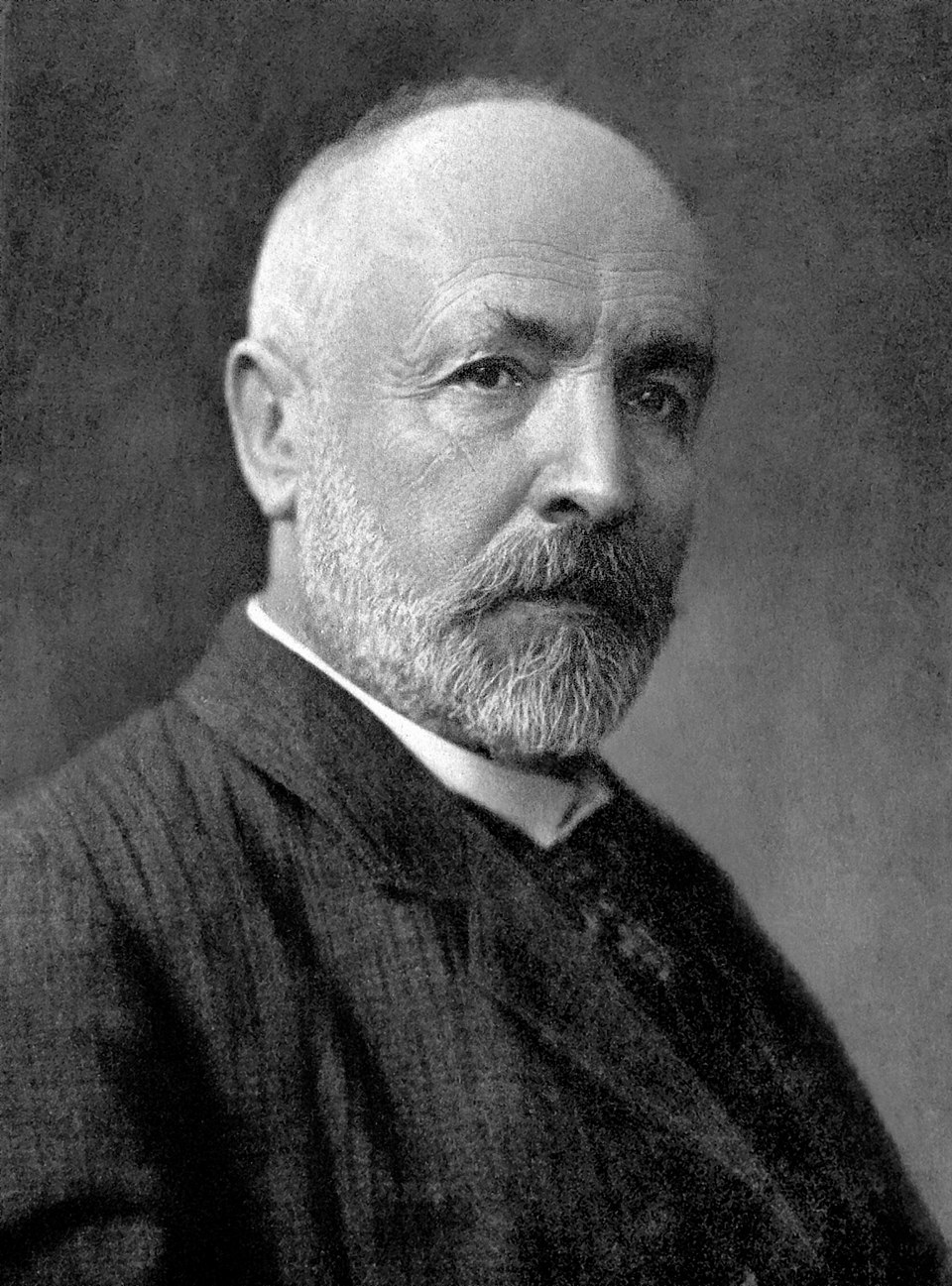
Carl Friedrich Gauss
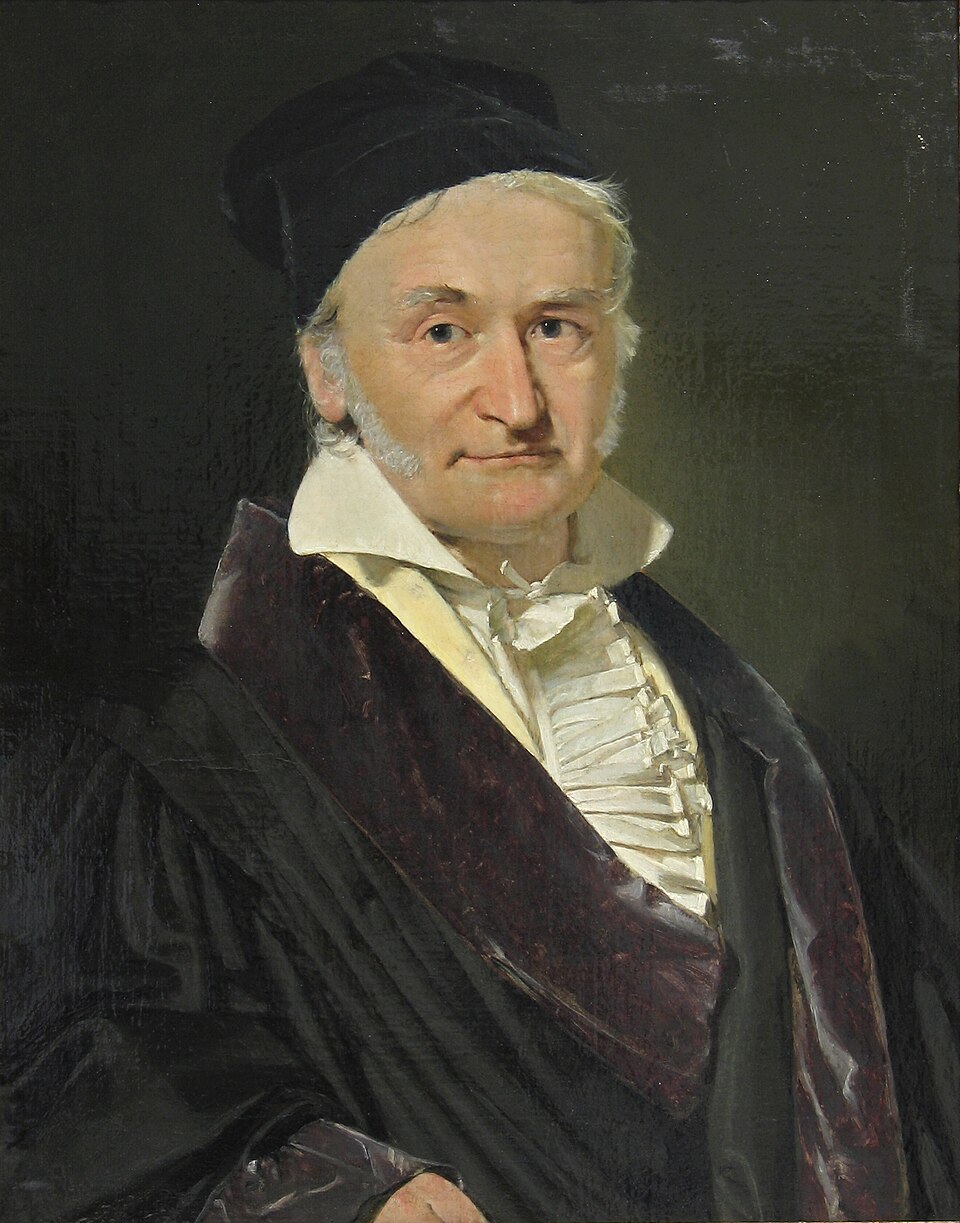
The German mathematician called the Prince of Mathematics, whose work in number theory, statistics, and geometry reshaped entire fields without yet abandoning rigour.
Carl Friedrich Gauss was a child prodigy from a poor Brunswick family who became the dominant mathematician of the 19th century. His 1801 Disquisitiones Arithmeticae founded modern number theory; his work in statistics produced the normal distribution; his geodetic surveys helped create differential geometry; and his investigations of terrestrial magnetism defined the mathematical treatment of physical fields. He insisted on certainty before publication, leaving generations of mathematicians to discover results he had privately reached decades earlier.
Prodigious origins
Gauss was born on 30 April 1777 in Brunswick, in what is now Germany. His family was working class; his father worked as a gardener and bricklayer. The stories of his precocity are well documented: he corrected his father's arithmetic before age three, and at ten he astonished his schoolmaster by summing the integers from 1 to 100 almost instantaneously, recognising that the hundred pairs (1+100, 2+99, …) each sum to 101, giving 5050.
The Duke of Brunswick sponsored his education at the Collegium Carolinum and then the University of Göttingen. At nineteen he proved the constructibility of the regular 17-gon by straightedge and compass — a result that had eluded mathematicians since antiquity — and decided to devote himself to mathematics rather than languages. He recorded the proof in a diary he kept from 1796 to 1814, which was rediscovered after his death and revealed the private scope of his discoveries.
Disquisitiones Arithmeticae
Published in 1801, the Disquisitiones Arithmeticae is the founding text of modern number theory. It introduced the notation and concept of congruences (a ≡ b mod n), proved the law of quadratic reciprocity (a result he called the "jewel of arithmetic"), analysed the structure of the integers, and laid foundations for algebraic number theory. Gauss gave eight independent proofs of the law of quadratic reciprocity during his lifetime; the final one appeared in a paper from 1818.
In the same year, 1801, he computed the orbit of the asteroid Ceres — lost after its discovery — from a few days of observation, predicting where it would reappear. The method used least squares fitting, which he had developed privately and published in 1809.
Statistics, geometry, and physics
Gauss developed the normal distribution (the bell curve) and proved the central limit theorem, establishing the probabilistic framework that underlies statistics, measurement theory, and experimental science. His method of least squares — minimising the sum of squared residuals — remains the most widely used fitting technique in science and engineering.
In geometry, his work on geodesy — the precise measurement of the Earth's surface — led him to develop the intrinsic geometry of curved surfaces, formulated in the Theorema Egregium: the Gaussian curvature of a surface is intrinsic and does not change when the surface is bent without stretching. This was the seed that Bernhard Riemann would develop into the geometry Einstein needed for general relativity.
He spent the last two decades of his life partly occupied with terrestrial magnetism, collaborating with Wilhelm Weber to build one of the first electromagnetic telegraphs and establishing a worldwide magnetic observation network.
Few, but ripe.