Carl Sagan
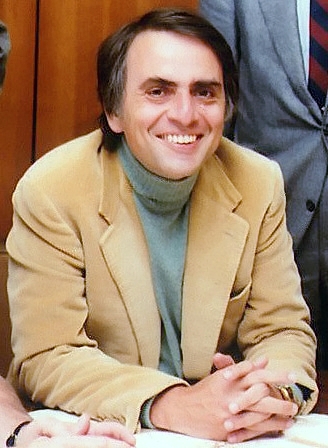
An astronomer who saw science communication as a moral duty — Sagan brought the cosmos into living rooms worldwide and argued, with rigour and feeling, that the universe's scale obliges humility.
Carl Sagan spent his career at the intersection of planetary science and public life, contributing to robotic space exploration while insisting that science had obligations beyond the laboratory — to democracy, to scepticism, to wonder. His television series Cosmos reached an estimated 500 million viewers and remains a benchmark of scientific communication.
Formation and Early Career
Sagan grew up in Brooklyn and developed an obsession with astronomy as a child. He studied at the University of Chicago, where he earned undergraduate and graduate degrees and a doctorate in astronomy and astrophysics in 1960. After a period at Harvard, he moved to Cornell University, where he would remain for the rest of his career as the David Duncan Professor of Astronomy and Space Sciences and director of the Laboratory for Planetary Studies.
His research covered planetary atmospheres — he contributed to understanding Venus's extreme greenhouse effect — extraterrestrial life, and the origins of life's chemical precursors. He was an early and consistent advocate for the search for extraterrestrial intelligence (SETI), helping design messages intended for non-human recipients.
Space Exploration and the Golden Record
Sagan played active roles in several major NASA missions. He was a member of the imaging team for Mariner 9 (1971), collaborated on the Viking landers' biology experiments (1976), and was instrumental in shaping the Voyager Golden Record — the gold-plated copper disc, carrying sounds and images of life on Earth, attached to each Voyager spacecraft launched in 1977. The record was both a scientific exercise and an act of cultural imagination: Sagan chaired the committee that selected its contents.1
Cosmos and Public Science
In 1980 Sagan co-wrote and hosted the television series Cosmos: A Personal Voyage, produced with his partner Ann Druyan and Steven Soter. The thirteen-part series moved across deep time and deep space, tracing the history of scientific discovery with a visual language — time-lapse photography, model spacecraft, dramatic reconstructions — that had not previously been applied to astronomy at television scale. An accompanying book, also titled Cosmos, became a bestseller.
His book The Dragons of Eden (1977), on the evolution of human intelligence, won the Pulitzer Prize for General Nonfiction in 1978. Pale Blue Dot (1994), prompted by a photograph of Earth taken by Voyager 1 from 6 billion kilometres, extended the philosophical argument of Cosmos into meditation on humanity's place and responsibilities.
He was also a consistent public critic of nuclear weapons, pseudoscience, and what he called the failures of sceptical thinking in public culture.
The cosmos is within us. We are made of star-stuff. We are a way for the universe to know itself.
Footnotes
- The record included greetings in 55 languages, music ranging from Bach to Chuck Berry, and 116 images — among them a silhouette of a man and woman and a nursing mother. ↩