Charles Darwin
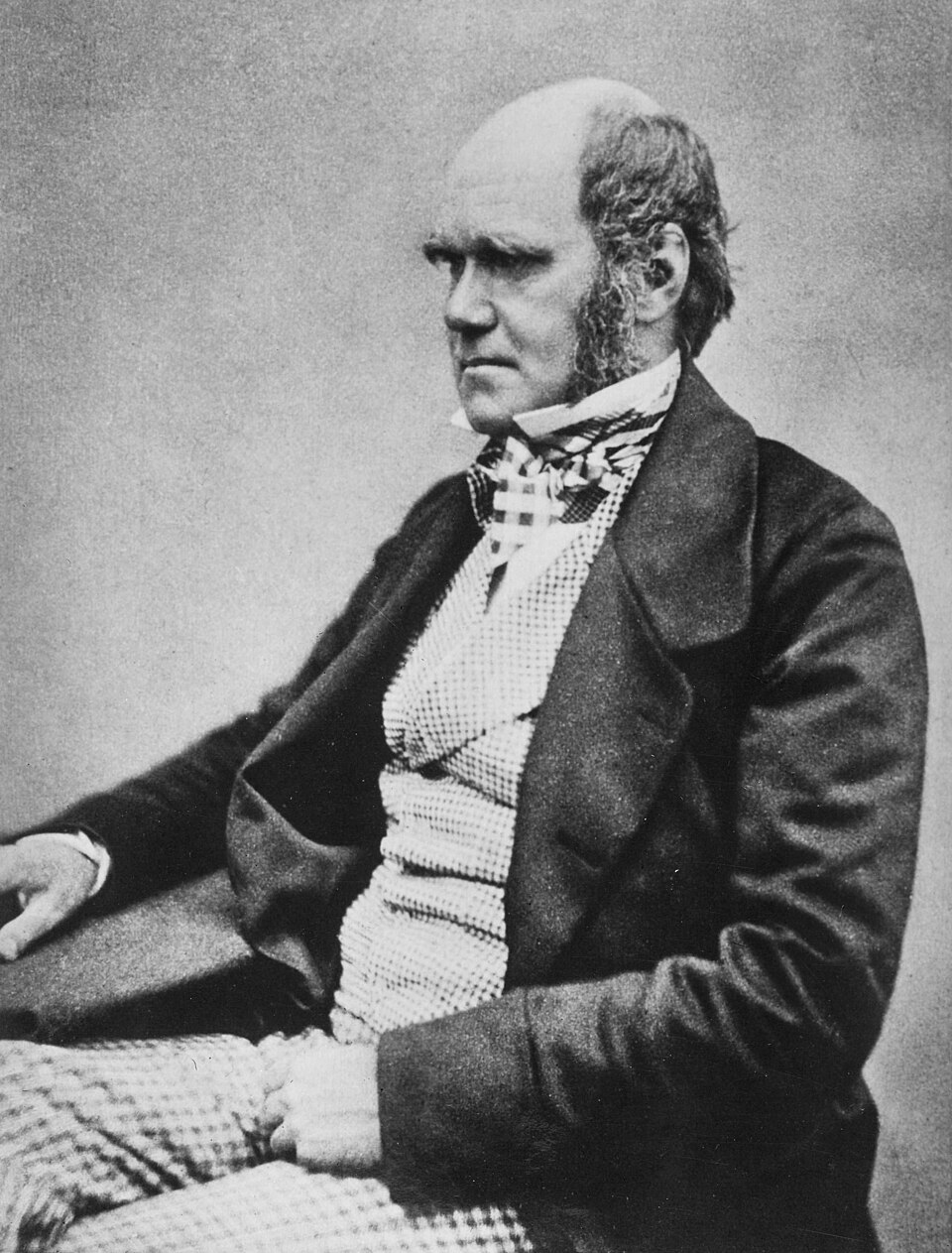
The English naturalist who, through two decades of painstaking observation and correspondence, assembled the evidence for evolution by natural selection and permanently altered humanity's understanding of life.
Charles Darwin spent five years circling the globe on HMS Beagle and twenty more years refining what he saw before publishing a theory that overturned natural theology and made shared ancestry the organising principle of all biology. Few scientific ideas have proved more durable or more unsettling to prevailing assumptions.
Origins and the Beagle voyage
Darwin was born in Shrewsbury, Shropshire, on 12 February 1809, into a prosperous and scientifically inclined family — his grandfather Erasmus Darwin had speculated on the mutability of life in verse. After unsatisfactory beginnings in medicine at Edinburgh, he moved to Christ's College, Cambridge, intending for the clergy. His friendship with the botanist John Stevens Henslow redirected him toward natural history, and Henslow recommended him for the position of gentleman-naturalist aboard HMS Beagle, which departed in December 1831.
The five-year circumnavigation took Darwin along the coasts of South America, through the Galápagos Islands, across the Pacific and Indian Oceans. He collected fossils and specimens obsessively, noting the way related species replaced each other across geography and the uncanny resemblance between island tortoises and the mainland populations from which they apparently derived. The raw material for his theory accumulated slowly, without any single eureka moment.
The long incubation of natural selection
Back in England by 1836, Darwin spent years in systematic analysis. He read Thomas Malthus's Essay on the Principle of Population in 1838 and recognised the mechanism he had been searching for: in populations where more individuals are born than can survive, those with heritable variations better suited to their environment will leave more offspring — natural selection. He sketched his theory in 1842 and expanded it to a 230-page essay by 1844, then largely set it aside, continuing geological and barnacle research for years.
In 1858 he received a letter from Alfred Russel Wallace describing an independently derived theory nearly identical to his own. A joint presentation at the Linnean Society of London on 1 July 1858 gave both men priority; Darwin then compressed years of notes into On the Origin of Species, published in November 1859.1
On the Origin of Species and its reception
The book sold out its first edition of 1,250 copies on the day of publication. Darwin argued that all species descended from common ancestors through branching modification, that the geological record showed successive faunas, and that the struggle for existence drove the differential survival of heritable variations. He deliberately avoided the question of human origins in 1859 — that came in The Descent of Man (1871). The initial controversy was fierce, most famously encapsulated in the 1860 Oxford debate between Thomas Henry Huxley and Bishop Samuel Wilberforce, though Darwin himself remained at Down House throughout.
Legacy
Darwin's framework has absorbed genetics, molecular biology, and genomics without requiring fundamental revision. The modern synthesis of the mid-twentieth century united natural selection with Mendelian inheritance; the sequencing of genomes has made the common ancestry of all life visible at the molecular level. Darwin was buried in Westminster Abbey, near Isaac Newton — a measure of the esteem in which Victorian science ultimately held him.
There is grandeur in this view of life, with its several powers, having been originally breathed into a few forms or into one; and that, from so simple a beginning endless forms most beautiful and most wonderful have been, and are being, evolved.
Footnotes
- Wallace's essay, "On the Tendency of Varieties to Depart Indefinitely from the Original Type," arrived with Darwin in June 1858. The joint Linnean Society reading is now recognised as establishing simultaneous discovery; Darwin's greater contribution lay in the twenty years of evidence and argument that followed in Origin. ↩