Charles Eames
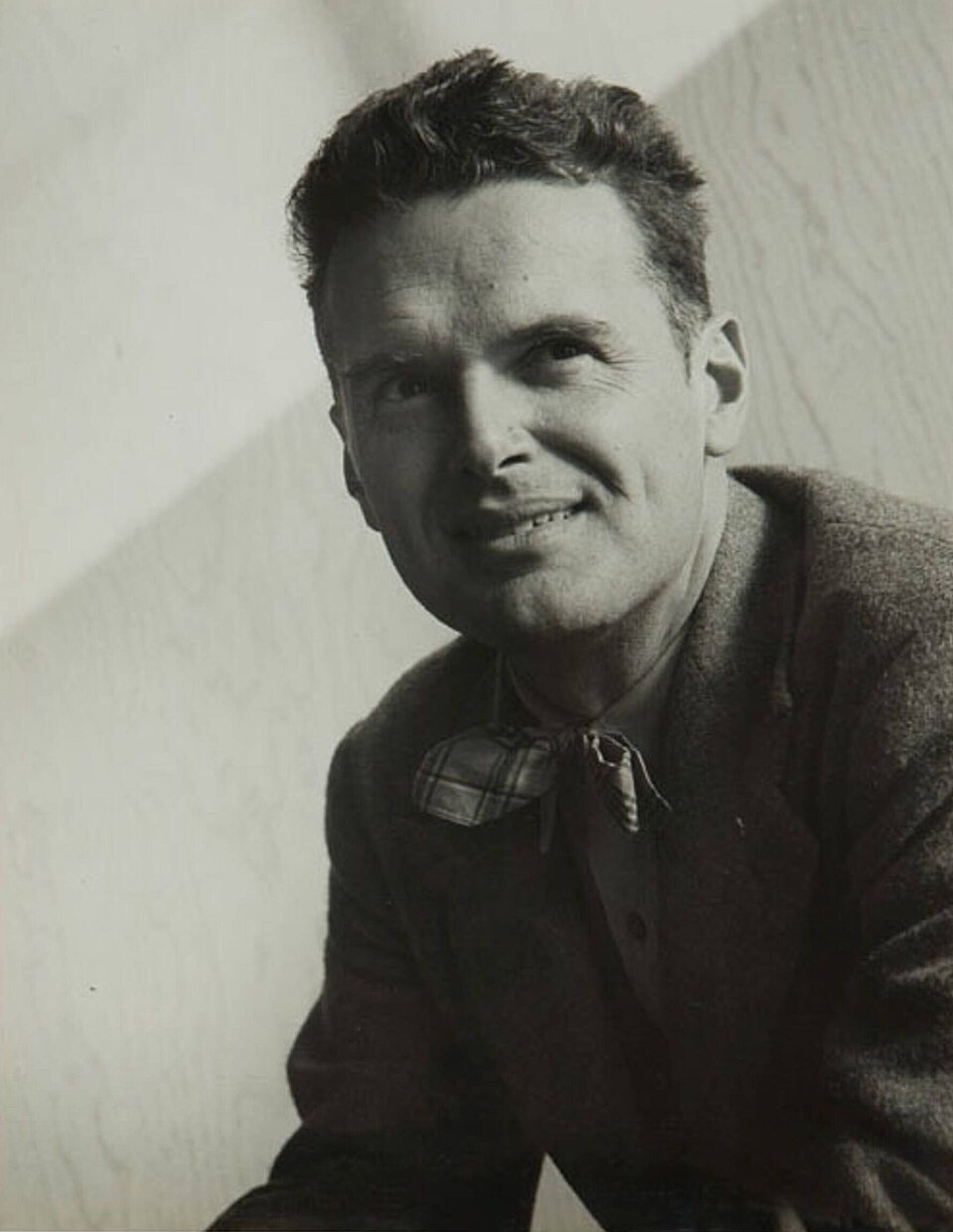
The American designer who, with his wife and partner Ray, transformed industrial materials and manufacturing logic into some of the most enduring furniture and film of the 20th century.
Charles Eames and his wife Ray worked from a studio in Venice, California to develop furniture, exhibition design, and film that tested a single proposition — that the best answer to a design problem is the most honest one. Their methods were empirical, their curiosity encyclopaedic, and their output has proved durable in ways that fashionable design rarely achieves.
Early career and the partnership with Ray
Charles Eames studied architecture at Washington University in St. Louis before winning a fellowship to the Cranbrook Academy of Art in Michigan, where he became head of the department of industrial design. It was at Cranbrook that he met Ray Kaiser, and their collaboration — professional from the start, then romantic and marital — became one of the defining creative partnerships of the century.
In 1941 they moved to Los Angeles. Charles had already been experimenting with moulded plywood alongside Eero Saarinen in competition entries; with Ray, he continued developing the technique using equipment they built themselves in their apartment. The problem they were solving was structural and human simultaneously — how to form plywood into a compound curve that would conform to the body while remaining manufacturable at scale.
Furniture and materials
The LCW (Lounge Chair Wood), produced by Herman Miller from 1945, embodied the Eameses' core method: take a material, understand its properties through experiment, and let those properties guide the form. Bent plywood could not take a compound curve as a single sheet, so the chair uses separate seat and back pads, each with its own curve, connected by a rubber shock mount — a junction that became a design signature.
The Eames Lounge Chair and Ottoman (1956), in moulded rosewood plywood and leather, applied the same logic at a different register — warmer, more luxurious, but still structurally justified.1 The fibreglass shell chairs, designed from 1948 with manufacturers Zenith Plastics then Herman Miller, were among the first mass-produced plastic chairs; their organic shell form derived directly from the moulding behaviour of the new material.
| Chair | Year | Primary material |
|---|---|---|
| LCW | 1945 | Bent plywood |
| DAR/LAR/RAR shell chairs | 1950 | Fibreglass reinforced plastic |
| Eames Lounge Chair | 1956 | Moulded veneer plywood, leather |
| Aluminium Group | 1958 | Cast aluminium, sling fabric |
Exhibition design and film
The Eames Office — as their studio was known — produced exhibition design for major clients including IBM and the US government. For the American National Exhibition in Moscow (1959) they created the Glimpses of the USA multi-screen film installation, projecting images of American life onto seven twenty-by-thirty-foot screens simultaneously in Buckminster Fuller's geodesic dome.
Their short films — including Powers of Ten (1977) and The Information Machine (1958) — used graphic precision and rigorous structure to make scientific and conceptual ideas accessible. Powers of Ten, which scales from a picnic blanket to the edge of the observable universe and back in nine minutes, remains in active educational use.
Legacy
Charles Eames died in 1978; Ray died exactly ten years later, on the same date in 1988. Their work endures in continuous production (the shell chairs are still made by Herman Miller), in museum collections worldwide, and in the Case Study House No. 8 in Pacific Palisades, California — their own home, now listed and open to visitors — which demonstrated that prefabricated industrial components could make genuinely inhabitable, beautiful architecture.
The details are not the details. They make the design.
Footnotes
- Eames described the lounge chair as having the warm receptive look of a well-used first baseman's mitt — a characteristically non-architectural analogy that captures his preference for experiential rather than formalist language. ↩