Charlotte Perriand
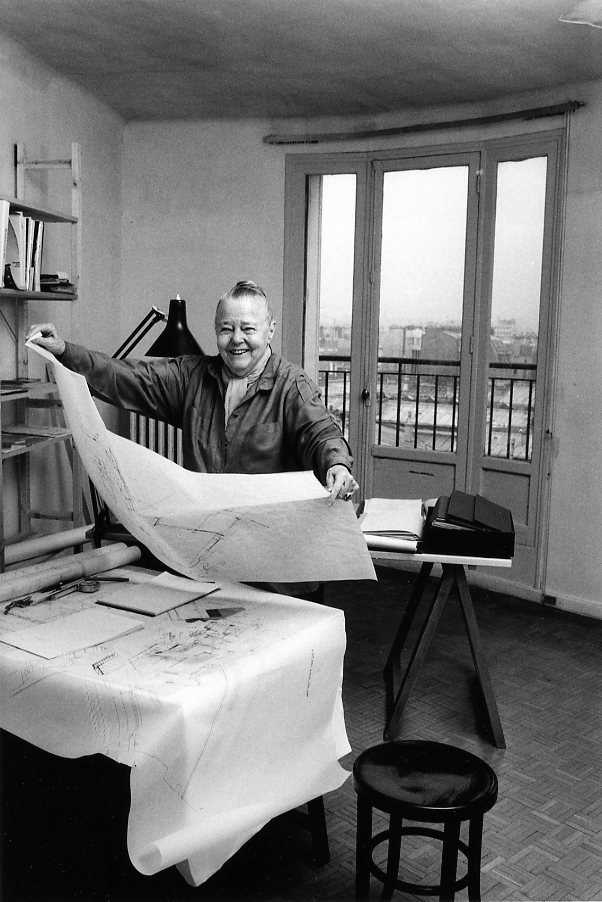
The French designer who brought the logic of the machine-age interior to bear on mountain chalets and ski stations, insisting that good design was a social right rather than a luxury.
Charlotte Perriand began her career at Le Corbusier's studio at 35 rue de Sèvres in Paris and spent the following seven decades expanding what interiors could be — from tubular-steel furniture conceived for mass production to modular mountain refuges built from timber and stone. She drew on Japanese craft traditions after a two-year advisory role in Tokyo, and returned to France with a fundamentally broadened vocabulary. Her career is one of the longest and most formally varied in twentieth-century design.
The Corbusier years
Perriand arrived at Le Corbusier's office in 1927, fresh from studies at the École de l'Union centrale des arts décoratifs. She was initially turned away — Le Corbusier is reported to have said that his studio did not embroider cushions — then taken on after she exhibited furniture in chrome and steel at the Salon d'Automne. The collaboration with Le Corbusier and his cousin Pierre Jeanneret produced some of the most reproduced furniture of the century: the LC4 chaise longue, the LC2 armchair, and the LC7 swivel chair, all designed collectively during this period. The furniture embodied the studio's conviction that the interior was a machine for living, with comfort and hygiene achievable through industrial materials and rational proportion.1
Independence and Japan
Perriand left the Corbusier office in 1937 and established an independent practice. In 1940 she accepted an invitation from the Japanese government to act as design adviser, travelling to Japan and spending two years studying traditional craft and spatial organisation. The experience shaped her subsequent approach: she became interested in natural materials, modular spatial units derived from tatami proportions, and the integration of furniture with architecture at the level of the building itself. She returned to France via Southeast Asia and Indochina, where she spent time during the Second World War.
Mountain architecture
Perriand's most sustained independent project was the design of ski stations and mountain infrastructure in the French Alps. Her work at Les Arcs resort, developed from the late 1960s through the 1980s, demonstrated her mature method: prefabricated modular units adaptable to difficult terrain, with interiors fitted with compact, multi-purpose furniture designed to maximise function in small volumes. The architecture engaged seriously with the landscape rather than imposing urban typologies onto alpine sites.
Legacy
Perriand's reputation suffered for decades from the tendency to attribute the Corbusier-studio furniture solely to Le Corbusier. Scholarship and exhibitions since the 1980s have corrected this, and she is now recognised as a primary author of the canonical furniture pieces. Her autobiography, published in English as Charlotte Perriand: A Life of Creation, charts a career shaped by a consistent conviction: that the design of everyday living environments carried social and political stakes.
| Phase | Period | Key output |
|---|---|---|
| Corbusier studio | 1927–1937 | LC4, LC2, LC7 furniture |
| Japan advisory | 1940–1942 | Study of craft, modular proportion |
| Alpine work | 1967–1989 | Les Arcs ski station design |
The extension of the art of dwelling is the art of living — living in harmony with man's deepest drives and with his adopted or fabricated environment.
Footnotes
- The furniture was designed for the Salon d'Automne of 1929 under the title L'Équipement de l'habitation — the fitting-out of the dwelling — a phrase that positions furniture as infrastructure rather than decoration. ↩