Christian Dior
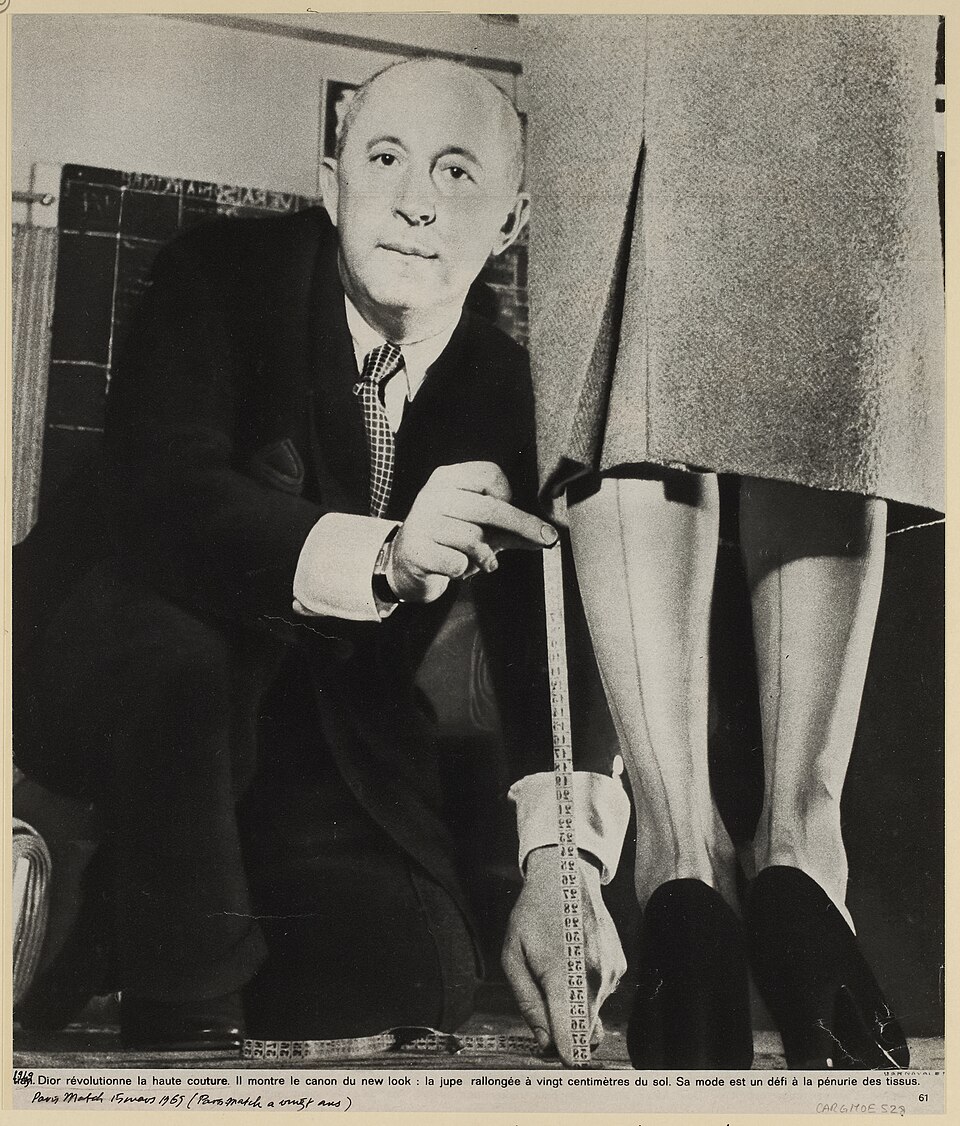
A former art dealer who came to fashion late, Dior reset the terms of women's dress in a single afternoon and spent the rest of his brief career proving it was no accident.
Christian Dior founded his couture house in 1946 and presented his first collection in February 1947 — a debut that Carmel Snow of Harper's Bazaar named the "New Look" on the spot. The silhouette he introduced that afternoon, with its nipped waist, padded hips, and full skirt falling to the calves, reversed the austerity of wartime fashion and re-established Paris as the capital of women's dress. Dior did not live to see his tenth anniversary collection; he died in 1957, fifty-two years old, having built one of the most recognisable fashion houses in the world in little more than a decade.
Origins
Dior was born in Granville, Normandy, on 21 January 1905, the second son of a prosperous manufacturer. His family moved to Paris when he was five, and the city's cultural life made its impression early. He studied at the École des Sciences Politiques with the expectation of a diplomatic career, but his interests ran elsewhere. In the late 1920s he opened an art gallery in Paris in partnership with Jacques Bonjean, dealing in work by Picasso, Matisse, and others associated with the Parisian avant-garde. The gallery closed in 1931 after financial difficulties, and Dior spent much of the early 1930s learning to draw fashion illustrations, selling sketches to couture houses and newspapers.
Apprenticeship
Dior joined Robert Piguet's atelier in 1938 as a design assistant, his first formal work in fashion. The occupation interrupted his development: he was mobilised in 1939, demobilised after France's defeat, and spent time in the south of France before returning to Paris. From 1941 to 1946 he worked as a designer for Lucien Lelong, one of the couture houses that continued to operate under German occupation. Lelong is credited with resisting Nazi pressure to relocate French couture to Berlin; Dior and Pierre Balmain were among his principal designers during this period.
The New Look
Backed by textile magnate Marcel Boussac, Dior founded Maison Christian Dior in 1946 and presented his debut collection on 12 February 1947 at 30 avenue Montaigne. The two lines he showed — "Corolle" and "En Huit" — shared a common vocabulary: shoulders rounded and natural rather than padded square, a cinched waist, and a skirt that fell to mid-calf in soft fullness. The effect was immediately read as a reaction against wartime utility and as a reassertion of a specifically French idea of femininity. Carmel Snow's phrase stuck. The New Look provoked genuine controversy — fabric was still rationed in France and Britain — but it also generated enormous demand, and Dior's house grew rapidly.
Expansion
Dior moved quickly into licensing and international markets. Miss Dior, the house's first perfume, launched in 1947 alongside the debut collection; Diorama followed in 1949. Ready-to-wear and licensing agreements extended the brand into new categories and geographies, establishing the commercial model that later defined luxury fashion. Each subsequent season brought a new line with its own name and silhouette theme — H-line, A-line, Y-line — with Dior presenting fashion as a sequential argument rather than a fixed identity.
Death and succession
Dior died suddenly of a heart attack on 24 October 1957 in Montecatini Terme, Italy, where he had gone to rest. He was fifty-two. His twenty-one-year-old assistant Yves Saint Laurent succeeded him as creative director of the house. Dior had recognised Saint Laurent's talent and is reported to have told colleagues he had found his successor; Saint Laurent's first collection for Dior, the Trapeze line of 1958, was a commercial and critical success.
"It's quite a revolution, dear Christian. Your dresses have such a new look."