Claude Shannon
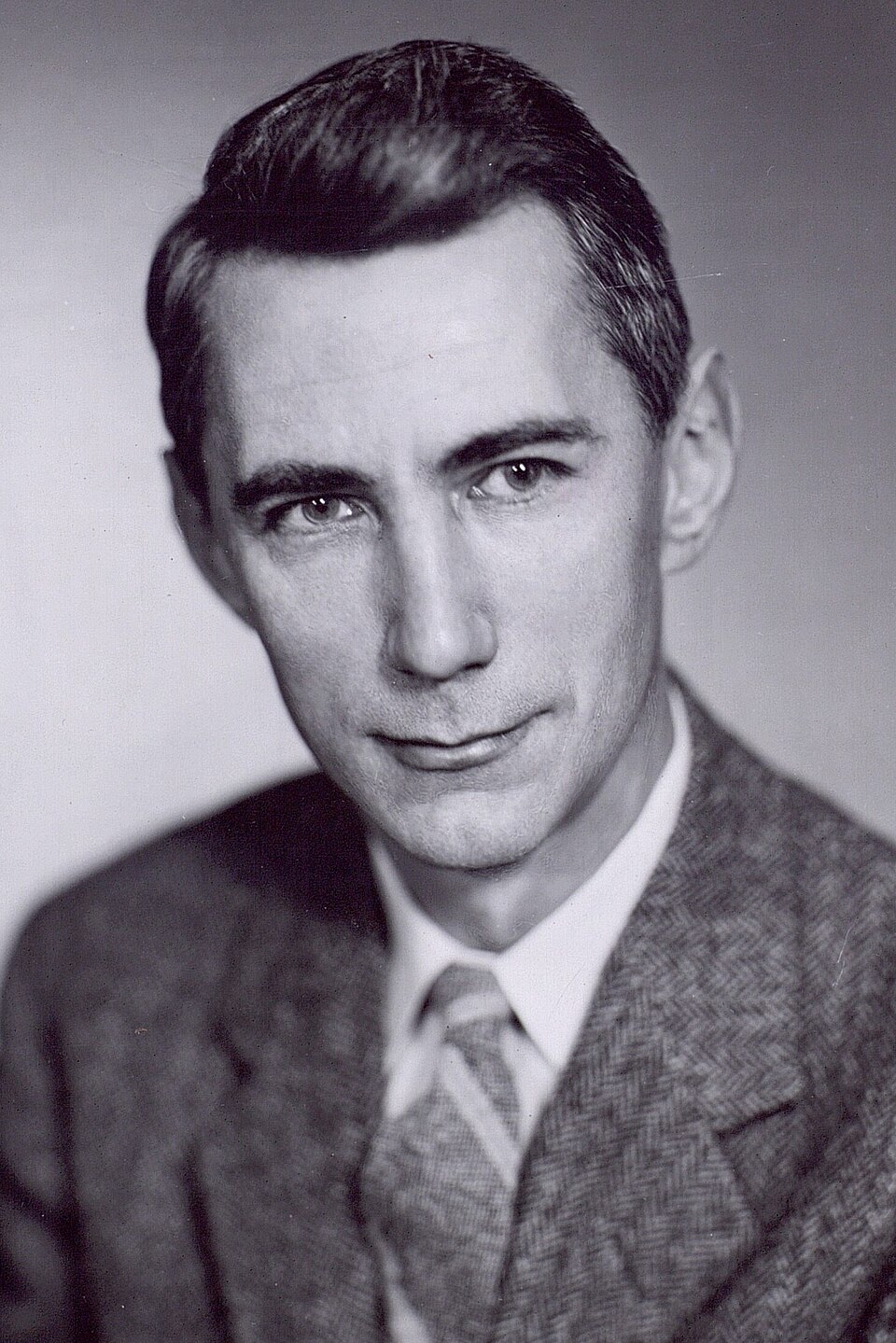
The mathematician who quantified information itself, giving engineers a universal theory of communication and founding the discipline that made the digital age possible.
Claude Shannon's 1948 paper introduced a single, audacious idea: that information — regardless of its meaning — could be measured, compressed, and transmitted with mathematical precision. Everything that followed, from satellite communications to the internet to data compression, is built on that foundation.
From Michigan to Bell Labs
Shannon grew up in Gaylord, Michigan, and showed an early aptitude for mathematics and electrical tinkering. He built a telegraph line to a friend's house as a boy, using barbed-wire fencing as the conductor. He studied mathematics and electrical engineering at the University of Michigan, then completed a master's degree and doctorate at MIT. His 1937 master's thesis — demonstrating that Boolean algebra could be used to analyse and design electrical circuits — was itself a landmark, instantly recognised as one of the most important theses ever written in electrical engineering. He joined Bell Telephone Laboratories in 1941, where he remained for most of his career.
A Mathematical Theory of Communication
In 1948, Shannon published "A Mathematical Theory of Communication" in the Bell System Technical Journal. The paper introduced entropy as a measure of information content: the more unpredictable a message, the more information it carries. He proved that any channel has a fixed maximum rate — the channel capacity — at which information can be transmitted with arbitrarily low error, regardless of noise, provided the sender uses an efficient enough code. This theorem (now called the Shannon–Hartley theorem) was both a ceiling and a guarantee: you could always approach the limit, never exceed it.
Information is the resolution of uncertainty.
The paper also introduced the bit — binary digit — as the fundamental unit of information, a coinage that has since become universal.
Cryptography and play
During the Second World War Shannon worked on cryptography at Bell Labs, producing a classified report that became the foundation of theoretical cryptanalysis. His 1949 paper "Communication Theory of Secrecy Systems" proved that the one-time pad is the only perfectly secure cipher — a result of lasting importance to security theory. Beyond formal research, Shannon was known for building mechanical mice that navigated mazes, a juggling robot, and a unicycle, expressing a conviction that mathematical ideas and physical play were inseparable.