Confucius
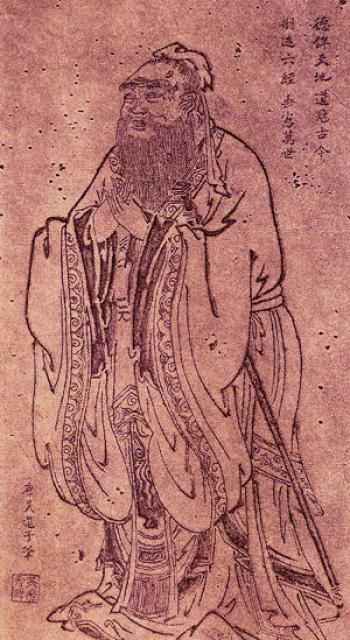
The teacher and administrator whose ethical system became the philosophical foundation of Chinese civilisation for two and a half millennia.
Confucius — born Kong Qiu — was a Chinese philosopher of the Spring and Autumn period whose ethical and political teaching became the dominant intellectual tradition of the Sinosphere for more than two thousand years. He taught that personal moral cultivation, beginning with filial piety and extending to the proper conduct of rulers and officials, was the foundation of a harmonious society. He wrote nothing himself; his sayings were compiled by disciples into the Analects, which became one of the most widely read texts in human history.
Life
Confucius was born in 551 or 552 BC in Zou, in the state of Lu, in what is now Shandong province. He came from a family of minor aristocratic officials. His father died when he was three, and he was raised by his mother in modest circumstances. He studied the ritual practices, music, archery, chariotry, calligraphy, and mathematics that constituted the education of the shi class — the class of educated administrators below the nobility.
He held various official positions in the state of Lu, reportedly rising to the position of Minister of Justice, though the historical record here is contested. He gathered a school of disciples and attempted to persuade the ruling lords of various states to adopt his principles of governance. Finding no ruler willing to implement his ideas, he spent approximately thirteen years in travel between states, accompanied by his disciples, before returning to Lu in old age to teach and edit ancient texts.
He died in 479 BC. Tradition holds that he expressed, in his final years, disappointment at having been unable to put his political principles into practice.
Confucianism
Confucius's teaching centred on several interlocking concepts. Ren (benevolence or humaneness) is the cardinal virtue — the quality of genuine care and respect for others that should inform all social relations. Li (ritual propriety) refers to the correct performance of ceremonies and social roles that maintains the fabric of civilised life. Yi (righteousness) demands that one act correctly regardless of personal advantage. Zhengming — the rectification of names — argues that social order depends on terms meaning what they should: a ruler must actually rule, a father must actually father.
His political thought held that governance should rest on moral example rather than force: a virtuous ruler draws the people toward virtue as the north star draws the other stars around it. The examinations that governed appointment to the Chinese imperial bureaucracy — from the Han dynasty through to the early twentieth century — were based largely on mastery of Confucian texts.
The Analects
The Analects (Lunyu) is a compilation of Confucius's sayings and short exchanges with disciples, assembled after his death. It is a fragmentary and sometimes cryptic text — not a systematic treatise but a collection of observations on virtue, ritual, government, and learning. Its brevity has made it extraordinarily generative: two and a half millennia of commentary have elaborated its lacunae.
The text spread from China throughout East Asia. Confucianism became the state ideology of China under the Han dynasty (206 BC – 220 AD) and remained central to Chinese intellectual and political life until the twentieth century. It profoundly shaped the cultures of Korea, Japan, Vietnam, and the broader Sinosphere.
Do not impose on others what you yourself do not want.
Legacy
Confucius's direct influence on the governance and culture of East Asia has few parallels in human history. His insistence on the connection between personal moral development and public order, on the cultivation of virtue through education and ritual practice, and on the responsibilities of those in power toward those they govern gave Chinese civilisation its ethical vocabulary. Neo-Confucianism, which emerged in the Song dynasty and integrated Buddhist and Taoist elements, extended and transformed his teaching. In the twentieth century, his legacy was attacked during China's Cultural Revolution and has since been partly rehabilitated by the Chinese state.