David Hilbert
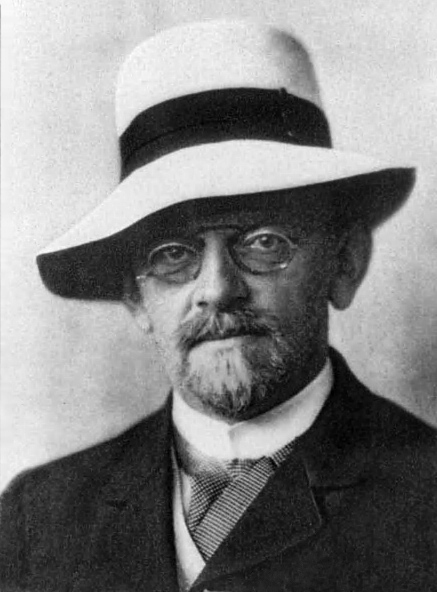
The German mathematician who tried to axiomatise all of mathematics and, in posing twenty-three problems at the dawn of the twentieth century, set its research agenda for generations.
David Hilbert was the most influential mathematician of the first half of the twentieth century. He remade the foundations of geometry, invented the Hilbert space framework that underlies quantum mechanics, led the formalist program to axiomatise all of mathematics, and at the 1900 International Congress of Mathematicians presented twenty-three unsolved problems that directed mathematical research for the century that followed. Gödel's incompleteness theorems of 1931 proved his foundational program could not be completed — the most significant intellectual defeat of the century, and the most productive.
Formation and early work
Hilbert was born on 23 January 1862 in Königsberg (now Kaliningrad), Prussia. He studied and received his doctorate at the University of Königsberg, where he became professor in 1886. In 1895 he moved to the University of Göttingen, which he made the foremost centre of mathematics in the world.
His first major work was in invariant theory. Where previous mathematicians had proved the existence of specific algebraic invariants by laborious explicit construction, Hilbert proved general existence theorems by showing that infinite sets of invariants always contain finite generating subsets — a non-constructive approach that Paul Gordan, the leading invariant theorist, is said to have criticised as "theology, not mathematics." Hilbert replied, in effect, that existence is what matters.
Foundations of geometry
In 1899, Hilbert published Grundlagen der Geometrie — the Foundations of Geometry. He gave a complete, rigorous axiomatic reconstruction of Euclidean geometry, filling the logical gaps in Euclid's original presentation and establishing the modern standard for an axiomatic system: completeness, consistency, and independence of axioms. The book went through seven editions during his lifetime and established the template for all subsequent axiomatic mathematics.
The 23 problems
In August 1900 at the International Congress of Mathematicians in Paris, Hilbert presented a list of twenty-three unsolved mathematical problems. The list covered number theory (the Riemann hypothesis), foundational questions (the Continuum Hypothesis), analysis, geometry, and mathematical physics. They were not random puzzles: each was chosen to open a new area of investigation. The problems shaped the research agenda of 20th-century mathematics; most have since been solved or found to be undecidable.
Hilbert spaces and quantum mechanics
Working in functional analysis, Hilbert developed the theory of Hilbert spaces — infinite-dimensional generalisations of Euclidean space, with an inner product and a notion of completeness. This framework, developed between 1904 and 1910 with his student Erhard Schmidt and others, was later recognised as the natural mathematical setting for quantum mechanics. John von Neumann used Hilbert spaces as the foundation for his 1932 axiomatisation of quantum theory.
The formalist program
From the 1920s onward, Hilbert's central ambition was to secure the foundations of mathematics by reducing all of it to a single formal system: a finite list of axioms and inference rules from which every mathematical truth could in principle be derived, and whose consistency could be proved by finitary methods. This is the Hilbert program.
In 1931, Kurt Gödel proved the incompleteness theorems: any consistent formal system powerful enough to express arithmetic contains true statements that cannot be proved within the system, and cannot prove its own consistency. The Hilbert program, as stated, was impossible. Hilbert is reported to have been devastated. Mathematical logic continued to develop, but differently from what he had envisioned.
We must know. We will know.