David Hume
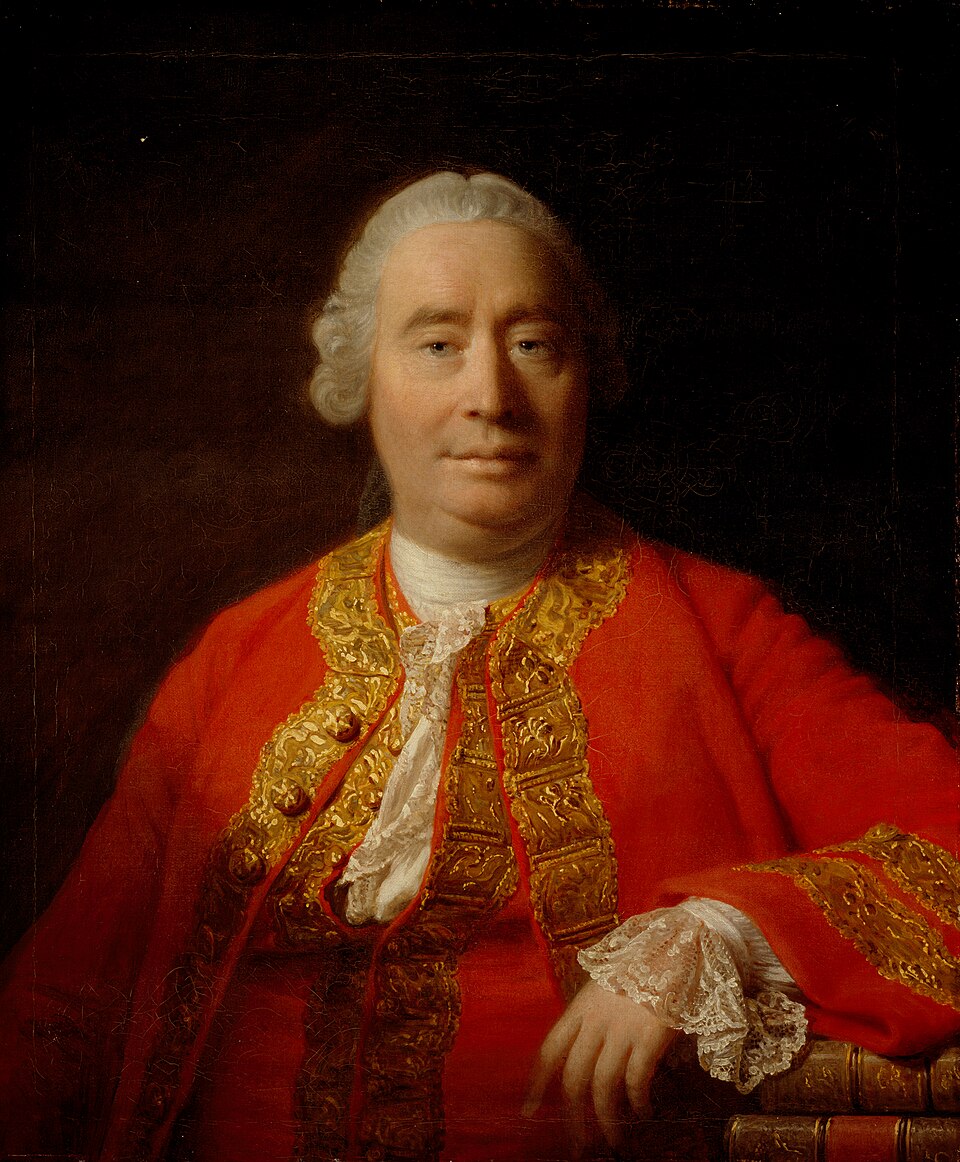
The most radical of the British empiricists, who demolished the rational foundations of causation, induction, and morality — and in doing so woke Kant from his dogmatic slumber.
David Hume pushed empiricism to conclusions his predecessors had stopped short of drawing. If all knowledge derives from sensory experience, then causation is not something we perceive in the world — it is a habit of expectation we project onto it. The argument was unsettling enough that Kant credited it with forcing him to reconstruct the entire basis of metaphysics.
Edinburgh and an early ambition
Hume was born in Edinburgh on 26 April 1711 into a family of modest landed gentry. He entered the University of Edinburgh at eleven — not unusual at the time — and left without a degree, having already decided that philosophy, not law or the ministry, was his vocation. A period of intense private study produced what he called a "new scene of thought," the germ of his mature system. He spent three years in France, partly at the Jesuit College of La Flèche, writing A Treatise of Human Nature.
The book was published in 1739–40 when Hume was still in his twenties. He later recalled that it "fell dead-born from the press, without reaching such distinction as even to excite a murmur among the zealots." The failure stung, but he revised and recast its arguments in shorter, more accessible works for the rest of his career.
The fork and the problem of induction
Hume's most durable contribution to epistemology is the distinction now called Hume's fork. All meaningful propositions, he argued, fall into two categories: relations of ideas — logical and mathematical truths that are necessarily true but tell us nothing about the world — and matters of fact — claims about the world that are contingent and known only through experience. Anything that fits neither category, he suggested, should be committed to the flames, for it contains nothing but sophistry and illusion.
The problem of induction follows directly. Our belief that the future will resemble the past — that the sun will rise tomorrow because it has always risen — cannot be grounded in reason. Reason alone cannot justify induction; induction cannot justify itself without circularity. We believe it because habit and custom compel us to, not because we have any rational warrant. This was not scepticism for its own sake: Hume thought custom and habit were sufficient for practical life. But the epistemological gap he identified has never been closed to everyone's satisfaction.1
Causation, morality, and the is-ought gap
Hume applied the same scrutiny to causation. We observe that one billiard ball strikes another and the second moves; we do not observe necessity. The connection is inferred, not seen. Necessity is something the mind adds, a product of repeated observed conjunction. This analysis dissolved the philosophical basis of causal necessity and forced subsequent philosophers to account for it on Hume's terms.
His is-ought problem — sometimes called Hume's guillotine — drew a sharp line between descriptive and normative claims. No accumulation of facts about how things are can by itself yield a conclusion about how things ought to be. The gap must be bridged by values that are themselves not derivable from facts alone. This challenge to moral rationalism remains one of the most debated arguments in ethics.
Historian and man of letters
Beyond his philosophical work, Hume was one of the most celebrated prose writers of his age. His six-volume History of England (1754–1762) was the standard reference on the subject for much of the eighteenth century and brought him the fame that philosophy alone had denied him. His essays on economics, politics, and aesthetics were widely read across Europe, and he served as a diplomat's secretary in Paris, where he was lionised by the philosophes.
If we take in our hand any volume — of divinity or school metaphysics, for instance — let us ask, does it contain any abstract reasoning concerning quantity or number? No. Does it contain any experimental reasoning concerning matter of fact and existence? No. Commit it then to the flames.
Footnotes
- Karl Popper's response — that science proceeds not by induction but by bold conjectures and attempted falsification — is the most influential modern answer, though it too remains contested. ↩