Douglas Engelbart
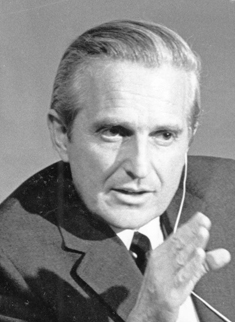
The engineer who conceived the augmented human intellect and then built the tools to realise it — among them the computer mouse, hypertext, and the networked workspace.
Douglas Engelbart spent his career solving a problem most engineers never thought to ask: how could computers be made to augment human intelligence rather than merely automate clerical work? The 1968 demonstration he staged in San Francisco — ninety minutes that came to be called "the Mother of All Demos" — answered the question with a working system that anticipated personal computing by a decade.
The founding idea
Engelbart was born in Portland and grew up on a farm in Oregon. He served as a radar technician in the US Navy during the Second World War, and it was in a Philippines hut while waiting for his discharge that he read Vannevar Bush's essay "As We May Think" — a speculative vision of a machine that could extend human memory and knowledge. The encounter planted the idea that shaped the rest of his life: technology as an amplifier of human capability, not a replacement for it.
He completed his PhD in electrical engineering at Berkeley in 1955 and joined SRI International, where he founded the Augmentation Research Center in 1962 with funding from ARPA.
The Mother of All Demos
On 9 December 1968, Engelbart and his team demonstrated the oN-Line System (NLS) to roughly a thousand computer professionals at the Fall Joint Computer Conference in San Francisco. In ninety minutes they showed: a pointing device (the mouse), windows, hypertext linking between documents, collaborative real-time editing, and video conferencing. Every element was live, networked, and functional.
The demonstration's influence was absorbed gradually. Xerox PARC staff attended; their Alto workstation carried Engelbart's ideas forward; the Macintosh and every subsequent graphical interface descended from that chain.
The key question is not what computers can do, but what they should do.
Method and obsession
Engelbart was driven by a specific conviction: that the world's most urgent problems were too complex for unaugmented human minds to solve, and that computing was the lever. This framing — bootstrapping, in his vocabulary — meant improving the tools used to improve the tools. It was systemic thinking applied to the design of human–computer interaction itself.
His productivity at ARC was remarkable through the late 1960s, but the lab's culture proved difficult to sustain. After SRI sold NLS to Tymshare in 1977, Engelbart spent years struggling to keep his ideas alive in organisations that wanted products, not frameworks.
Legacy
The ACM Turing Award came in 1997 — nearly thirty years after the demo. By then the graphical interface, the mouse, and hypertext had become so ubiquitous that tracing them back to one source required deliberate effort. Engelbart remained a prophet slightly ahead of his institutional moment: his broader vision of collaborative knowledge-management tools only became widely understood in the era of wikis and shared documents.
Engelbart's law — his observation that the intrinsic rate of human performance is exponential — is named in his honour.