Edgar Allan Poe
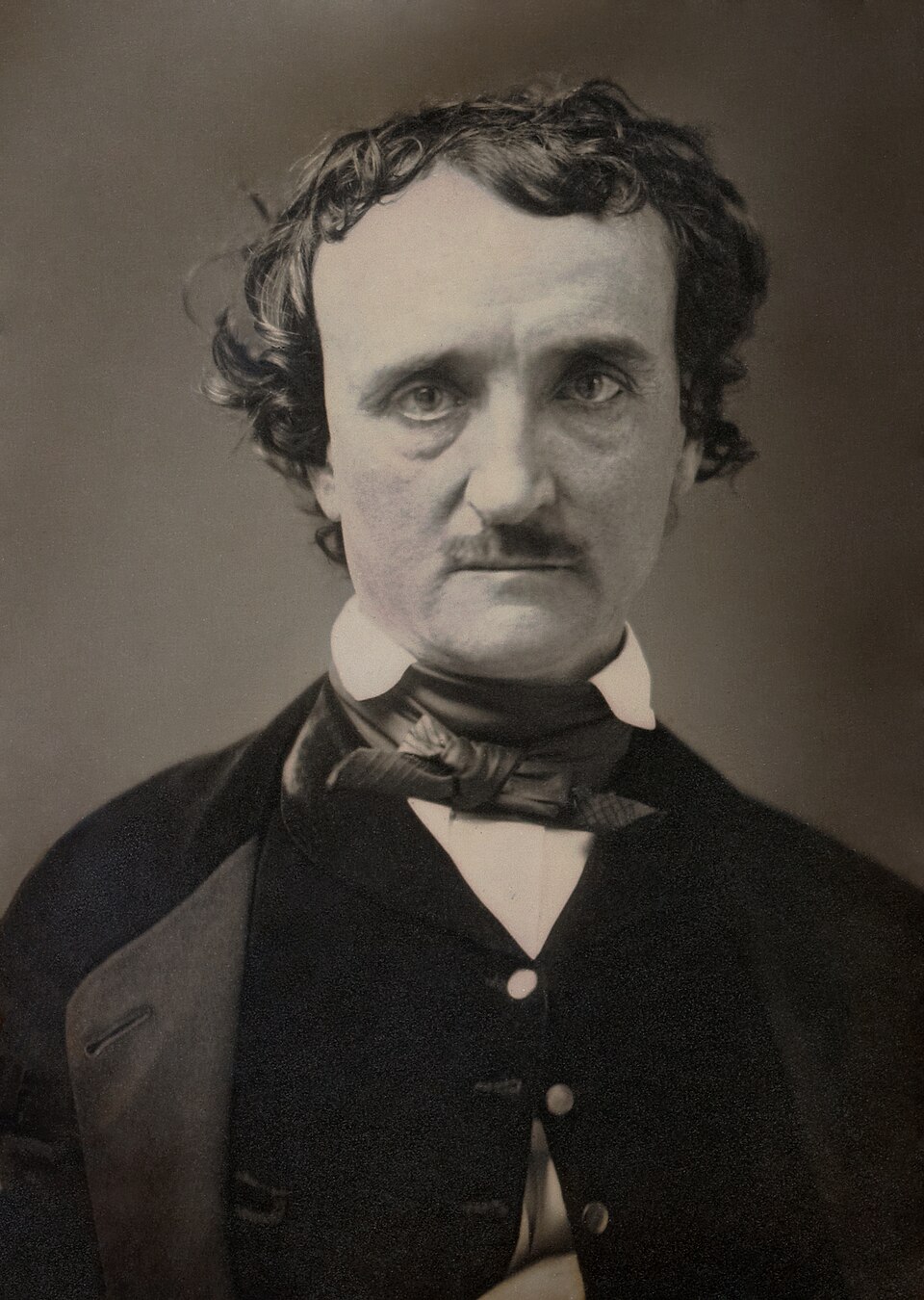
The poet and storyteller who built American Gothic from scratch — and invented the detective story in the process.
Edgar Allan Poe was an American writer who spent his brief life in poverty and notoriety and his afterlife as one of literature's canonical figures. He invented the modern detective story, helped establish the short story as a serious literary form, wrote poetry of extreme sonic intensity, and produced tales of psychological horror that still read as technically accomplished. He died at forty, under circumstances that have never been adequately explained.
Early life and formation
Poe was born in Boston on 19 January 1809. His parents were travelling actors; his father abandoned the family, and his mother died of tuberculosis before he was three years old. He was taken in — though never formally adopted — by John and Frances Allan of Richmond, Virginia. The relationship with John Allan was tense throughout his life; Allan disapproved of his literary ambitions and eventually disinherited him.
Poe attended the University of Virginia briefly in 1826 but left due to gambling debts. He served in the US Army under the name Edgar A. Perry (1827–1829) and entered West Point in 1830, engineering his own dismissal the following year to pursue writing. He moved to Baltimore, then to Richmond, Philadelphia, and New York, working as an editor and critic for various magazines.
The tales
Poe's theory of the short story — articulated most fully in his 1842 review of Nathaniel Hawthorne's Twice-Told Tales — held that a short narrative should achieve a single, unified effect, every detail subordinate to that end. It was a manifesto as much as a review, and it shaped the form for the rest of the century.
His tales of horror operate through atmosphere and psychological pressure rather than gore: "The Fall of the House of Usher" (1839), "The Tell-Tale Heart" (1843), and "The Cask of Amontillado" (1846) all turn on a narrator's disturbed mind, leaving the boundary between paranoia and reality deliberately unclear.
His three tales featuring the detective C. Auguste Dupin — "The Murders in the Rue Morgue" (1841), "The Mystery of Marie Rogêt" (1842), and "The Purloined Letter" (1844) — established the conventions of detective fiction: the brilliant amateur, the bumbling police, the locked-room puzzle, the solution by pure ratiocination. Arthur Conan Doyle acknowledged Dupin as Holmes's forerunner.
The poetry
Poe's poems pursue musical effect with deliberate calculation. "The Raven" (1845), his most famous poem, uses internal rhyme, repetition, and an insistent metre to create something closer to incantation than description. In The Philosophy of Composition (1846) he claimed — partly as provocation — that he had constructed "The Raven" by pure logic, working backward from the intended effect.
There is a radical error in the usual mode of constructing a story. Either history affords a thesis — or one is suggested by an incident of the day — or, at best, the author sets himself to work in the combination of striking events to form merely the basis of his narrative — designing, generally, to fill in with description, dialogue, or authorial comment, whatever crevices of fact, or action, may, from page to page, render themselves apparent.
Legacy
Poe died in Baltimore on 7 October 1849, having been found delirious in the street four days earlier. The cause of death remains disputed. His influence on French literature — particularly Baudelaire, who translated his work — was enormous, and through the French Symbolists he shaped the course of European poetry. In fiction, his invention of the detective story propagated through Conan Doyle and Agatha Christie to become one of the most commercially dominant narrative genres in the world.