Elsa Schiaparelli
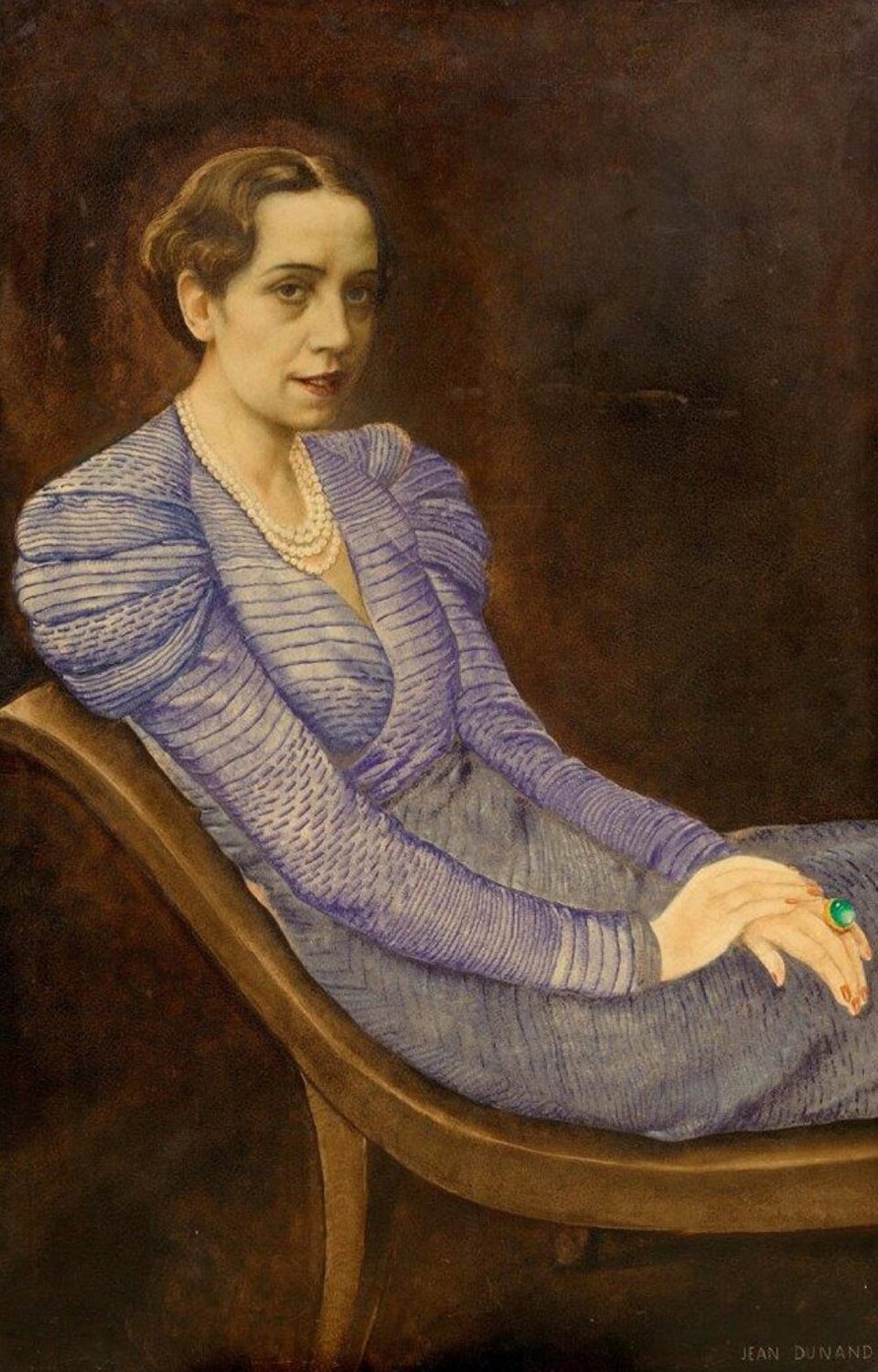
The Italian couturier who made Surrealism wearable — collaborating with Dalí and Cocteau to produce clothes that were simultaneously fashion objects and avant-garde provocations.
Elsa Schiaparelli approached fashion with the irony and visual ambition of an artist — which is what she had trained to be — and in doing so produced a body of work that Coco Chanel, her great rival, dismissed as a "that Italian artist who makes clothes." The dismissal was accurate. Schiaparelli made clothes that were arguments about seeing.
Roman origins and an accidental fashion career
Schiaparelli was born in Rome in 1890 into an aristocratic family with scholarly connections — her father was a librarian at the Lincei. She studied philosophy, published a volume of poetry, lived briefly in London and New York, and came to Paris in 1922 with no formal fashion training and very little money.
Her entry into fashion was characteristic: she wore a hand-knitted sweater with a trompe-l'œil bow collar to a society lunch. A Vogue editor saw it, wanted to buy it, and asked who made it. Schiaparelli located the Armenian knitter, commissioned twelve sweaters, received a Vogue order, and had a business.
Surrealism and the impossible garment
Schiaparelli opened her couture house in 1927 and attracted the artists who were then reshaping visual culture in Paris. Her collaborations with Salvador Dalí produced the most notorious pieces: the Lobster Dress (1937), worn by Wallis Simpson, featuring a painted lobster on the skirt; the Skeleton Dress (1938), its padding creating the illusion of visible ribs; the Shoe Hat (1937), an inverted heel on the head. With Jean Cocteau she produced embroidered evening coats whose figuration read differently as the eye moved.
The collections were organized around themes — Circus (1938), Pagan (1938), Astrological (1938) — each generating a coherent visual programme rather than seasonal novelties.
In difficult times, fashion is always outrageous.
Shocking pink and the olfactory
Schiaparelli also worked in perfume. Her 1937 fragrance Shocking came in a bottle shaped like a dressmaker's dummy — modelled on Mae West's torso — and introduced the colour that bore its name. Shocking pink (her own phrase) became one of the most recognised colour associations in twentieth-century design, associated with her work in the same way that Klein blue is associated with Yves Klein.
The fashion house closed in 1954. Coco Chanel had reopened in 1954 after wartime closure and captured the market Schiaparelli could no longer hold.
Legacy
Schiaparelli's work was rediscovered by fashion historians in the 1970s and 1980s and has never lost critical prestige since. The Maison was revived in 2012 under new creative directors, with the original archive as a reference. Her autobiography, Shocking Life (1954), remains readable.
Her importance rests on having demonstrated — before anyone else had systematically done so in fashion — that a garment could be a conceptual proposition as well as a useful or beautiful object.