Emily Dickinson
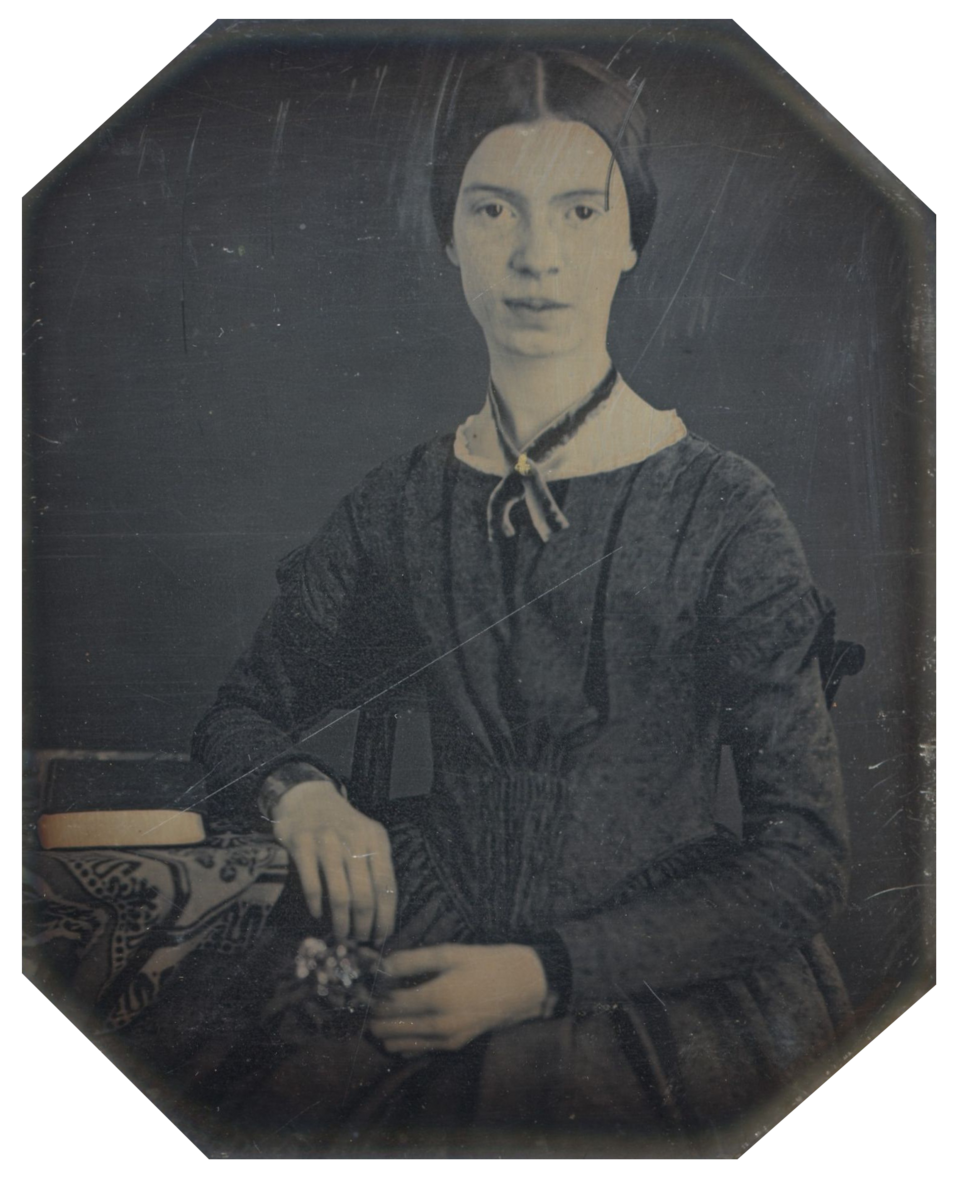
The American poet who wrote nearly eighteen hundred poems in near-total seclusion, publishing almost none of them in her lifetime, and who is now considered one of the foundational voices of English-language literature.
Emily Dickinson spent most of her adult life within the grounds of her family's home in Amherst, Massachusetts, writing poems that dismantled the conventions of Victorian verse — metre, rhyme, sentiment, subject — and rebuilt them into something altogether more compressed, oblique, and strange. She published almost none of them. The poems were found after her death and have never stopped being read.
Amherst and the narrowing world
Dickinson was born in Amherst in 1830 into a prominent New England family. Her father Edward was a lawyer and state legislator; the household was educated and culturally engaged. She attended Amherst Academy and spent a year at the Mount Holyoke Female Seminary, but returned home and largely stayed there. Her social world narrowed progressively over the 1850s and 1860s until she rarely left the house and communicated with friends almost exclusively by letter.
The causes of this withdrawal are contested. Biographers have proposed eye trouble, depression, agoraphobia, and protective withdrawal for creative purposes — Dickinson herself gave no consistent explanation. What is clear is that the restriction of her outer life accompanied an expansion of her inner one.
The poems
Dickinson composed her poems on scraps of paper, envelopes, and bound them into small gatherings — fascicles — with thread. The manuscripts have been preserved at Amherst College and the Houghton Library at Harvard. She wrote nearly 1,789 poems by most counts, on subjects ranging from death, immortality, and nature to pain, love, and the act of perception itself.
Her formal approach was radical within its context. She used common metre — the alternating 8–6 syllable pattern of Protestant hymns — as a structural default, then broke it with dashes, off-rhymes, slant rhymes, and sudden compression. The effect is of thought moving too fast for conventional syntax.
I'm Nobody! Who are you? Are you — Nobody — too?
Correspondence and the literary relationship
Dickinson maintained an intense correspondence with the literary critic Thomas Wentworth Higginson, whom she first contacted in 1862 after reading his advice to aspiring writers in The Atlantic Monthly. He recognized her gifts but found her work too unconventional for publication; he became instead a long-distance mentor and friend. Their correspondence continued until her death and is the primary documentary source for her views on her own work.
She also maintained close correspondence with Susan Gilbert Dickinson, her sister-in-law, who lived next door, and to whom she sent hundreds of poems.
Legacy and posthumous publication
The first edition of her poems appeared in 1890, edited by Higginson and Mabel Loomis Todd, with punctuation and dashes regularised and titles supplied. It was a bestseller. Subsequent editions were more faithful to the manuscripts. Thomas H. Johnson's 1955 variorum edition — the first to attempt completeness and to reproduce her idiosyncratic punctuation — established the texts now in general use.
Her influence on American poetry has been continuous and documented: Hart Crane, Elizabeth Bishop, Adrienne Rich, Sylvia Plath, and many others have cited her specifically as a formal and tonal precedent.