Emmy Noether
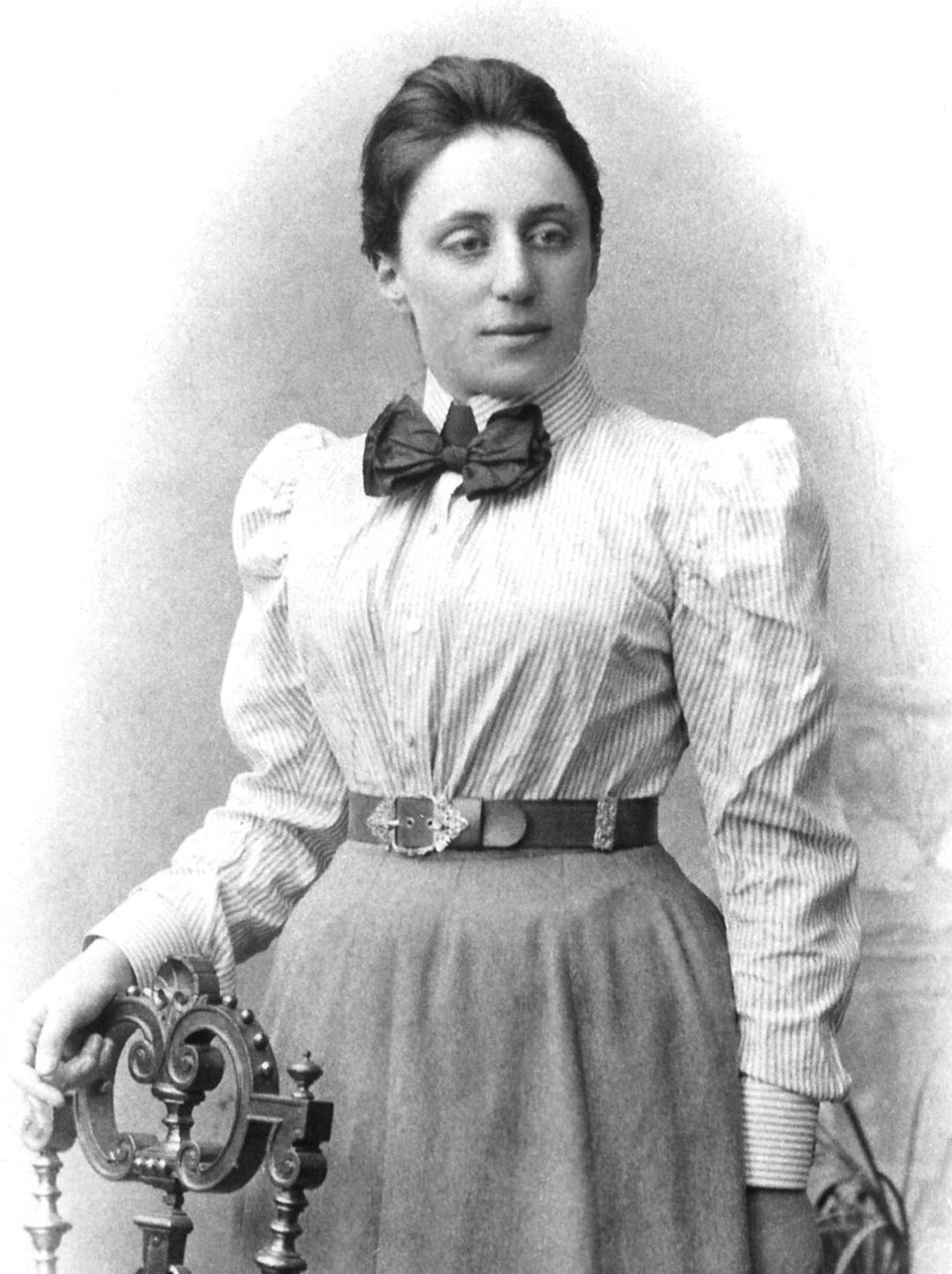
The German mathematician who rebuilt abstract algebra from first principles and proved the theorem connecting symmetry and conservation laws — described by Einstein as the most significant creative mathematical genius thus far produced.
Emmy Noether could not initially be paid to lecture at Göttingen because she was a woman, so David Hilbert advertised her courses under his own name and she taught them anyway. In the years that followed she produced work that her colleagues — among them Hilbert, Einstein, and Hermann Weyl — described as transformative. She is the most important algebraist of the twentieth century.
Erlangen and a barred path
Noether was born in Erlangen, Bavaria, in 1882. Her father Max Noether was a professor of mathematics at the university there; Emmy grew up in an academic household and showed mathematical aptitude early. But access to the university was officially closed to women: she could audit courses with professors' permission but not formally enrol. She took the matriculation examination anyway and was admitted to Erlangen University in 1904, after restrictions were lifted, completing her doctorate in 1907.
Her dissertation was on the invariant theory of ternary biquadratic forms — technically proficient but, as she later said herself, not where her real interests lay.
Göttingen and the theorem
Felix Klein and David Hilbert invited her to Göttingen in 1915, where the mathematics faculty was then the most distinguished in the world. The University Senate blocked her habilitation — the qualification required to lecture — on the grounds that women should not be allowed to teach. Hilbert's response is documented: "I do not see that the sex of the candidate is an argument against her admission as a Privatdozent. After all, we are a university, not a bath house."
She lectured under his name until regulations changed.
In 1915–16, at the request of Hilbert and Klein, Noether turned to the mathematical foundations of Einstein's general theory of relativity. The result was Noether's theorem (published 1918): the proof that every differentiable symmetry of the action of a physical system corresponds to a conservation law. This single result underlies all of theoretical physics: conservation of energy follows from time-translation symmetry; conservation of momentum follows from spatial symmetry. The theorem is the deepest connection between mathematics and physics discovered in the twentieth century.
My methods are working and thinking methods, and therefore have crept into everything.
Abstract algebra
From the 1920s Noether turned to what became her central programme: the restructuring of abstract algebra. Where earlier algebra worked with specific objects — polynomials, matrices, integers — Noether worked with structures defined by their properties alone: rings, ideals, modules, fields. Her 1921 paper on ideal theory in rings introduced what are now called Noetherian rings — a fundamental class — and established the framework that algebra has used since.
She also collaborated extensively, shaping younger mathematicians — Bartel van der Waerden's foundational textbook Moderne Algebra (1930) was based substantially on her lectures.
Dismissal and America
In 1933 the Nazi government dismissed Jewish civil servants from their posts. Noether was among those expelled from Göttingen. She accepted a visiting professorship at Bryn Mawr College in Pennsylvania and also lectured at the Institute for Advanced Study in Princeton. She died of complications from surgery in April 1935, aged fifty-two.
Einstein's obituary notice in the New York Times called her "the most significant creative mathematical genius thus far produced, so far as women are concerned."