Ernest Hemingway
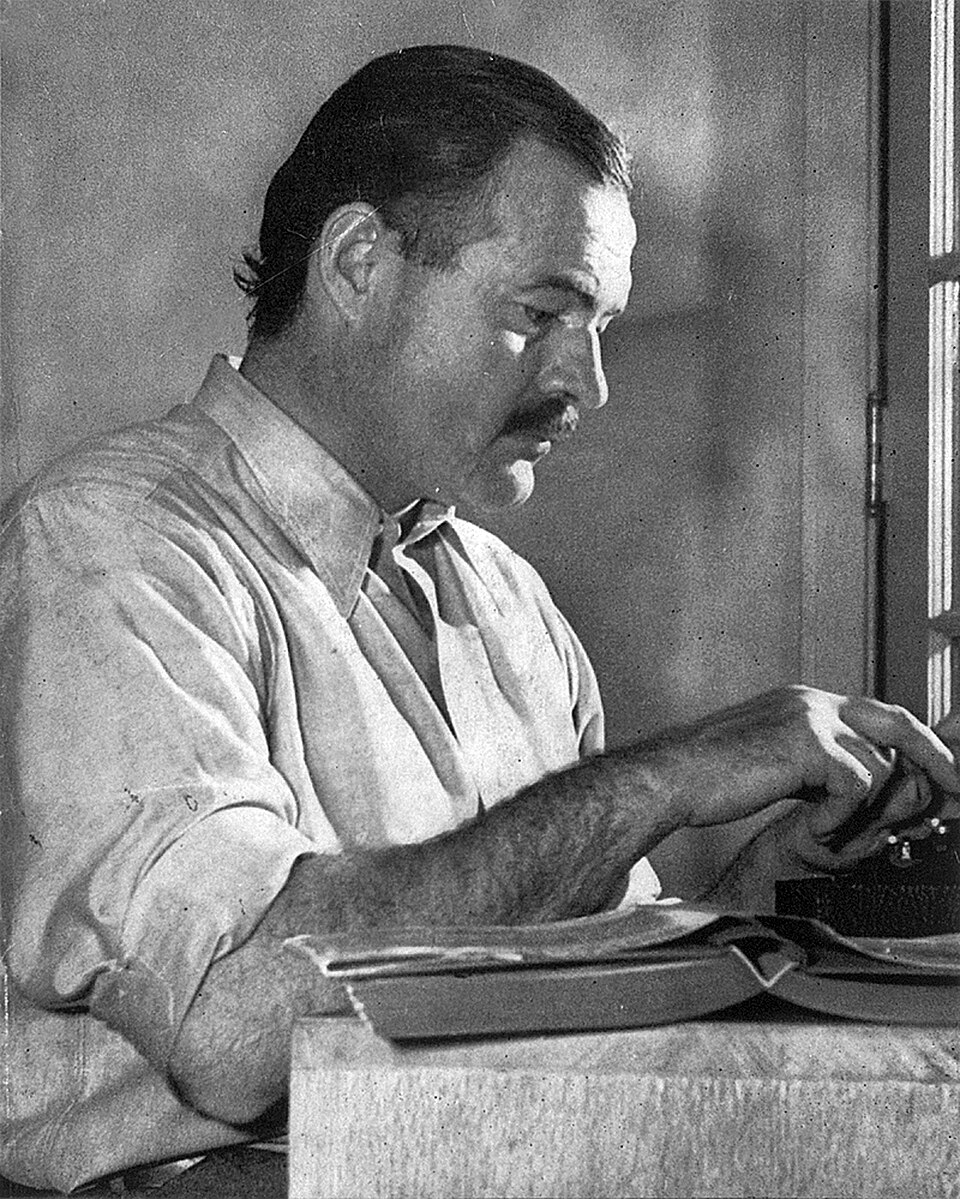
The American novelist who compressed the language of fiction until pressure became style — and gave the twentieth century a template for literary masculinity it has spent decades interrogating.
Ernest Hemingway's prose was a departure radical enough to alter the baseline of American fiction: short declarative sentences, suppressed emotion, dialogue stripped of psychological commentary, and a structural principle — the iceberg theory — in which the weight of meaning lay beneath the surface of what was actually said. The style was widely imitated and has proved difficult to escape.
Early formation
Ernest Miller Hemingway was born in Oak Park, Illinois, in 1899, the son of a physician and a musician. After high school he went to work as a reporter for the Kansas City Star, where the house style guide — short sentences, active verbs, concrete nouns — became his foundational discipline. He drove ambulances on the Italian front in 1918 and was severely wounded near Fossalta di Piave, an experience that saturated his fiction without being directly transcribed.
After the war he settled in Paris as a correspondent for the Toronto Star, where he came into contact with Gertrude Stein, Ezra Pound, and the expatriate circle that shaped the early work. Stein's influence on his rhythmic use of repetition and the vernacular is acknowledged; Pound pushed him towards compression and away from adjective.
The short stories and early novels
Hemingway's first significant publication was In Our Time (1925), a sequence of short stories and interchapters about the character Nick Adams. The book established the techniques he would refine for the rest of his career: dialogue-driven action, the omission of explanatory prose, the weight carried by what characters do not say. The Sun Also Rises (1926) drew on his experience of the Paris expatriate community and the annual bullfights at Pamplona, and introduced his public voice — declarative, ironic, superficially detached.
A Farewell to Arms (1929) addressed his war experience directly, following an American ambulance driver's retreat from Caporetto and his love affair with an English nurse. It became one of the defining novels of the First World War.
If a writer of prose knows enough of what he is writing about he may omit things and the reader will still have a strong feeling of those things.
The later work
For Whom the Bell Tolls (1940), set during the Spanish Civil War, was his most ambitious novel in scope. The Old Man and the Sea (1952), a novella about an aged Cuban fisherman's battle with a great marlin, won the Pulitzer Prize in 1953 and was cited when he received the Nobel Prize in Literature in 1954. The Nobel committee referred specifically to his mastery of narrative art and the influence he had exerted on contemporary style.
His final years were marked by declining health, depression, and repeated electroconvulsive therapy, which he believed had destroyed his memory and therefore his capacity to write. He died by suicide in Ketchum, Idaho, in 1961.