Erwin Schrödinger
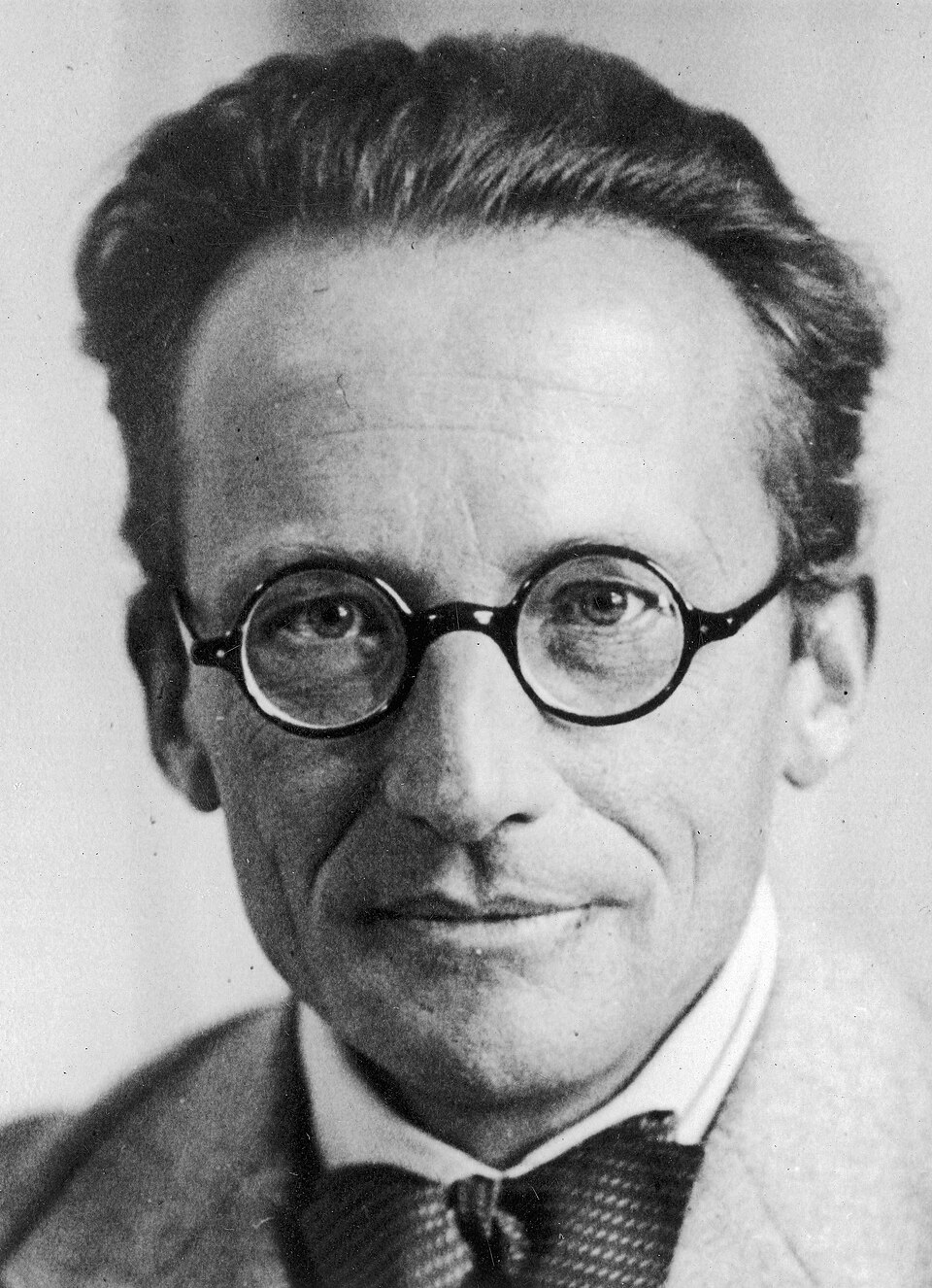
The Austrian physicist who gave quantum mechanics its governing equation and coined the term quantum entanglement — then spent years trying to prove the theory he had helped build was philosophically untenable.
Erwin Schrödinger's wave equation sits at the foundation of quantum mechanics — the mathematical statement of how quantum states evolve in time that every working physicist uses — yet Schrödinger himself was among the most determined critics of the interpretation his equation seemed to demand, inventing the cat paradox as a reductio ad absurdum of what the theory implied.
Formation in Vienna
Erwin Rudolf Josef Alexander Schrödinger was born in Vienna in 1887 into an educated bourgeois family. He showed early facility across subjects — Latin, Greek, German, mathematics, physics — and studied at the University of Vienna under Franz Exner and Friedrich Hasenöhrl, the latter a major influence on his theoretical orientation. He completed his doctorate in 1910 and served in World War I as an artillery officer before returning to academic physics.
His early postwar career was peripatetic — positions in Jena, Stuttgart, Breslau, and Zurich. It was at Zurich, between 1921 and 1927, that he produced the work that made his name.
The wave equation
In 1926 Schrödinger published a series of papers deriving what became the Schrödinger equation — the fundamental equation of nonrelativistic quantum mechanics, describing how the quantum state of a physical system evolves over time. The equation was continuous and deterministic in form, operating on a wave function that Schrödinger initially hoped corresponded to a real physical wave. He also showed, to the field's relief, that his wave mechanics and Heisenberg's matrix mechanics — previously appearing incompatible — were mathematically equivalent.
The physical interpretation of the wave function proved contentious. Schrödinger's preference was a real wave in ordinary three-dimensional space; Max Born's interpretation — probability amplitudes — became the standard one, which Schrödinger never fully accepted.
He was appointed to the chair in theoretical physics at the University of Berlin in 1927, succeeding Max Planck. He left Germany in 1933 following the Nazi seizure of power.
I don't like it, and I'm sorry I ever had anything to do with it.
The cat and entanglement
In 1935 Schrödinger published two papers of lasting consequence. The first introduced the cat thought experiment — a cat in a sealed box with a quantum mechanism that might or might not have triggered a lethal device, leaving the cat, by the logic of quantum superposition, neither alive nor dead until observed — as a demonstration of what he considered the absurdity of applying quantum mechanics to macroscopic objects. The argument was intended as a critique, not as a positive account of reality.
The same year he coined the term quantum entanglement (Verschränkung in German) to describe the correlations between separated quantum systems, recognising it as "the characteristic trait of quantum mechanics."
After periods in Oxford, Graz, and Ghent, he spent seventeen years at the Dublin Institute for Advanced Studies, where he also wrote What is Life? (1944), a book proposing that hereditary information was stored as an aperiodic crystal — an argument that influenced Francis Crick and James Watson in their approach to DNA.