Euclid
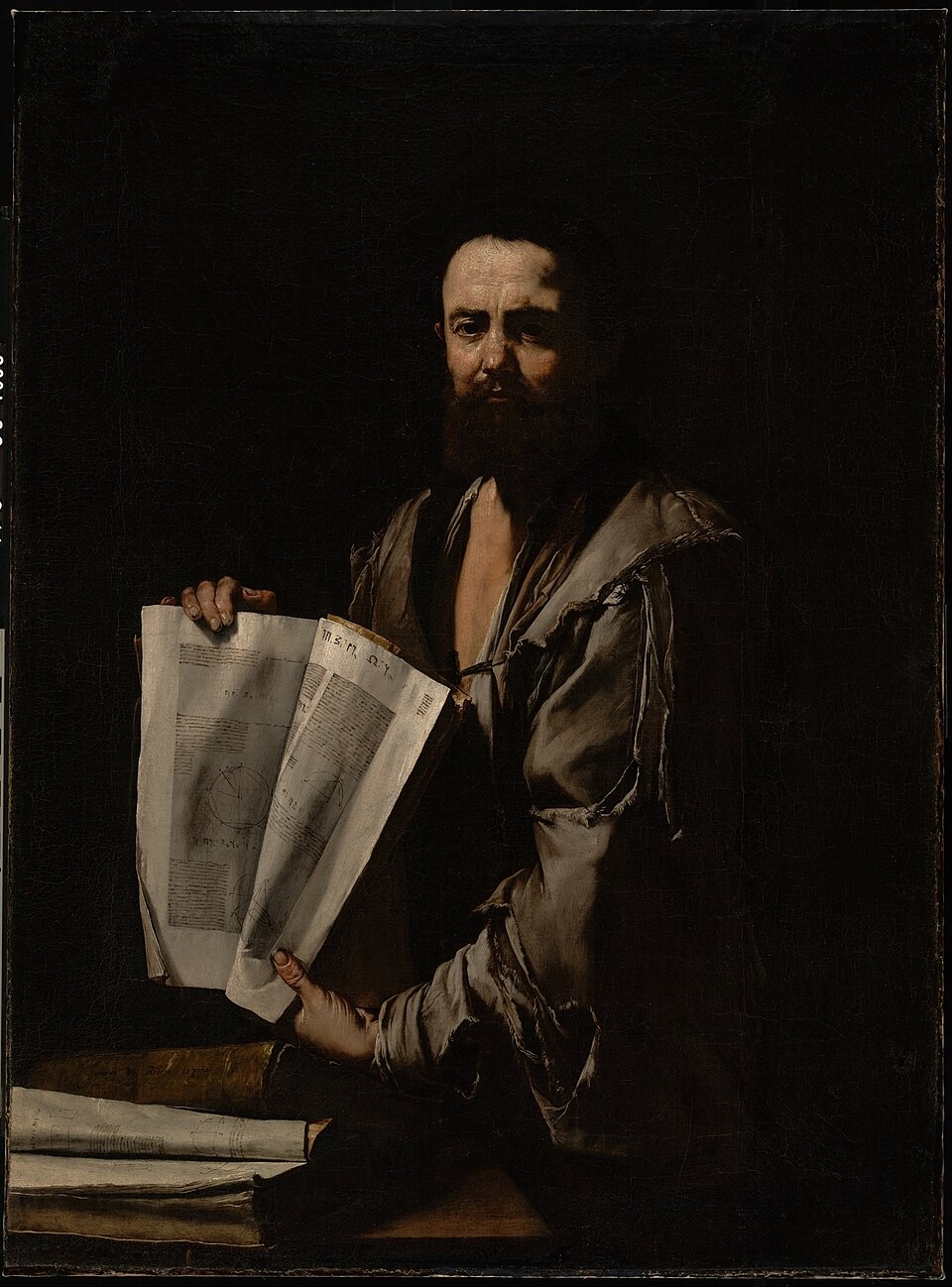
The geometer of Alexandria whose axiomatic method set the standard for mathematical proof for more than two thousand years.
Euclid is the most successful mathematics textbook author in history: the Elements, composed around 300 BC, was copied, translated, and taught continuously for more than two millennia. In it he demonstrated that all of plane geometry follows from five postulates — and invented the model of rigorous axiomatic proof that still defines mathematics today.
The geometer of Alexandria
Almost nothing is known of Euclid's life. Ancient sources place him in Alexandria during the reign of Ptolemy I, around 300 BC. He is believed to have studied in Athens and to have founded the mathematical school at the Library of Alexandria. The biographical details amount to a handful of anecdotes of uncertain reliability; what survives with authority is his work.
The Elements
The Elements — thirteen books covering plane geometry, number theory, and solid geometry — is not primarily a collection of new results. Its achievement is the organisation of existing knowledge into a single deductive system. Euclid opens with 23 definitions, 5 common notions, and 5 postulates. From these alone, by strict logical inference, he derives 465 propositions.
The fifth postulate — the parallel postulate — states that through a point not on a given line, exactly one line can be drawn parallel to the given line. For two thousand years mathematicians tried to prove it from the other four. Their failure eventually produced non-Euclidean geometries in the 19th century, one of the transformative moments in the history of ideas.
The Elements contains the proof that there are infinitely many prime numbers, the algorithm for computing the greatest common divisor (the Euclidean algorithm), and the construction of the five Platonic solids. Every result is given in the form that became the template for mathematics: statement, proof by logical deduction, conclusion.
There is no royal road to geometry.
Method and style
Euclid's style is spare and impersonal. He never explains why he chooses a particular approach; he simply demonstrates. The proofs use only straightedge and compass, and all construction is explicit — nothing is assumed that is not either postulated or previously proved. This rigor made the Elements a model not only for mathematics but for philosophy and law, wherever a community needed to reason from agreed premises to agreed conclusions.
Beyond the Elements, Euclid wrote on optics (Optica), the theory of music (Sectio Canonis), and data (Data, a companion work on geometrical analysis). These survive, though with less authority of transmission than the Elements.
Legacy
The Elements was translated into Latin, Arabic, and eventually every European vernacular. It was among the first mathematical works printed after Gutenberg; the 1482 Venice edition by Erhard Ratdolt is one of the earliest illustrated printed books. Isaac Newton used the Elements' style of proof as the template for the Principia. It remained the standard school geometry text in Britain until the early 20th century.