Évariste Galois
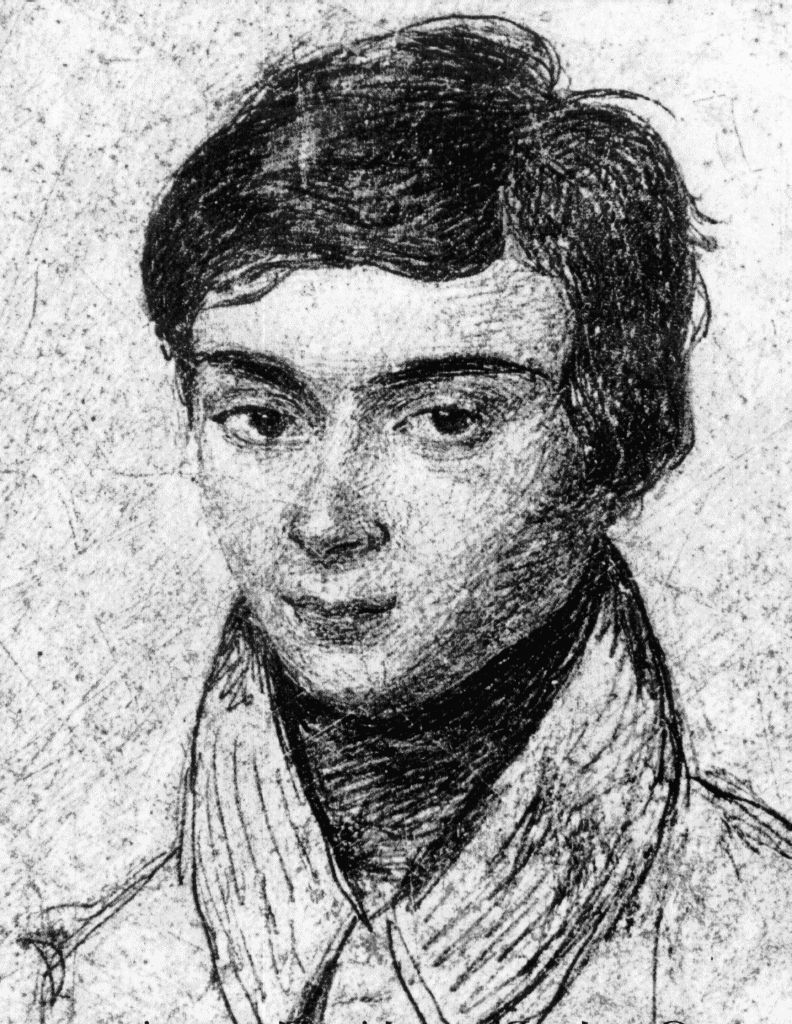
The French teenager who solved a 350-year-old problem in a single night and invented group theory before dying in a duel at twenty.
Évariste Galois resolved in his teens a problem that had defeated mathematicians for three and a half centuries: whether a general algebraic equation of degree five can be solved by a formula involving radicals. His method — associating a group of symmetries to each polynomial and showing when that group's structure permits a solution — invented group theory and set the agenda for abstract algebra. He was killed in a duel at twenty.
Short life
Galois was born on 25 October 1811 in Bourg-la-Reine, a small town south of Paris. His father was the mayor. He showed exceptional mathematical ability early and became obsessed with algebra, neglecting other studies. He twice failed the entrance examination for the École Polytechnique — accounts differ on whether the failures were due to his own unconventional methods or the examiners' inadequacy — and eventually enrolled at the less prestigious École Normale.
His mathematical papers were submitted to the Académie des Sciences but went unread or were lost. His correspondence with leading mathematicians of the day produced little recognition. He was twice imprisoned for his radical republican political activities. On the night of 29–30 May 1832, believing he would die in a duel the next day, he wrote a letter to his friend Auguste Chevalier outlining his mathematical discoveries; the letter contains some of the most concentrated mathematics ever written. He died the following day, 31 May 1832, from wounds sustained in the duel.
The mathematical achievement
The question Galois answered concerned the solvability of polynomial equations by radicals — that is, whether the solutions can be expressed using the four arithmetic operations plus square roots, cube roots, and so on. The quadratic formula solves degree-2 equations; analogous formulas exist for degree 3 (Cardano, 1545) and degree 4 (Ferrari, 1545). Mathematicians had sought a general formula for degree 5 since the 16th century; Abel had proved in 1824 that no such formula exists, but without explaining why.
Galois provided the explanation by a new method. To each polynomial he associated a group — the set of permutations of its roots that preserve all algebraic relations among them (now called the Galois group). He then proved: a polynomial equation is solvable by radicals if and only if its Galois group is solvable (has a subnormal series with abelian quotients). For the general quintic, the Galois group is the symmetric group S₅, which is not solvable — confirming Abel's result and explaining its necessity.
This construction founded group theory and Galois theory, two of the central pillars of modern abstract algebra.
I have no time.
Legacy
Galois's manuscripts were published by Joseph Liouville in 1846, fourteen years after his death. Mathematicians gradually recognised that the framework he had sketched — groups, fields, and their correspondence — was not merely a solution to one problem but a new language for algebra. Galois theory now underpins the proof that angle trisection and doubling the cube are impossible by straightedge and compass, the study of algebraic number fields, coding theory, and cryptography.