Federico Fellini
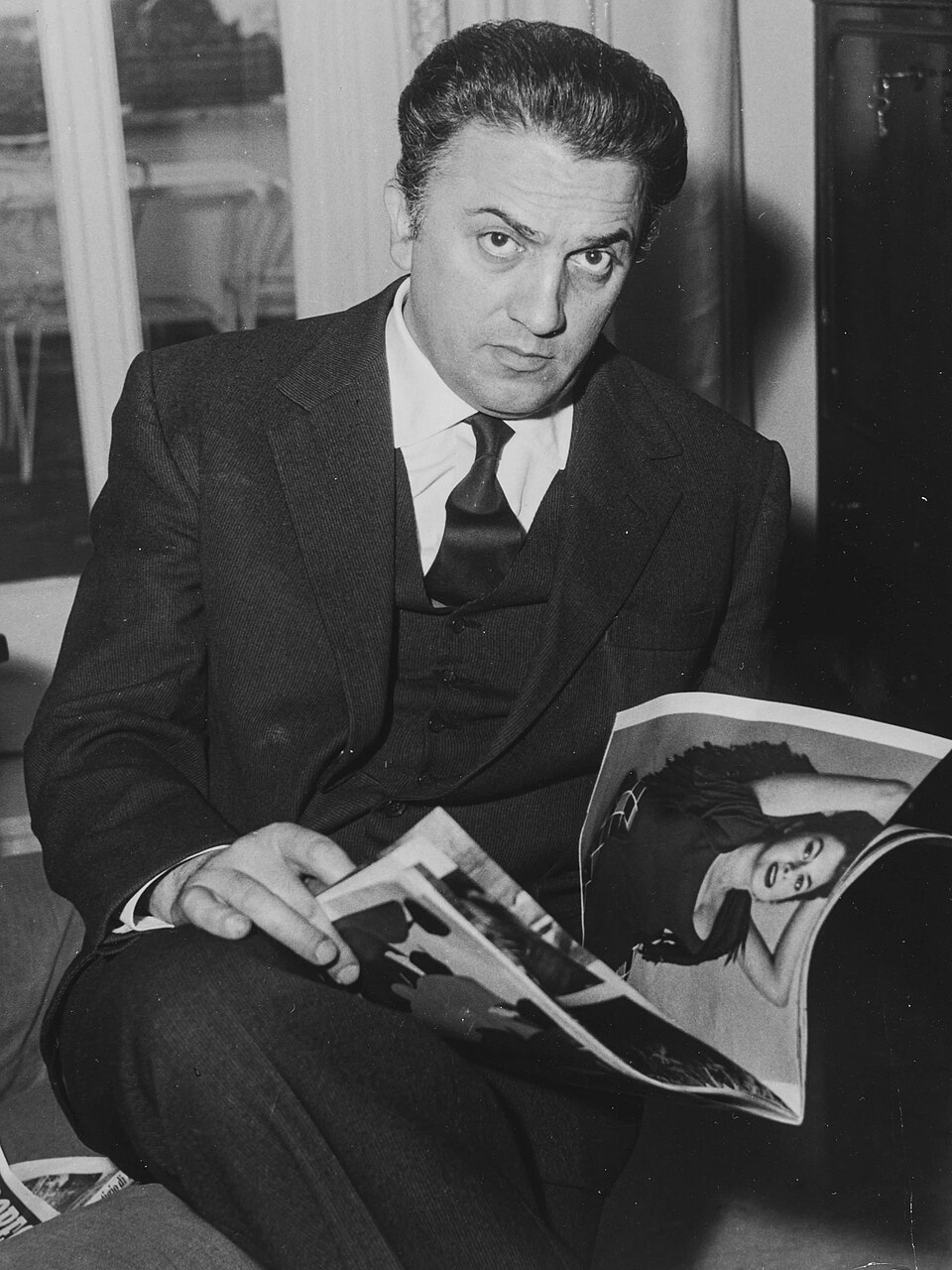
The Italian director who made autobiography into spectacle, dissolving the boundary between memory, dream, and cinema.
Federico Fellini transformed Italian cinema from neorealist document into surrealist autobiography, creating a visual language so personal and so overwhelming that his name became an adjective. From the poverty-inflected fables of his early career to the baroque dream-pageants of his mature work, he remained the most consistently theatrical director of the postwar era.
Origins and Early Career
Fellini grew up in Rimini, a coastal Adriatic town whose provincial pleasures — the circus, the beach, the carnival — supplied him with images he would mine for the rest of his life. He drifted to Rome in the late 1930s as a caricaturist and gag writer, and entered film through a chance encounter with Roberto Rossellini, for whom he co-wrote Rome, Open City (1945). The experience of neorealism gave Fellini his technical foundation while also representing the tradition he would spend his career transcending.
His early solo features — Variety Lights (1950), The White Sheik (1952), I Vitelloni (1953) — are still mostly realist in method, concerned with provincial idleness and the small vanities of provincial life. La Strada (1954) marked the pivot: here the grotesque, the poetic, and the spiritually charged began to crowd out social observation.
The Defining Work
La Dolce Vita (1960) was the rupture. A three-hour episodic portrait of Rome's celebrity class — journalists, aristocrats, starlets orbiting the Via Veneto — it announced Fellini's mature manner: the loose associative structure, the procession of faces, the refusal of conventional plot resolution. The film created a cultural shock wave across Europe and gave the world the word paparazzo.
8½ (1963) went further inward. A director unable to begin his next film finds himself invaded by memories, fantasies, and desires; the film its hero cannot make becomes the film we are watching. Sight & Sound has consistently placed it among the ten greatest films ever made, and its influence on subsequent self-reflexive cinema — from All That Jazz to Adaptation — is difficult to overstate.1
Method and Style
Fellini worked with a small, loyal circle of collaborators over decades: cinematographer Giuseppe Rotunno, composer Nino Rota (whose scores are inseparable from the Fellinian atmosphere), and costume designer Danilo Donati. He post-dubbed all dialogue, shooting silent and adding sound in the editing room — a practice that gave his films a slightly dislocated, dreamlike quality.
He cast faces over conventional actors, choosing subjects from streets and circuses whose physiognomies conveyed character before a word was spoken. His productions were famously improvisatory at the set level despite elaborate pre-production drawings.
| Period | Characteristic |
|---|---|
| Early (1950–1957) | Neorealist tone, provincial subjects |
| Transitional (1957–1963) | Spiritual allegory, grotesque imagery |
| Mature (1963–1980) | Baroque fantasy, memory, autobiography |
| Late (1980–1990) | Nostalgia, television satire |
Legacy
Fellini received four competitive Academy Awards for Best Foreign Language Film — for La Strada, Nights of Cabiria, 8½, and Amarcord — as well as an honorary award in 1993, five in total. He remained one of the most influential figures in world cinema; the term Felliniesque entered multiple languages to describe any work blending the carnivalesque with deep private melancholy.
A different language is a different vision of life.
Footnotes
- Fellini reportedly kept a notebook beside his bed to record dreams, treating unconscious imagery as raw material on the same level as location photographs or actor auditions. ↩