Federico García Lorca
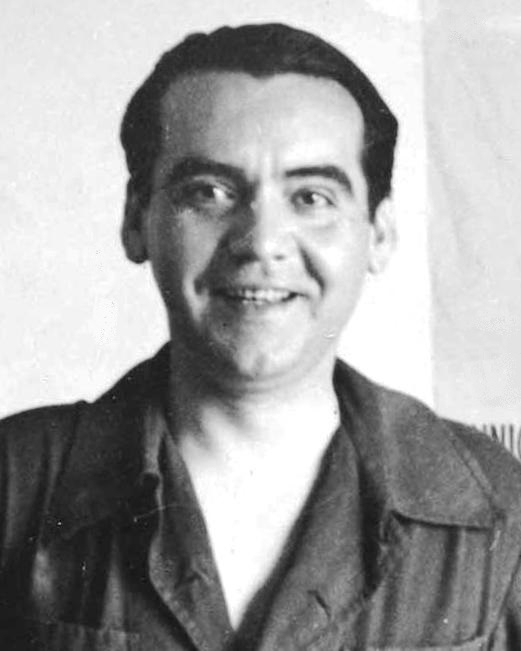
The Spanish poet and playwright who fused Andalusian folk tradition with avant-garde surrealism into a body of work so charged with violence and beauty that the regime that murdered him feared it for decades.
Federico García Lorca compressed an entire tradition of Spanish folk music, Andalusian landscape, and Catholic imagery into poetry and plays that were simultaneously archaic and modern — and was shot by Nationalist forces in the first weeks of the Spanish Civil War at the age of thirty-eight, a murder whose exact circumstances remain officially unacknowledged.
Origins in Granada
Federico del Sagrado Corazón de Jesús García Lorca was born in 1898 in Fuente Vaqueros, a village in the vega of Granada. His family was prosperous — his father a landowner, his mother a teacher who gave him his early musical education. He moved to Granada as a child and later to Madrid, where he enrolled at the Residencia de Estudiantes in 1919, the intellectual gathering point where he became close friends with Salvador Dalí and Luis Buñuel, with whom he shared the avant-garde atmosphere of the period.
He studied law at the University of Granada without much commitment; his energies went to poetry, piano, and theatre. His first collection, Libro de poemas, appeared in 1921.
Poetry and duende
García Lorca's key concept was duende — an untranslatable quality of authentic, death-inflected expressive power that he located in flamenco, in bullfighting, and in the deepest vein of Andalusian culture. He lectured on it in 1933 in Buenos Aires and Havana, and it structured his mature poetic practice.
Romancero gitano (1928) — the "Gypsy Ballads" — used the traditional romance metre to produce poems saturated with violence, sexuality, and Andalusian imagery, making him nationally famous overnight. Poeta en Nueva York (written 1929–1930, published posthumously) recorded his year at Columbia University in surrealist imagery that registered the shock of the modern industrial city against his formation in the rural south.
Llanto por Ignacio Sánchez Mejías (1935), an elegy for a bullfighter killed in the ring, is considered among the greatest elegies in the Spanish language.
The duende is a power, not a work. It is a struggle, not a thought.
Theatre
García Lorca's theatrical work runs parallel to his poetry in intensity. The "rural trilogy" — Bodas de sangre (Blood Wedding, 1932), Yerma (1934), and La casa de Bernarda Alba (written 1936, not performed until 1945) — placed women's desire, social constraint, and death at the centre of a tragic form that drew on Greek theatre and Spanish folk ritual simultaneously. La casa de Bernarda Alba is his most austere work: a household of women, a recently widowed matriarch's imposition of silence, and catastrophe withheld until the final moment.
He directed the student theatre company La Barraca from 1932 to 1936, taking classical Spanish plays to rural audiences across the country.
Murder
García Lorca was in Granada when the Nationalist uprising began in July 1936. He was arrested on or around 16 August 1936 and shot by Nationalist forces near Víznar. He was thirty-eight. His body has never been found; attempts to locate it have been politically contested. During the Franco regime his work was suppressed; it circulated in exile editions and returned to Spain only gradually after 1953. He is now the most translated Spanish poet in history.